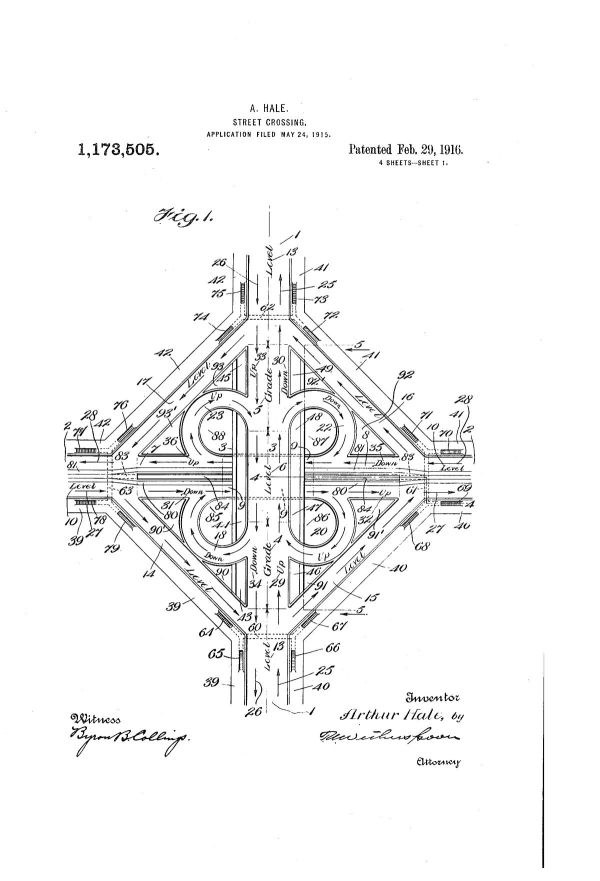
May 24, 1915 Civil engineer Arthur Hale applied for a patent for his design of a road interchange focused on facilitating the flow of automobile traffic. Hale, who resided in the village of Rowlandsville in Maryland, characterized this design as one that contained “certain new and useful improvements in street crossings.” Hale’s proposed interchange consisted... Continue Reading →

May 21, 1901 In response to the steady increase of automobiles on its roads, the state of Connecticut enacted a pioneering speed limits law. This law required that automobiles travel no faster than 12 miles (19.3 kilometers) per hour within cities and 15 miles (24.1 kilometers) per hour on roads elsewhere. The law also required automobile drivers... Continue Reading →

April 5, 1878 Albert Champion, who made notable contributions to various modes of transportation, was born in Paris. By the end of the 19th century, he had established himself as a formidable track bicycle racer in his native France. In 1899, Champion surprised nearly everyone by beating out quite a few seasoned cyclists to win... Continue Reading →

March 12, 1882 Edwin George “Cannon Ball” Baker, who would achieve widespread fame for his motorcycle and automobile records, was born in the community of Weisburg, Indiana. He first became known to the public as a vaudeville performer but started focusing instead on transportation-oriented pursuits after winning a dirt-track motorcycle race in the Hoosier State... Continue Reading →

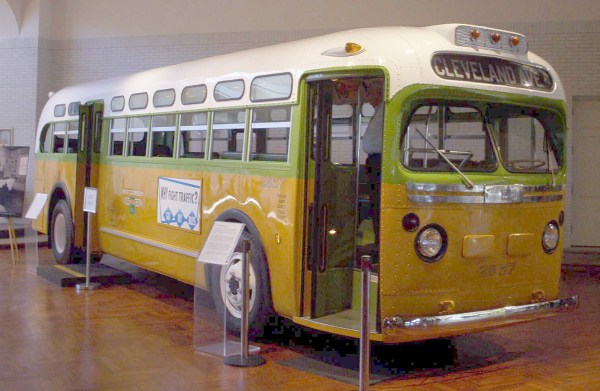
The Montgomery Bus Boycott, along with being a transportation-oriented protest against racial segregation practices in Alabama’s capital city, was a pivotal chapter in the larger civil rights movement in the United States. At the time of this boycott during the mid-1950s, longstanding Jim Crow laws that enforced segregation throughout the American South were very much... Continue Reading →

January 16, 1932 The Arlington Memorial Bridge, crossing the Potomac River and linking Virginia with Washington, D.C., was opened. A caravan of 12 automobiles became the first vehicles to travel over this stone, steel, and neoclassical masonry arch bridge. The first of these automobiles transported President Herbert Hoover (1874-1964) and First Lady Lou Henry Hoover (1874-1944). While... Continue Reading →

December 6, 1913 The steam ferry Leschi was launched from Rainier Beach on Lake Washington, a large freshwater lake adjacent to Seattle. Chief Leschi (1808-1858), for whom this vessel was named, served as the leader of the Nisqually Indian Tribe in the vicinity of Puget Sound in present-day Washington State. The ferry Leschi had the... Continue Reading →

November 29, 1957 A pair of two-lane road tunnels built southeast of downtown Baltimore was officially inaugurated. These 1.4-mile (2.3-kilometer)-long tunnels, collectively known as the Baltimore Harbor Tunnel, carry Interstate 895 under the Patapsco River. Theodore McKeldin, who was governor of Maryland from 1951 to 1959, presided at the opening ceremonies for the Baltimore Harbor... Continue Reading →

In 2008, racecar driver Matt Kobyluck achieved a notable career milestone when he won the NASCAR Camping World East Series Championship. This victory made Kobyluck, who is a member of the federally recognized Mohegan Tribal Nation in southeastern Connecticut, the first Native American to win that NASCAR-sanctioned regional stock car racing series (now part of... Continue Reading →

October 24, 1923 The Pacific Highway was officially opened in Olympia, Washington. This international highway would ultimately extend from Vancouver in British Columbia to San Diego in California. There were 1,687 miles (2,715 kilometers) of the Pacific Highway in place by 1926, making this route the longest continuously paved road at that time. The 1923... Continue Reading →

Create a website or blog at WordPress.com

Up ↑