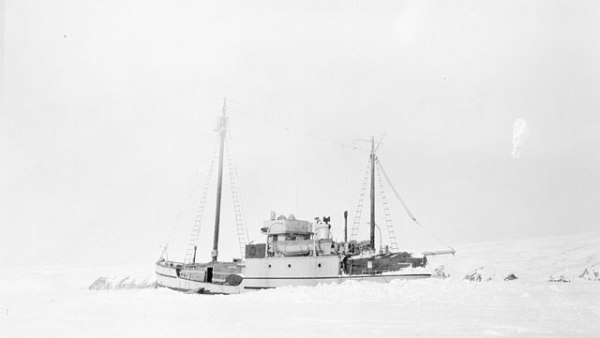
May 29, 1950 The Royal Canadian Mounted Police (RCMP) schooner St. Roch arrived in Halifax, Nova Scotia, after becoming the first ship to circumnavigate North America. The ship, which was launched in 1928, was specially designed and built to withstand the heavy ice pressures of Canada’s Arctic region. The vessel’s original purpose included serving as... Continue Reading →
May 24, 1843 In the British colony (and present-day state) of Western Australia, the first of a series of bridges known as the Causeway was opened to serve as a crossing over the Swan River and connect the town (now city) of Perth with the port of Fremantle. For more than a decade, many settlers... Continue Reading →
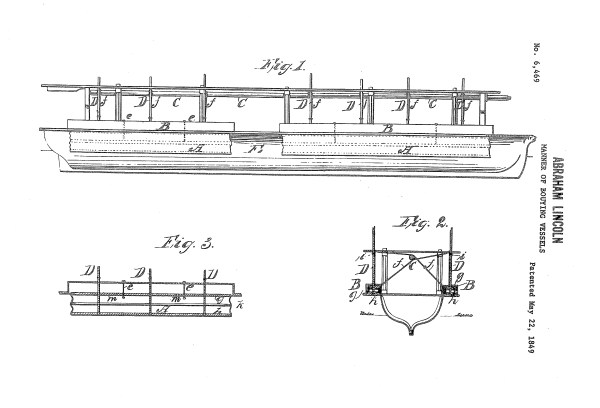
May 22, 1849 Abraham Lincoln, at the time 40 years old and a self-described "prairie lawyer" from Illinois (as well as a recently retired one-term U.S. congressman), was issued a patent for a flotation device for the movement of boats in shallow water. To date, this patent is the only one ever registered to somebody... Continue Reading →
May 17, 1976 The first commuter aerial tramway in North America was officially opened in New York City. This tramway, spanning the East River, serves as a public transit connection between Roosevelt Island and the Upper East Side of Manhattan. (An aerial tramway is a means of overhead transportation in which as many as two... Continue Reading →
The Board of Road Commissioners for Alaska – better known as the Alaska Road Commission (ARC) – was organized by order of U.S. War Secretary (and future president) William Howard Taft to oversee construction of highways in what was then an American territory. The ARC was created in response to a steadily growing demand for adequate... Continue Reading →
The Argentine Navy ship ARA Buenos Aires was launched. The vessel, which Marine Engineer magazine characterized at the time as “a very remarkable cruiser,” was built by British manufacturer Armstrong, Mitchell & Co. Ltd. The launch of the Buenos Aires took place at the company’s shipyard in the city of Newcastle in northeastern England. “She... Continue Reading →
A few years before European automotive pioneers such as Karl Benz and Gottlieb Daimler introduced their own versions of the "horseless carriage," a lawyer and inventor from Rochester, New York, named George B. Selden filed the first U.S. patent for an automobile. Selden, who was 32 at the time, submitted a patent application for what... Continue Reading →
Not long after Najeeb Elias Halaby, Jr., stepped down as administrator of the Federal Aviation Agency (the present-day Federal Aviation Administration), various newspapers carried an Associated Press story about his just-released congressional testimony earlier in the year on a major aviation challenge. “Drunk Flying Among Private Pilots is Serious Problem,” proclaimed the headline in one... Continue Reading →
Southeastern England’s Canterbury and Whitstable Railway – also known by its nickname the “Crab and Winkle Line” – was officially opened. That public railway, linking the famed cathedral city of Canterbury with the seaside town of Whitstable, was created to transport both passengers and freight. The railway relied on cable haulage by steam engines over... Continue Reading →
May 1, 2001 Charles Elachi officially assumed his duties as the eighth director of the Jet Propulsion Laboratory (JPL), a California-based federally funded research and development center and NASA field center. Elachi had been born in the town of Rayak in Lebanon in 1947. Elachi received a bachelor’s degree in physics from Joseph Fourier University... Continue Reading →