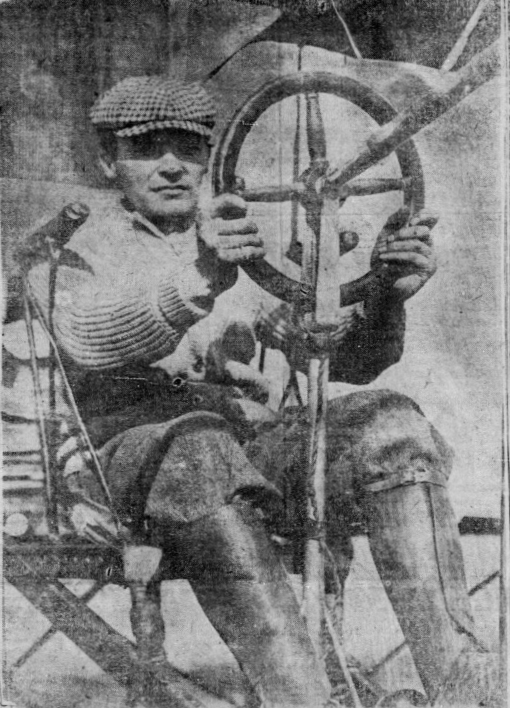
August 27, 1910 The first known wireless transmission of a message between an airplane and the ground below took place in Brooklyn, New York. Canadian aviator John Alexander Douglas McCurdy sent this pioneering message from the Curtiss biplane he was piloting 500 feet (152.4 meters) above the earth. He had a 50-foot (15.2-meter) antenna trailing... Continue Reading →

July 23, 1911 It was an auspicious start for a record-setting career in aviation . . . In the skies above the Nassau Boulevard Aerodrome on Long Island, 23-year-old George W. Beatty first flew solo in a plane. This flight occurred less than a month after he began taking lessons from instructor Arthur L. “Al”... Continue Reading →

July 16. 1957 U.S. Marine Corps Major John H. Glenn set a transcontinental speed record when he piloted a Vought F8U Crusader jet aircraft from Los Alamitos Naval Air Station in California to Floyd Bennett Field in New York City. Glenn dubbed this cross-country effort “Project Bullet” to emphasize the plane’s high-speed capability. Glenn completed... Continue Reading →

June 28, 1939 Ushering in a new age of scheduled transatlantic passenger airplane service, the Dixie Clipper “flying boat” made its first run along Pan Am Airways’ newly established route between New York and Marseilles, France, via the South Atlantic Ocean. This long-range aircraft was one of several produced by the Boeing Airplane Company between... Continue Reading →

June 18, 1967 The first regularly scheduled wintertime flight to Antarctica took place. (In the Southern Hemisphere, the seasons of the year are the opposite of their order in the Northern Hemisphere.) All previous flights to Antarctica during that time of the year had involved only emergency evacuations of patients needing urgent medical treatment; otherwise,... Continue Reading →

June 12, 1994 The Boeing 777, the world’s largest twinjet, made its first flight. The two-engine, wide-body jetliner, popularly known as the “Triple Seven,” was manufactured by Boeing Commercial Airlines. The aircraft was flown by chief test pilot John E. Cashman, taking off at 11:45 on that Sunday morning for a three-hour excursion from a... Continue Reading →

May 25, 2015 Time magazine published an interview with U.S. Navy Admiral Harry B. Harris, Jr., just a couple of days before he began officially serving as head of the U.S. Pacific Command (the oldest and largest of the unified combatant commands of the U.S. Armed Forces). Harris is the first Asian-American to achieve the... Continue Reading →

May 21, 1979 The U.S Air Force (USAF), in a key victory for a group of American women who had flown planes in support of their country during World War II, officially recognized the active military status of the Women’s Airforce Service Pilots (WASP) during that global conflict and issued honorable discharges to those aviators.... Continue Reading →

Aviation pioneer Ben Kuroki was born in Gothenburg, Nebraska. His parents were Japanese immigrants. Kuroki grew up in the Cornhusker State, graduating from high school in 1936. After the Japanese attack on Pearl Harbor in 1941, Kuroki’s father encouraged both him and his brother Fred to join the U.S. military. The brothers were turned down... Continue Reading →

The Los Angeles Times highlighted an important but increasingly overlooked aviation pioneer from the World War II era. Hazel Ying Lee was the first Chinese-American woman to fly in support of U.S. military efforts, and the article in the Los Angeles Times focused on a 1944 letter from her to one of her still-surviving relatives.... Continue Reading →

Create a website or blog at WordPress.com

Up ↑