July 3, 1828
The North Carolina-based Fayetteville Weekly Observer was one of several newspapers throughout the United States to cite plans for a groundbreaking ceremony on Independence Day for a major canal in the Washington, D.C., region. This new waterway, the Chesapeake and Ohio (C&O) Canal, would be built along the Potomac River from Washington to western Maryland.
The announcement in the Fayetteville Weekly Observer stated, “The Stockholders of the Chesapeake and Ohio Canal Company met in Washington a few days ago, and organized the company by the appointment of Charles Fenton Mercer, President, and Joseph Kent, Andrew Stewart, Walter Smith, Phineas Janney, Frederick May, and Peter Lenox, Directors . . . Arrangements are [being made] for breaking ground upon the Canal, on the 4th instant.”
As a lead-up to that ceremony, hundreds of people in the Washington area gathered the next morning at the High Street Wharf in what was then the municipality of Georgetown. (Georgetown remained a separate municipality until 1871, when Congress established a consolidated government for the District of Columbia in its entirety.) The crowd at the High Street Wharf cheered when a group of men wearing red uniforms showed up playing drums and horns. These men belonged to the U.S. Marine Band, and they were en route to take part in the groundbreaking ceremony. They boarded the first of several boats docked there along the wharf and soon led a procession of other vessels several miles upstream.
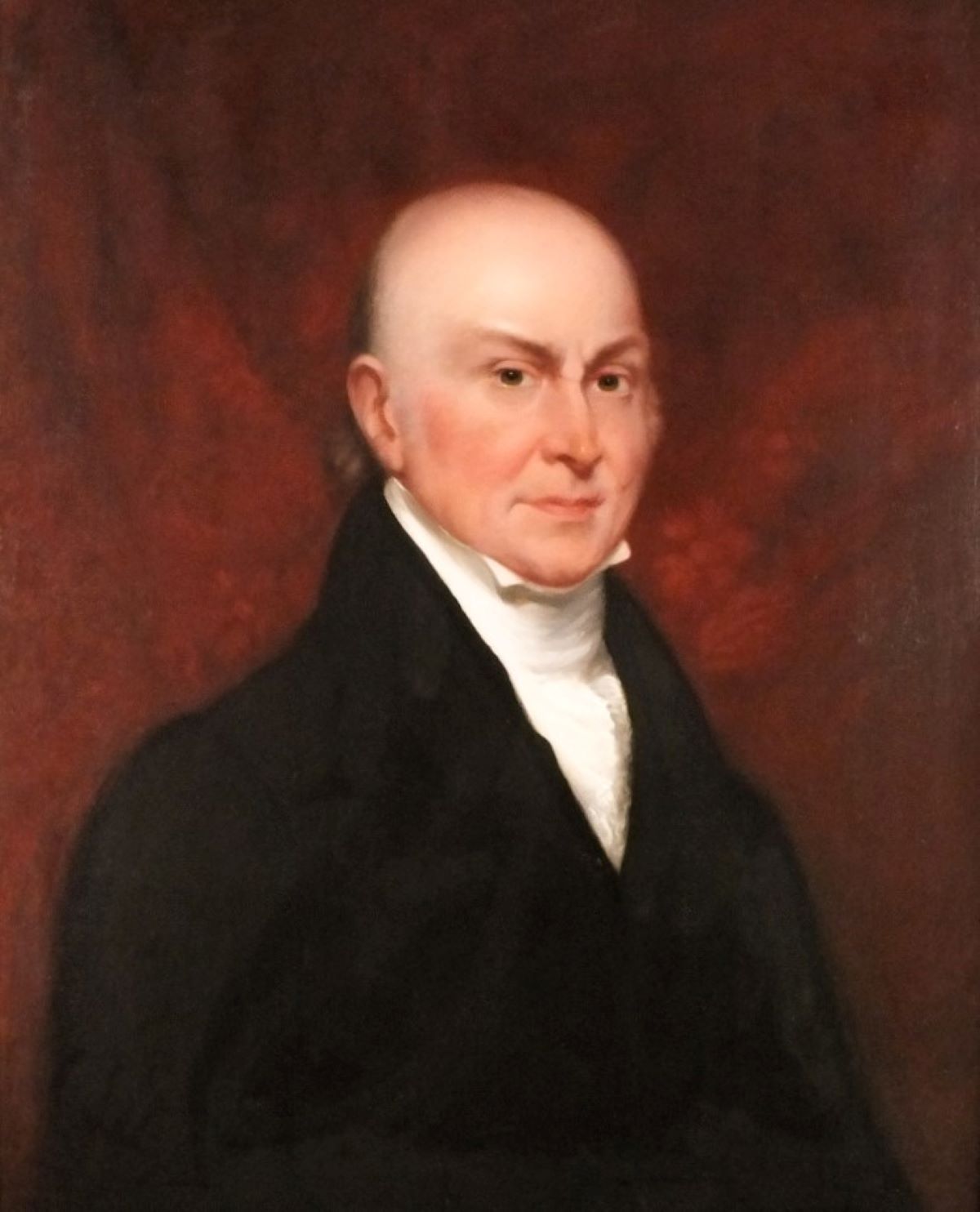
The party made its way to a place near Little Falls, a section of the Potomac River where Washington, Maryland and Virginia meet. It was at this landing point that the ceremony was held. A large number of other people were likewise gathered there for the event, and its main participant soon arrived as well. That participant was none other than President John Quincy Adams (shown in the accompanying portrait created that same year by Massachusetts-born artist Charles Osgood). The Marine Band, gathering near Adams, welcomed him with the melody of a boating song entitled Hail to the Chief; it marked the first time that this now-familiar anthem was played in tribute to a president in attendance.
Adams’ own role at the ceremony involved digging up the first spadeful of soil for the C&O Canal. Unfortunately, this task was easier said than done. His first attempt resulted in the spade hitting a tree root; this prevented the spade from penetrating into the earth as needed. When Adams tried again, the outcome was not any better. He again failed to drive the spade into the soil.
Enough was enough. With a great deal of determination and no doubt exasperation, the 60-year-old president threw down the spade. He then speedily took off his coat and retrieved the spade for yet another attempt to dig up some dirt. The third time was the charm. The Washington-based National Intelligencer later reported that the many people witnessing this successful effort “raised a loud and unanimous cheering, which continued for some time after Mr. Adams had mastered the difficulty.”
Adams’ perseverance saved the day. With ground broken for the C&O Canal, construction began on a transportation network that would long serve as an important lifeline for communities along much of the Potomac River.
Image Credit: Public Domain
For more information on the construction of the Chesapeake and Ohio Canal, please check out Canal Construction – Chesapeake & Ohio Canal National Historical Park (U.S. National Park Service) (nps.gov)

 Transportation History
Leave a comment