November 7, 1857
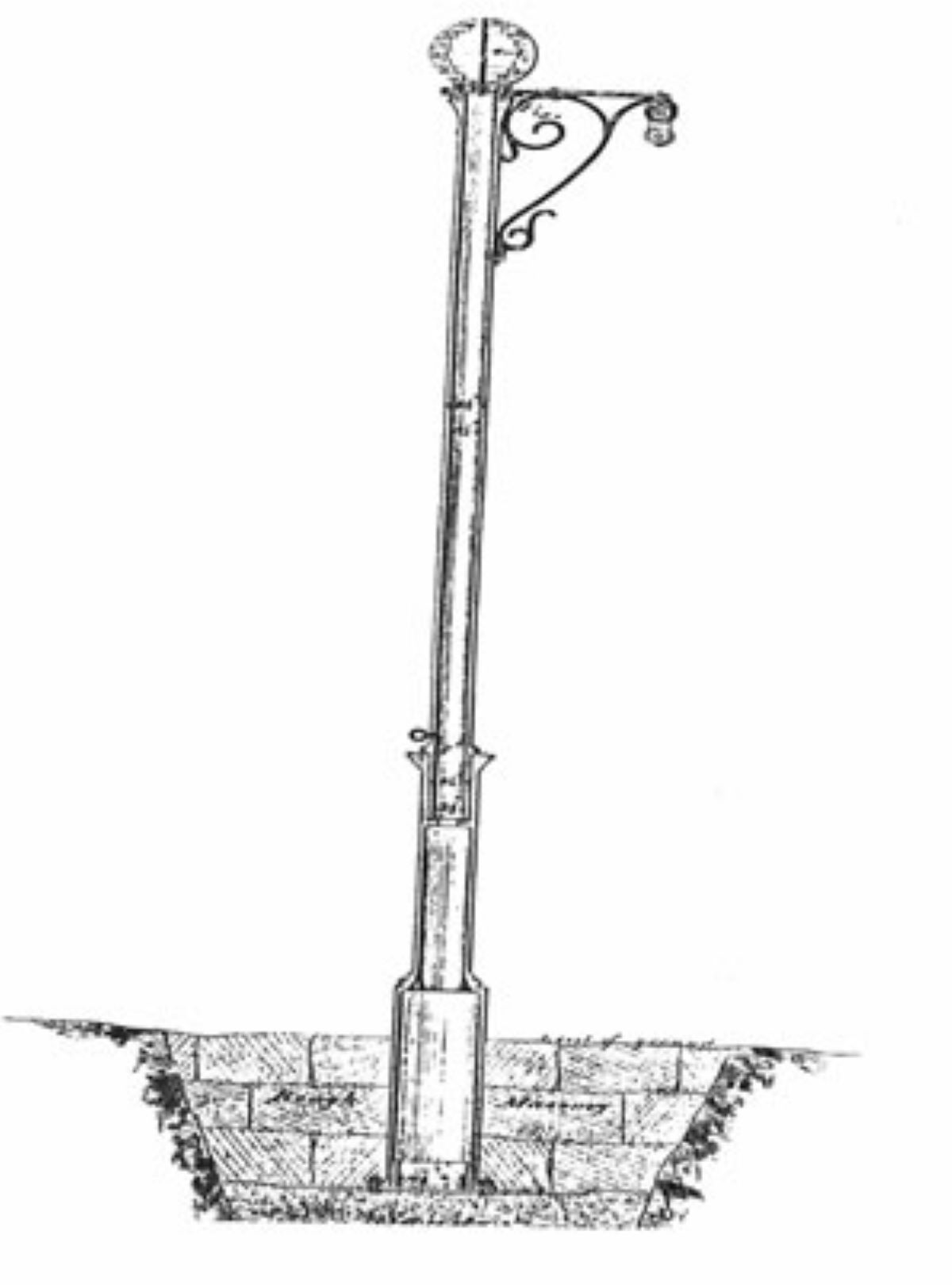
On Maryland’s side of the Potomac River, a cast iron light pole was installed as the first navigational aid in an area that is about 20 miles (32.2 kilometers) south of Washington, D.C. This pole was specifically put into place on the grounds of Fort Washington, which ultimately served for many years as the only defensive fort protecting the nation’s capital.
Measuring only 18.5 feet (5.6 meters) in height, the cast iron pole was built with an allocation of just $500 to help guide vessels sailing through that vicinity of the river. As illustrated in the accompanying image, the pole was crowned with a lighting apparatus.
The person responsible for the maintenance of this navigational aid starting at the time of its debut was Joseph Cameron, a U.S. Army ordnance sergeant stationed at Fort Washington. Cameron joined the Army in 1806 and spent a total of 37 years of that military service at Fort Washington; from 1853 to 1861, as a matter of fact, he was the only soldier stationed at the fort on a full-time basis. Cameron remained keeper of the original Fort Washington Light until 1869.
This light was long regarded as a stopgap solution at best and it was finally replaced with a shorter but decidedly sturdier structure in 1870. The new version of Fort Washington Light was a 16-foot (4.9-meter) tower constructed at the Lazaretto Depot in Baltimore and installed even closer to the water. Extra space was added to this tower four years later so that lighthouse keepers would have a place to stay during nights when inclement weather in the area compelled them to remain on duty.
A 32-foot (9.8-meter)-tall fog bell tower was built nearby in 1882, with a structure deemed more suitable as a house for the keeper added three years later. By the turn of the century, everything from boathouses to gun batteries built at or near the shoreline there blocked the view from original tower and consequently hindered that structure’s ability to serve as an effective navigational aid. The end result of these logistical challenges was the modification of the fog bell tower in 1901 so that the lighting apparatus could be set up there instead.
This newer and taller tower became the version of Fort Washington still in operation today; it has also outlasted both the first tower and keeper’s house, which each joined the cast iron pole in being torn down. The current version of Fort Washington Light has been automated since 1954. It now has a blinking red light that is operated by the U.S. Coast Guard. In addition, this structure and the namesake fort where it is located are maintained by the National Park Service.
Image Credit: National Park Service
Additional information on the various versions of Fort Washington Light is available at http://cblights.com/lights/fortwashington.html and https://www.nps.gov/fowa/learn/historyculture/light80.htm
For more information on navigational aids in Maryland, please check out https://media.defense.gov/2018/Jul/09/2001940171/-1/-1/0/LHMD.PDF

 Transportation History
Leave a comment