June 4, 1933
In the northeastern New Jersey township of Nutley, a cycle-racing track was opened in what the Chatham Press newspaper called “a most auspicious manner” and with a standing-room-only crowd of 12,000 people in attendance. The Nutley Velodrome consisted of a saucer-shaped track made of wood and covered with galvanized sheets.
The competitors taking part in the facility’s opening events included cyclists from not just the United States but also such other countries as Belgium, France, Germany, Italy, and Australia. The three-hour round of bicycle and motorcycle competitions that Sunday afternoon began at three o’clock, with Nutley Mayor Walter F. Reinheimer firing a gun to launch the featured “Inaugural Stakes” race.
This competition covered 25 miles (40.2 kilometers) altogether around the track and involved having each cyclist closely follow a partner on a motorcycle in order to pick up speed from the motorcycle’s slipstream (the reduced air pressure and forward suction left behind by that vehicle). The bicyclist winning the Inaugural Stakes was 28-year-old New York City resident Paul Croley, whom the Chatham Press had highlighted the day before as “one of America’s most promising riders.” Croley, who was awarded a silver cup by Mayor Reinheimer, had been paired in the race with motorcyclist Thomas Grimm of Maplewood, New Jersey.
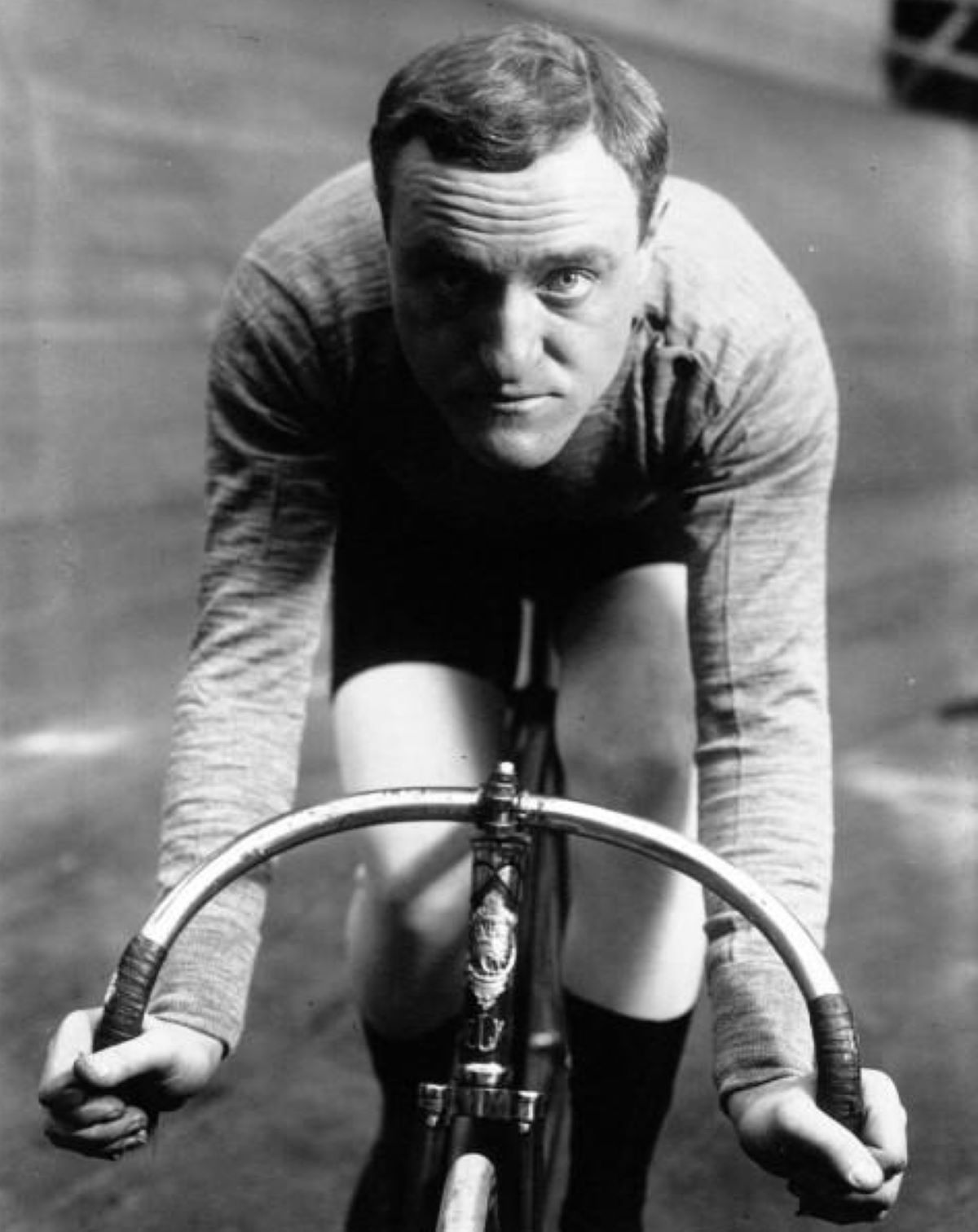
The Nutley Velodrome initially thrived after that strong and well-attended debut, with thousands of people regularly showing up to enjoy cycling races on Sunday afternoons and Wednesday evenings. A larger-than-life individual in the cycling world who was involved in these events on a regular basis was Frank Louis “Big Steve” Kramer. He took part in the races at the Nutley Velodrome not as a competitor, but as a referee. The Indiana-born Kramer also happened to be the chairman of the National cycling Association’s board of control. His greatest claim to be fame, however, was that he had been a widely renowned cyclist. Kramer’s key achievements in this regard included winning 16 consecutive national championships between 1901 and 1916. (The accompanying photo of Kramer was taken in 1913.)
After Kramer died in 1958 at the age of 77 in the village of South Orange (likewise located in northeastern New Jersey), the Montclair Times published a glowing tribute to him. “‘Big Steve’ earned more than $25,000 a year until his retirement in 1922, and he was the highest paid figure in sports until Babe Ruth,” proclaimed this article. “As a young boy, he was a 90-pound (40.8-kilogram) weakling, but bike riding built up his body until he captured the national amateur and then the world’s pro crown.”
Notwithstanding the early public enthusiasm for the Nutley Velodrome, it eventually fell on hard times after a sharp drop in fan attendance. This drop very much reflected the steady decline of nationwide interest in cycling as a spectator sport. The Nutley Velodrome closed its gates for the last time in 1940 and was demolished two years later. This facility nonetheless remains a noteworthy part of the final chapter of what many call a golden age of American cycle racing that began in the 1890s.
Photo Credit: Public Domain
For more information on the Nutley Velodrome, please check out https://www.northjersey.com/story/news/essex/nutley/2018/05/25/nutley-nj-velodrome-bicycle-racing-track-celebrate-85th-anniversary/641221002/
Additional information on Frank Louis “Big Steve” Kramer is available at https://en.wikipedia.org/wiki/Frank_Louis_Kramer

 Transportation History
Leave a comment