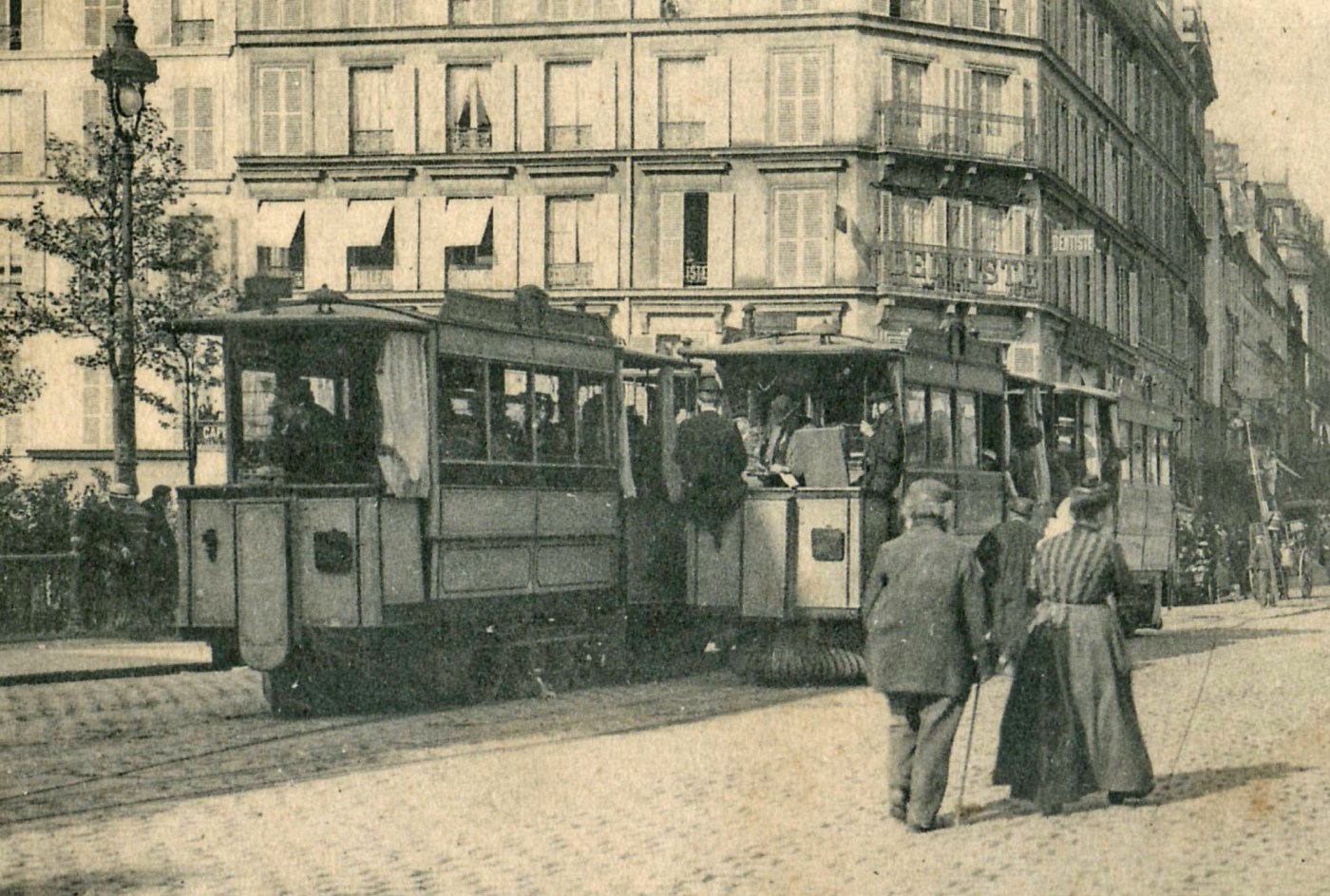
July 18, 1924
After more than three decades of service, the Belleville funicular tramway in Paris ceased operations. This railway consisted of cable cars connecting the Place de la la République (Republic Square) in the north-central region of France’s capital city with Saint-Jean-Baptiste de Belleville, a major church on a hill in northeastern Paris’s Belleville neighborhood.
As its name indicates, the Belleville funicular railway was essentially a tram-funicular transit line hybrid similar in function to both the cable car system in San Francisco; and the Elevador do Lavra (also known as the Ascensor do Lavra) in Portugal’s capital city of Lisbon. As with those two means of public transportation elsewhere in the world, the Belleville funicular tramway relied on cable traction to make travel on an incline all the more manageable. (The origins of the term “funicular” can be traced to the Latin word “funis,” which means “rope” or “cord.”)
Construction of the Belleville funicular tramway was supervised by civil engineer Fulgence Bienvenüe (1852-1936). This 1.3-mile (2.1-kilometer) single track railway was officially launched on August 25, 1891. It quickly became popular, transporting 4.4 million passengers in 1895 alone. The record year for ridership on the Belleville funicular tramway was 1902, when 5.2 million passengers traveled aboard those cable cars.
Ultimately, however, this railway encountered financial hardships due to underfunding in the World War I years and the subsequent need for significant repairs. After the line was shut down altogether in 1924, its infrastructure was torn apart and the cable cars were sold for scrap. In 1935, Line 11 of the rapid transit network called the Paris Métro was opened on the one-time route of the Belleville funicular tramway.
Photo Credit: Public Domain
For more information on the Belleville funicular tramway, please check out https://en.wikipedia.org/wiki/Belleville_funicular_tramway

 Transportation History
Leave a comment