September 25, 1938
The big sports event in Washington, D.C., on that Sunday was without question the President’s Cup Regatta. This multi-day series of waterborne competitions had been introduced in the nation’s capital a dozen years earlier, and the annual event quickly became renowned for the motorboats and hydroplanes participating in a variety of races on the Potomac River.
The 1938 President’s Cup Regatta very much reflected the ever-growing popularity and prestige of these races. The widespread public enthusiasm for this regatta could readily be seen in the multitude of spectators showing up on September 25 for that day’s competitions. An estimated 75,000 people either lined the seawalls or filled the stands built along the two-and-a-half-mile (four-kilometer) course at Hains Point in the southwest part of the city. (This artificial island is located between the main branch of the Potomac River and the Washington Channel.) Another 25,000 people watched the races from numerous other spots in the area.
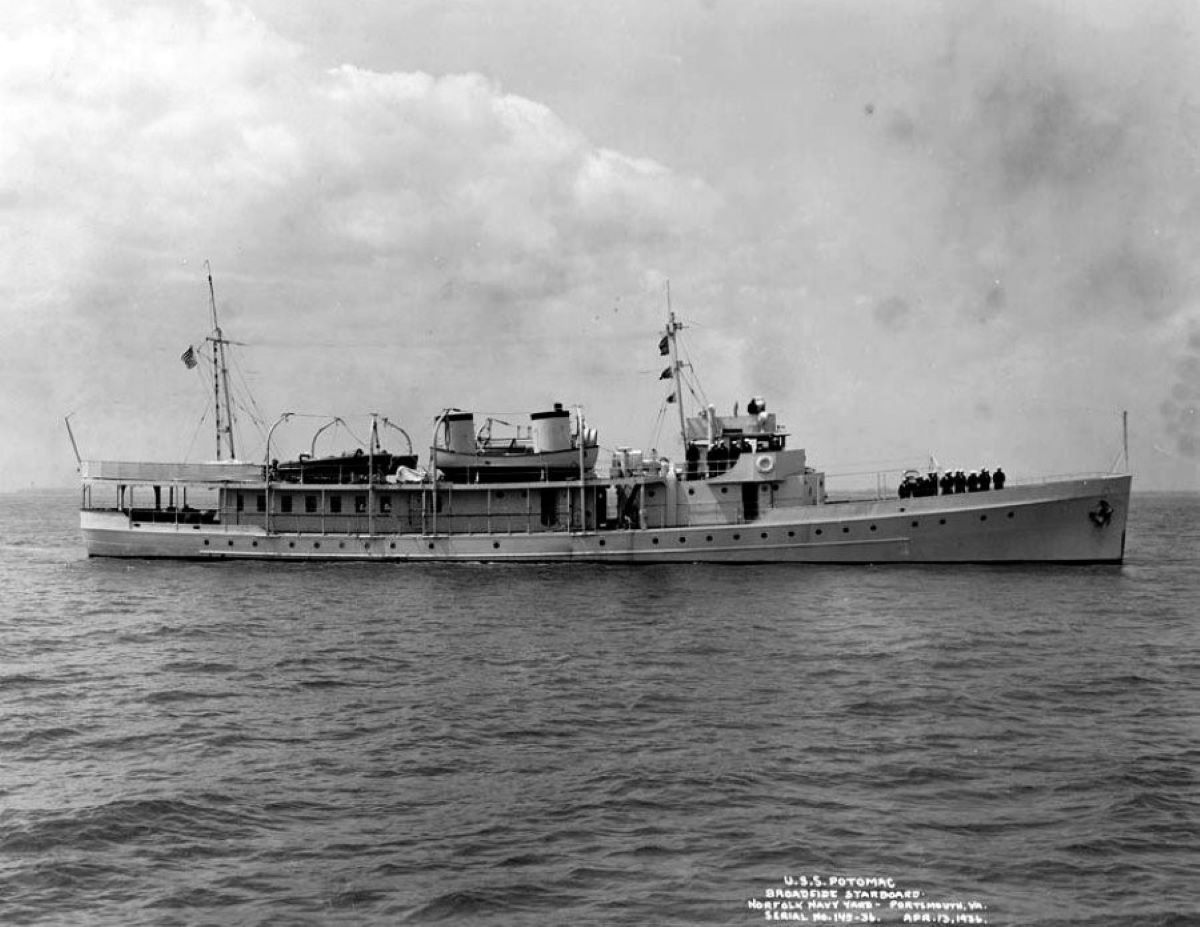
Those on hand for the Sunday competitions included the city’s most famous resident, President Franklin D. Roosevelt (1882-1945). He enjoyed the races while on board the aptly named presidential yacht USS Potomac (AG-25). The Washington Post reported, “Attired in a gray, double-breasted suit of light material, the Chief Executive sat on deck in a wicker chair and watched the hydroplanes and speedboats churn the water around the oval course which circled the Presidential yacht.” (The accompanying photo of this vessel was taken in 1936.)
The star performer of that day’s races was an Italian millionaire sportsman named Count Teofilo “Theo” Guiscardo Rossi di Montelera (1902-1991), who set a new average speed record of 69.7 miles (112.2 kilometers) per hour out on the water and — at a pace of 70.9 miles (114.1 kilometers) — a new record for a single lap. Count Rossi was allowed to board the USS Potomac so that Roosevelt could personally congratulate him for his record-breaking achievements.
It was while the two of them were together on the yacht that the familiar melody of Happy Days Are Here Again, which had been Roosevelt’s presidential campaign song in 1932, could be heard loudly and clearly. The person broadcasting this music was local bandleader and boating enthusiast Horace “Happy” Walker (1899-1964), who was nonchalantly operating a motorboat near Roosevelt’s vessel.
Overall, the races on that Sunday as well as throughout the remainder of the 1938 President’s Cup Regatta benefitted greatly from the cooperation of Mother Nature. Motor Boating magazine affirmed, “Perfect water and weather conditions prevailed, so perfect in fact that the Potomac River is always a rough course.”
Those races on September 25 also benefitted from well-coordinated logistics. A large number of Girl Scouts and Boys Scouts alike, for example, served as ushers and messengers for the thousands of people in attendance. In addition, there was a Red Cross first-aid tent set up near the river; these medical services were needed no more than two or three times, and only then for small scratches, during the entire day.
The only major downside pertaining to the regatta that day, as a matter of fact, involved the automobiles driven by spectators as they left the area following the races. “Roads leading from Hains Point were choked as spectators started the trek homeward,” reported the Washington Post. “On one-way streets traffic was virtually at a standstill, a few resourceful motorists cutting out and speeding down the bridle path paralleling the roadway until motorcycle police called a halt.”
Photo Credit: Public Domain
For more information on the 1938 President’s Cup Regatta, please check out https://hydroplanehistory.com/races/1938_presidents_cup_presidents_cup_regatta.html
Additional information on the presidential yacht USS Potomac (AG-25) is available at https://www.history.navy.mil/content/history/nhhc/research/histories/ship-histories/danfs/p/potomac-iv.html and https://www.whitehousehistory.org/uss-potomac-franklin-roosevelts-presidential-yacht

 Transportation History
Leave a comment