October 21, 1856
The steamship USS Arctic, the first of five U.S. Navy vessels named after the polar region in the northernmost section of Earth, was decommissioned in New York City. This original version of Arctic had been built at the Philadelphia Navy Yard and commissioned only the year before.
On June 4, 1855, Arctic and the barque (sailing vessel) USS Release headed north from New York City to search for the missing expedition of Navy surgeon and medical officer Elisha Kent Kane (1820-1857) and his party of explorers. Both vessels ultimately made their way to Disko Island, located in Baffin Bay and off the west coast of Greenland. Kane and the other survivors of their expedition were found on that island, where they had found refuge after a high-risk journey of 84 days via both pack ice on foot and open water in boats. During the fall of 1855, Arctic helped transport the party back to the United States.
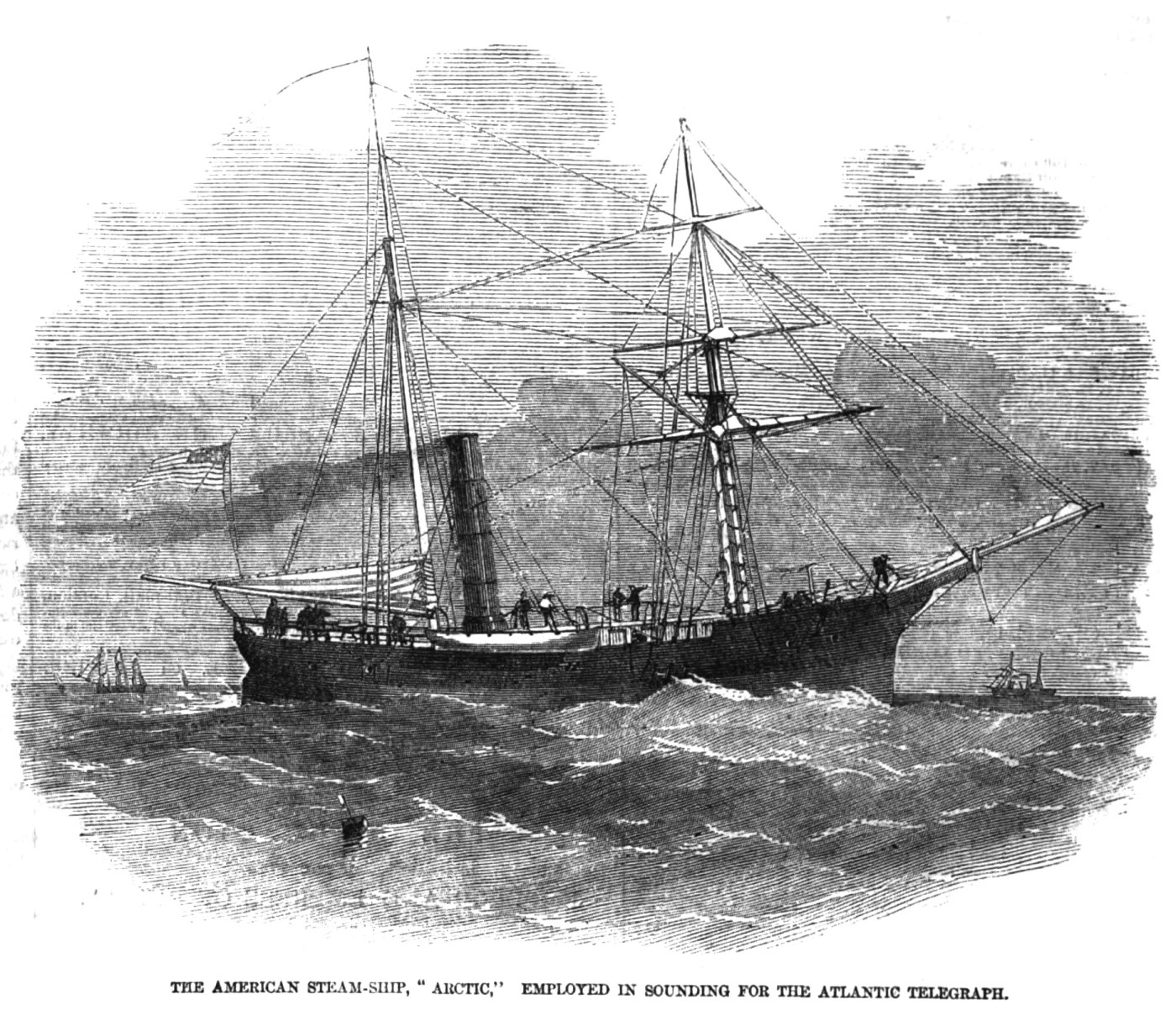
In July of the following year, Arctic was sent back out to sea for another unique mission. This time around, she was used to make depth soundings (the measurement of the depth of a body of water) of the Atlantic Ocean to help prepare for the laying of the first transatlantic cable. These undersea cables would mark a significant technological milestone in communications between both sides of the Atlantic; messages between those parts of the world that previously had to be delivered by ship over the span of at least several days could now be received and answered within a single day.
Under the command of Captain Otway Henry Berryman (1812-1861), Arctic began her depth soundings assignment at the present-day city of St. John’s in what was then the British colony of Newfoundland. Berryman and his crew subsequently continued their work across the Atlantic, arriving in Queenstown (now known as Cobh) in Ireland on August 23, 1856. On her return voyage from Europe, Arctic was used to complete yet more depth soundings for the cable. She arrived at St. John’s on September 30. The vessel was then taken back to New York City.
Less than a week before her decommissioning, Arctic was lauded by the New York Journal of Commerce for her contributions to the future transatlantic cables. “She completed the undertaking in the most satisfactory manner,” stated this biweekly magazine. “She sounded the Atlantic all way across, finding the greatest depth 2,070 fathoms [3,785.7 meters] (more than two miles [3.2 kilometers]).”
This article further noted, “It was not accomplished without difficulties, as many of the instruments used were new inventions; but the persevering spirit of Capt. Berryman and his officers conquered every obstacle.” (The accompanying image of Arctic carrying out this work in the Atlantic was published in the September 13, 1856, issue of Illustrated London News.)
The 1856 decommissioning of Arctic was hardly the final chapter for this steamship. She was soon commissioned into the U.S. Coast Survey and, with Berryman again serving as the commander, used throughout 1857 and in the early part of 1858 to make additional depth soundings for the first transatlantic cable. (The first communications sent via cable finally took place on August 16, 1858.) Arctic was recommissioned into the Navy and, between May and July 1858, served as part of a squadron of ships dispatched to the waters around Cuba to prevent the search of American merchant ships by British cruisers.
Yet another chapter opened for Arctic early in 1859, when — after her steam engine had been removed — she was transferred to the U.S. Lighthouse Board. She remained in service as a lightship over the next several years. On April 1, 1879, this vessel was sold at public auction.
Image Credit: Public Domain
For more information on the original USS Arctic, please check out https://en.wikipedia.org/wiki/USS_Arctic_(1855)

 Transportation History
Leave a comment