David Moses Bridges was a member of the federally recognized Passamaquoddy Tribe on the Passamaquoddy Pleasant Point Reservation in the eastern part of Maine. The Passamaquoddy people constitute one of the Eastern Algonquian nations that form the Wabanaki Confederacy, which encompasses various tribes within both the northeastern United States and southeastern Canada.
Bridges was born on May 17, 1962, in Portland, Maine. Along with becoming a strong advocate for the environmental rights of tribes in the Pine Tree State and elsewhere in North America, Bridges invested his considerable creative skills and energies into helping to preserve as well as promote the Wabanaki culture. One of his major pursuits in this regard involved constructing birchbark canoes. This centuries-old means of transportation was extensively used by Bridges’ ancestors but had increasingly become obsolete in recent decades.
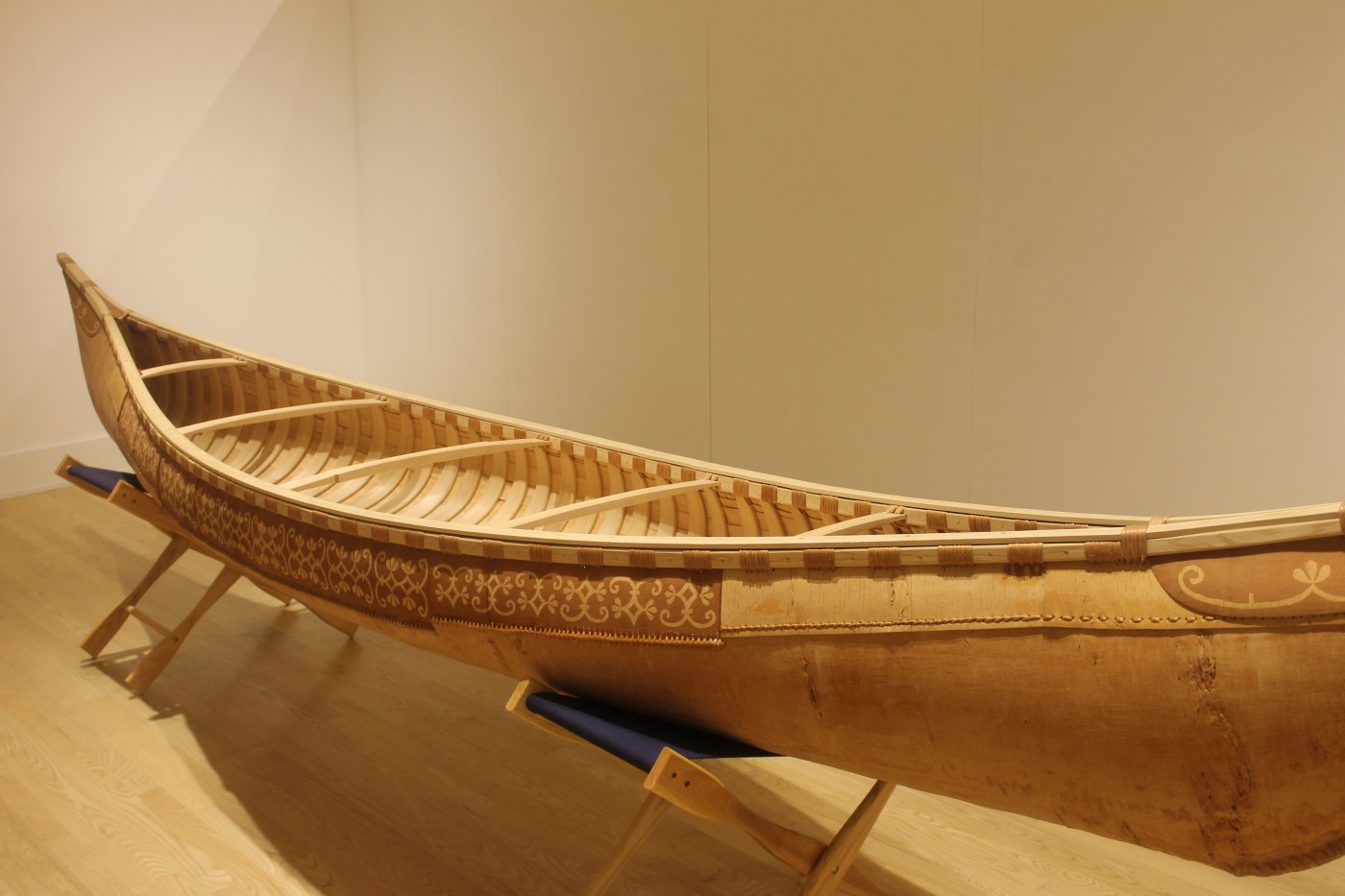
As a child, Bridges was introduced to this traditional boat by his great-grandfather Sylvester Gabriel. It was Gabriel who provided his great-grandson with the instructions and tools for building a birchbark canoe. The materials used for this type of canoe included not only birchbark but also spruce roots and red cedar. As Bridge likewise learned from his great-grandfather (who passed away in 1972), a birchbark canoe should be slender enough for someone to easily carry to and from bodies of water and sturdy enough for traveling safely on rivers and bays. (The accompanying photo depicts a birchbark canoe that is on display at the Abbe Museum in Bar Harbor, Maine.)
Bridges maintained a lifelong enthusiasm for birchbark canoes and their potentially pivotal role in highlighting the legacy of his people. He learned even more about how to construct these canoes by taking classes at the WoodenBoat School in Brooklin, Maine. Over time, he also conducted workshops of his own to show a diverse range of individuals how to make and use a boat that clearly meant a lot to him.
After Andrew Wyeth hired him to build a canoe, Bridges brought along birchbark when he went to the renowned artist’s home on an island off the coast of Maine. Bridges subsequently wandered throughout the island to gather up spruce roots for the project. This multi-week construction endeavor turned out to be a group effort. “Everybody on the island was involved in the process,” recalled Amy Morey, manager of the Wyeth Study Center at the Farnsworth Art Museum in Rockland, Maine. “He was a cheerleader for the rest of us. He showed us how to do things. It was a wonderful experience.”
Bridges received several honors throughout the years. These included being named a Traditional Arts Fellow by the Maine Arts Commission in 2000; and receiving both the Boat of the Year Award from Maine Boats, Homes and Harbors magazine in 2004 and the Community Spirit Award from the South Dakota-based educational organization First Peoples Fund in 2006.
After being diagnosed with cancer, Bridges made it clear that – along with receiving medical treatment – he would remain as engaged as possible in his various creative endeavors. “Work keeps my mind off where I am,” he said in a February 2016 interview with the Portland Press Herald. “Work keeps my mind in a happy place. I am trying to balance the reality by living today, one moment at a time.” Bridges died on January 20 of the following year at Passamaquoddy Pleasant Point Reservation. He was 54.
“For lack of a better term, he was a culture bearer, and he worked very hard at it for a very long time,” noted Hugh French, director of the Tides Institute & Museum of Art in Eastport, Maine, at the time of Bridges’ passing. “He was very proud of his culture, and he worked to preserve that culture through his own work and through education. It was a tall order, and he went at it hard.”
Theresa Secord, a member of the Penobscot Nation (another constituent of the Wabanaki Confederacy) who was one of Bridges’ fellow makers of traditional baskets, likewise paid tribute to him. “He will always be remembered among the brightest stars of our Wabanaki culture today,” she said. “The Passamaquoddys have a song, and some of the words are, ‘We are the stars who sing, we sing with our light.’ David now sings with his light.”
Rhythms of the Heart, a documentary about Bridges, was released in August of that same year. In 2019, Donald Soctomah and Jean Flahive released their book The Canoe Maker: David Moses Bridges, Passamaquoddy Birch Bark Artisan.
Photo Credit: Billy Hathorn (licensed under the Creative Commons Attribution 3.0 Unported license at https://creativecommons.org/licenses/by/3.0/deed.en)
For more information on David Moses Bridges, please check out https://www.pressherald.com/2017/01/23/passamaquoddy-canoe-maker-david-moses-bridges-dies-at-54/

 Transportation History
Leave a comment