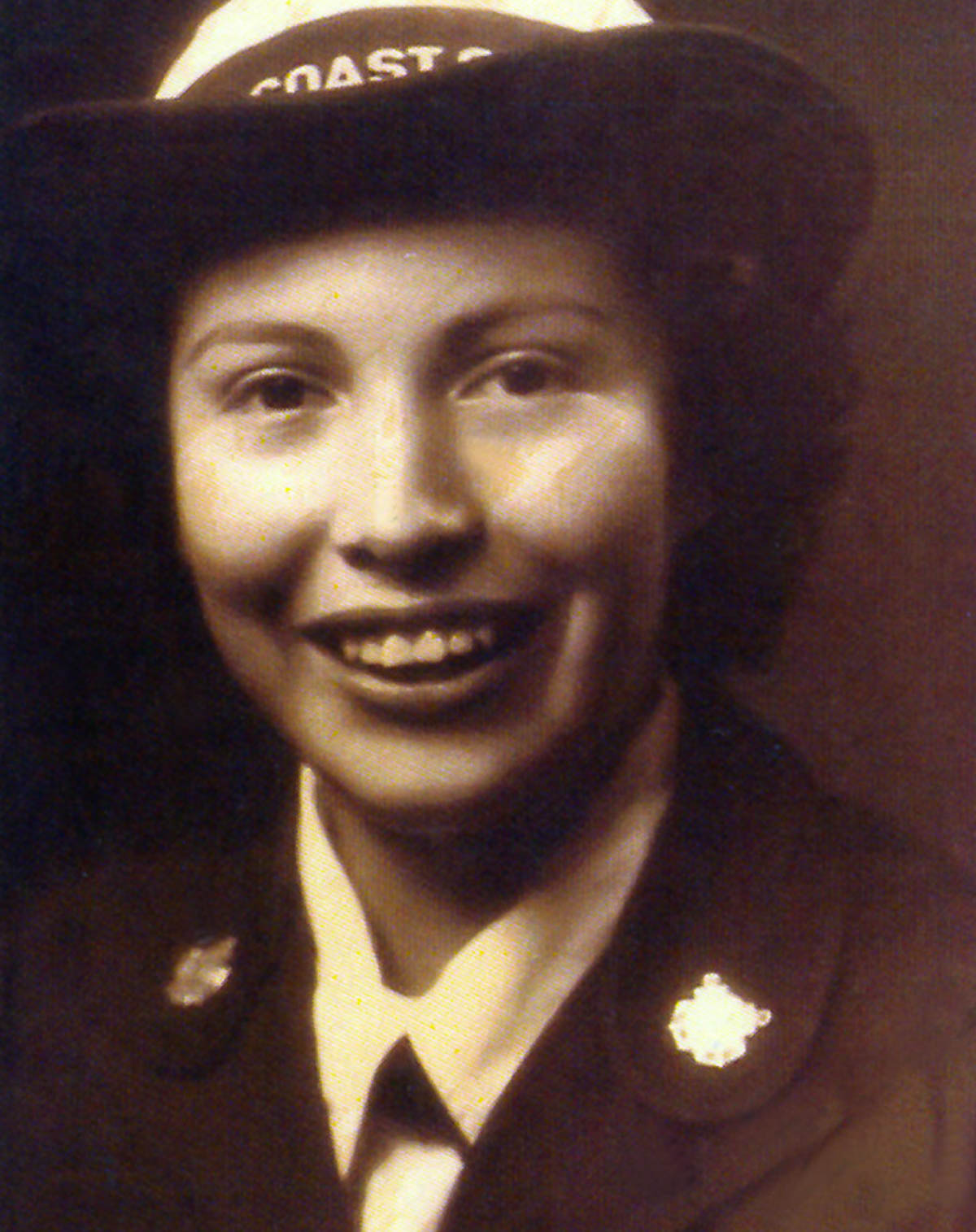
During World War II, Mildred Cleghorn Womack became one of six Native American women from Oklahoma to serve in the U.S. Coast Guard (USCG) Women’s Reserve. This unit, which was best known as the SPARS (the acronym for “Semper Paratus – Always Ready”), was established in 1942 as the women’s branch of the USCG Reserve.
Womack was born on August 25, 1922, in the city of Pawnee in northeastern Oklahoma. Her parents, Grant and Mary Cleghorn, were both members of the Otoe-Missouria tribe. Mary Cleghorn was also of Sac and Meskwaki (Fox) descent.
Womack, along with her cousin and fellow Oklahoma resident Corrine Koshiway Goslin (also a member of the Otoe-Missouria tribe), enlisted in the SPARS during the spring of 1943. They both subsequently underwent training with other recruits at a USCG station in Palm Beach, Florida. In July of that year, the Pawnee Chief newspaper provided an update on how Womack was faring in the Sunshine State. “She likes her work, also her swimming lessons,” reported this newspaper, “but states [that there’s] no place like good old Oklahoma.”
After the completion of that training, Womack – promoted to Seaman, First Class — was assigned to the USCG headquarters in Washington, D.C. Goslin, who attained the rank of Yeoman, Second Class, ended up serving in the office of the USCG’s captain of the port in Tampa.
In the nation’s capital, Womack was in charge of tracking down and accounting for missing USCG servicemen on behalf of their concerned relatives. This mission was far from easy due to the considerably expanded role of the USCG in wartime. Even before the United States entered World War II on the side of the Allies in December 1941, President Franklin D. Roosevelt had temporality transferred the USCG in its entirety to the U.S. Navy to help carry out a wide range of military priorities across the globe.
These duties of the USCG included not only its traditional efforts to patrol the country’s coastlines but also the pressing need to help protect against potential Axis sabotage out at sea; perform rescue operations for the survivors of torpedoed vessels; and coordinate the transport of critically needed troops, supplies, and equipment to various war theaters. (The termination of the Navy’s jurisdiction over USCG took place on January 1, 1946.)
In November 1943, Womack was married in Oklahoma during a brief furlough from her USCG responsibilities. Her husband, Claude O. Womack, was also of Otoe ancestry. The birth of their daughter Mary the following year might have been the reason why Mildred Cleghorn Womack’s service with the SPARS ended.
Womack went on to earn her bachelor’s degree in sociology from the University of Oklahoma. Over the next several decades, she served the Otoe-Missouria tribe as a social worker. Her other major post-war activities included serving on the tribal council for the Otoe Eagle clan; and belonging to a military veterans support group known as the Otoe War Mothers. Womack died in Ponca City, Oklahoma, on August 21, 2013. She was 90.
Photo Credit: U.S. Coast Guard
For more information on Mildred Cleghorn Womack, please check out https://www.nps.gov/people/mildred-womack.htm

 Transportation History
Leave a comment