January 15, 1884
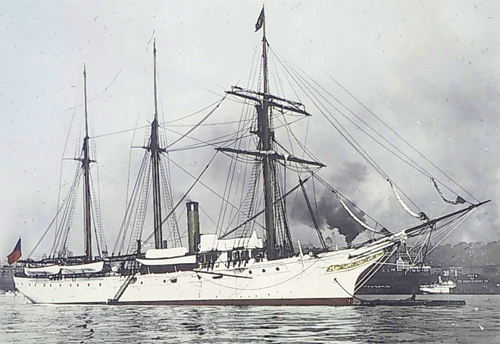
A steamship built for the U.S. Coast and Geodetic Survey (USC&GS) was launched in the ward of Williamsburg in the city of Brooklyn (now one of New York City’s five boroughs). This late-morning ceremony specifically took place at the shipyard of James D. Leary (1837-1902). The design for the ship has been credited to Colby Mitchell Chester (1844-1932), who was a hydrographic inspector for USC&GS at the time.
This vessel was named after Carlile P. Patterson (1816-1881). He served as the fourth superintendent of the U.S. Coast Survey and, after this federal scientific agency underwent a name change in 1878, the first superintendent of USC&GS. (Since 1970, USC&GS has been known as the National Geodetic Survey and is part of the National Oceanic and Atmospheric Administration of the U.S. Department of Commerce.)
The day after USC&GS Carlile P. Patterson was launched, the New York Times reported on that event. “In spite of the cold and cheerless weather yesterday a large number of ladies and gentlemen witnessed the launching of the new coast steamer,” noted this article. “Miss Katie Patterson the daughter of the late superintendent, christened the vessel with a gaily decked bottle of champagne.” The New York Times further stated, “At 11 o’clock the steamer glided gracefully into the water, her arch of Stars and Stripes floating in the breeze, while the surrounding tugs uttered their usual melancholic notes, indicative of welcome.”
Over the next several years, Patterson was primarily used as a survey ship off the coast of what was then the U.S. territory of Alaska. She was also used for other purposes from time to time. In 1914, for example, she played a lifesaving role as the vessel that rescued 26 members of the crew of the U.S. Revenue Cutter Service’s USRC Tahoma after that cutter ran up against an uncharted reef in the Aleutians and sank.
During World War I, Patterson was transferred to the U.S. Navy for use as a patrol ship. The vessel, which was renamed Forward, ended up performing both patrol and hydrographic missions both in the vicinity of Alaska and off the coast of Mexico. After being returned to USC&GS in 1919, she was placed out of service and ultimately owned and used instead by various private companies on the west coast.
In 1925, she was purchased by the Northern Whaling and Trading Company. From then until 1936, Patterson served as a trading ship under the command of Christian Theodore Pedersen (1876-1969). The ship was used by this ship on a route between Herschel Island, which is 3.1 miles (five kilometers) off the coast of northern Yukon, and San Francisco. While traveling between those two points, Patteson also made regular stops along the Alaskan coast. This vessel was eventually sold to the Alaksa Patterson Company for use in transporting freight.
On December 11, 1938, Patterson was wrecked after running aground eight miles (13 kilometers) northwest of Cape Fairweather in the Gulf of Alaska. The 18 members of the crew who survived this disaster were eventually rescued.
Photo Credit: Public Domain
For more information on the launch of USC&GS Carlile P. Patterson, please check outhttps://timesmachine.nytimes.com/timesmachine/1884/01/16/106137376.pdf
Additional information on this ship is available at https://en.wikipedia.org/wiki/USC%26GS_Carlile_P._Patterson

 Transportation History
Leave a comment