February 11, 1933
In Allegheny County, a suspension bridge built in Pittsburgh’s South Side was opened to traffic without any formality or notable amount of fanfare. This bridge’s low-key debut was reported in the next day’s edition of the Pittsburgh Press.
“Undedicated and without ceremony, the county’s new bridge across Monongahela River at Tenth Street went into service yesterday,” stated this newspaper. “South Side business men said they had insufficient time to plan dedication ceremonies, and the County Commissioners said they didn’t have money for them.” The Pittsburgh Press further noted, “The Commissioners were due to drive across the span yesterday afternoon as a gesture of formal opening. If they did few saw them, because few yesterday used the bridge, under construction 18 months and costing $1,600,000.”
This structure was the third version of the South Tenth Street Bridge built at that location in the Steel City. The first of these structures was a covered wooden bridge completed in 1859 and connecting the then-borough of Birmingham with Pittsburgh. (Birmingham was one of several boroughs merged into Pittsburgh in 1872.) The original South Tenth Street Bridge was demolished in 1902 due to its steadily deteriorating condition.
In 1904, the second bridge at the site was completed. This Pratt truss bridge was 1,400 feet (430 meters) in length. By the late 1920s, there were strong concerns that this bridge – despite its relatively young age – had become too unsafe for accommodating heavier motor vehicles. Consequently, the second South Tenth Street Bridge was torn down in 1931 so that a sturdier bridge could be constructed there.
Vernon R. Covell (1866-1949), the chief bridge engineer for the Allegheny County Public Works Department at the time, has been the one generally credited with designing that replacement bridge. It appears, however, that it was more specifically several of Covell’s subordinates working under his direction who jointly developed much of the design for the third South Tenth Street Bridge. Somebody else who was significantly involved in these design plans was architect Stanley Roush (1884-1946). Roush had been the city architect for Pittsburgh between 1914 and 1921 and then served as Allegheny County architect until 1932. The Art Deco details of the bridge’s railings and towers have been attributed to his influence.
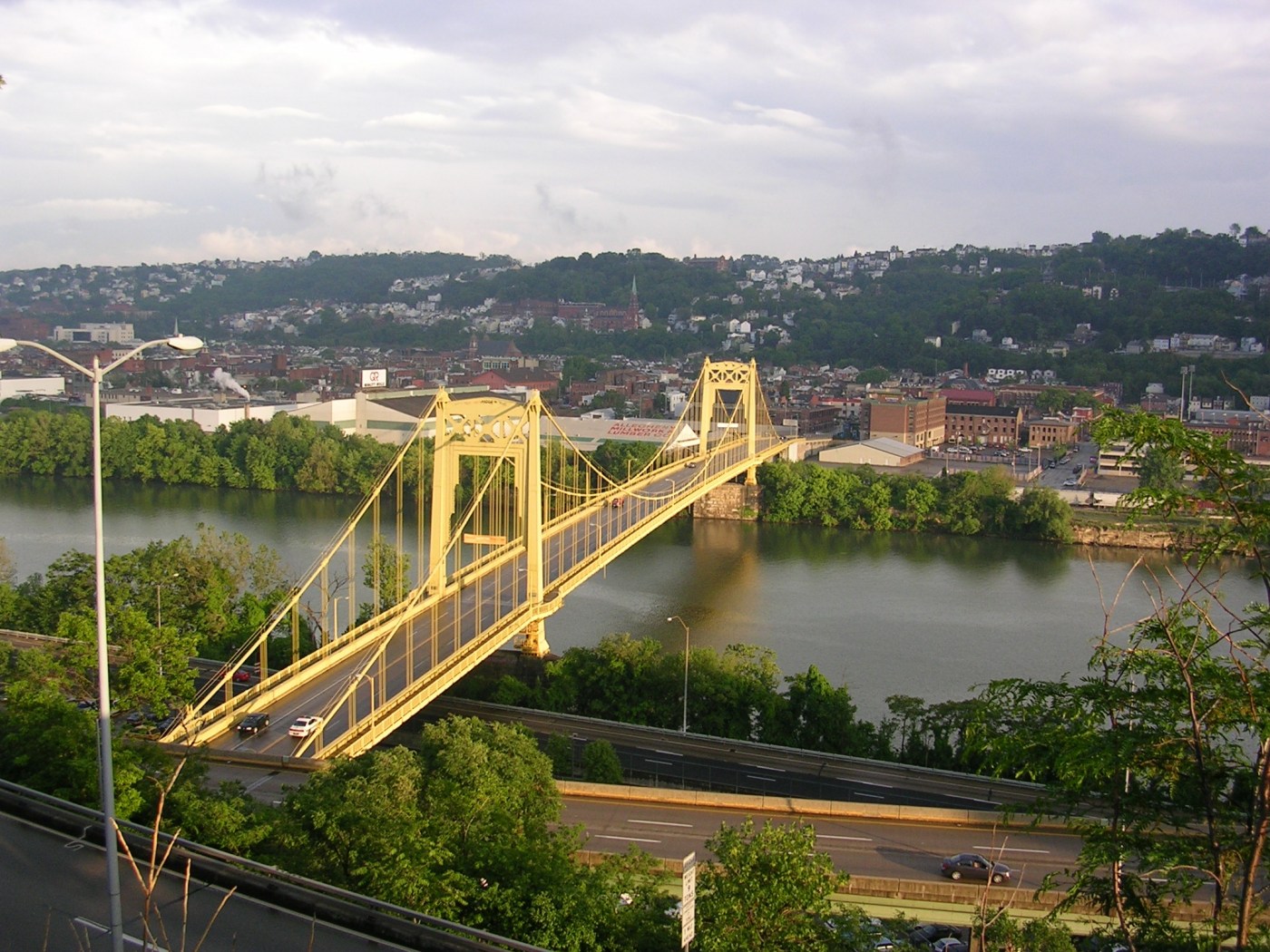
This 1,275-foot (389-meter)-long structure remains the only conventional cable suspension bridge in Allegheny County. This bridge has become a pivotal link between South Tenth Street on the South Side and both Second Avenue and the Armstrong Tunnel within the Pittsburgh neighborhood known as the Bluff. In addition, there is a staircase at the northern terminus of the bridge that connects with the campus of Duquesne University in the Bluff. Along with carrying motor vehicles across the Monongahela River, the Tenth Street Bridge contains bicycle lanes that were put in place there in 2015.
A trademark that the bridge shares with others in Pittsburgh is the Aztec Gold paint applied to it. Other distinguishing features of the present-day South Tenth Street Bridge include painted images of four geese on the south tower. These images have been characterized as “quirky icons” by the Pittsburgh Tribune-Review and also widely referred to as “dino-geese.” The person who painted these popular but unauthorized figures on the bridge during the 1990s was artist Tim Kaulen (born in 1966).
After these geese were covered up during a repainting of the bridge in 2018, Kaulen launched a petition drive to allow him to create new likenesses of those birds. He acquired enough signatures for the petition to gain official approval from the Allegheny County Council for his request. Kaulen subsequently – and legally — repainted those images on the south tower.
In 2007, the bridge was renamed in memory of Pittsburgh-area steelworker and labor leader Philip Murray (1886-1952). Murray was the first president of both the Steel Workers Organizing Committee and United Steelworkers of America. He was also the longest-serving president of the Congress of Industrial Organizations. The South Tenth Street Bridge, as it is still popularly known, was added to the National Register of Historic Places in 1986.
Photo Credit: Samuel Sonne (licensed under the Creative Commons Attribution-Share Alike 2.5 Generic license at https://creativecommons.org/licenses/by-sa/2.5/deed.en)
For more information on the current version of the South Tenth Street Bridge (officially redesignated as the Philip Murray Bridge) and its predecessors, please check out https://en.wikipedia.org/wiki/South_Tenth_Street_Bridge

 Transportation History
Leave a comment