February 21, 1894
A pilot boat constructed by shipbuilder Moses Adams (1837-1894) in Essex, Massachusetts, was launched. Moses, who died less than five months after this launch, built the vessel for a company of Sandy Hook pilots.
These pilots are transported via such boats to ships bound for or already within the region encompassing of the East River; the Hudson River; Jamaica Bay; Long Island Sound; Atlantic City, New Jersey; or what is now collectively known as the Port of New York and New Jersey. (The peninsulas of Sandy Hook and Rockaway in Lower New York Bay mark the southern entrance of New York Harbor at the Atlantic Ocean.) After boarding those ships, the pilots are responsible for safely guiding that ship through the area.
The pilot boat launched on February 21, 1894, was named after Joseph Pulitzer (1847-1911), who earned wide-ranging fame as the publisher of the New York City-based newspaper New York World from 1883 until his death. He is best known today for the Pulitzer Prizes, which were established in 1917 from an endowment in his will for Columbia University in New York City. These prizes are awarded each year for achievements in categories such as American journalism, literature, poetry, music, and photography.
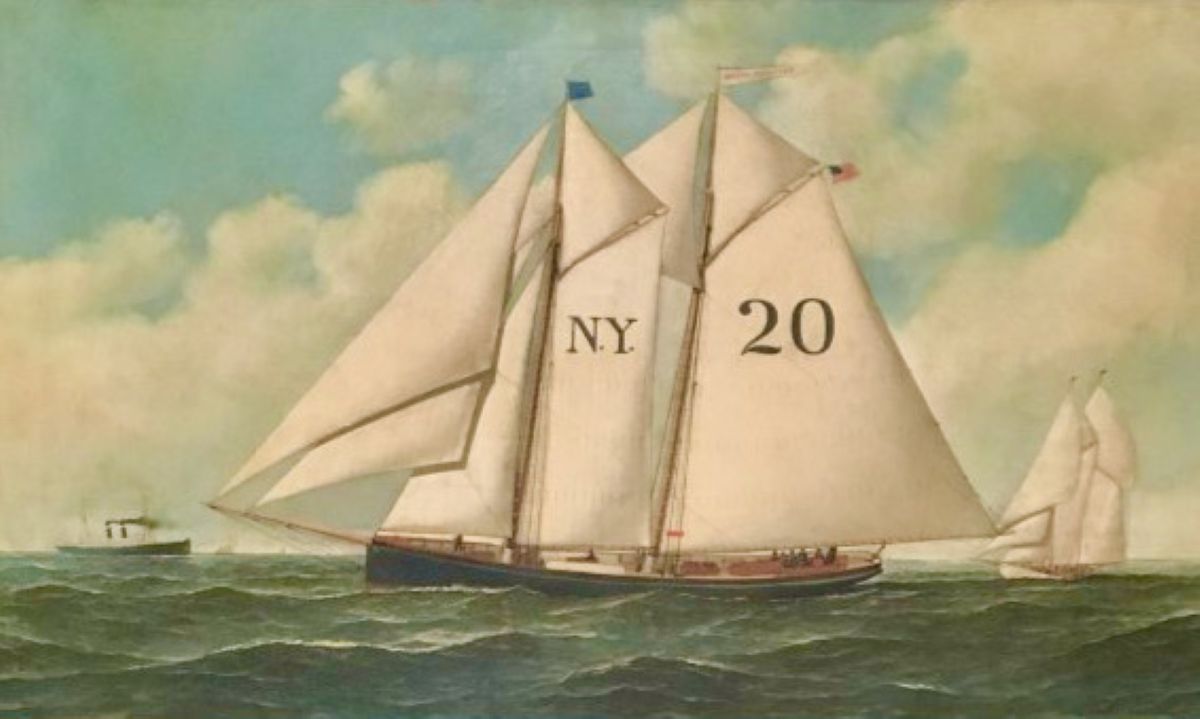
The schooner bearing Pulitzer’s name was created to replace the pilot boat Edward Cooper, No. 20, which sank off the coast off Sandy Hook during a snowstorm on Christmas Day in 1892. The number “20” was reassigned to the Joseph Pulitzer and painted on her mainsail. The launch of this vessel in Massachusetts was recounted in rather effusive terms in the next day’s edition of the Evening World. (This newspaper was likewise based in New York City and owned by Pulitzer; it served as an evening edition of the New York World.)
“There slid off the ways in Moses Adams’s ship-yard, as Essex, Mass., yesterday a triumph of the modern art of ship-building, in the shape of the new pilot boat, No. 20,” reported the Evening World. “She was christened the Joseph Pulitzer, and will be one of the fastest as well as finest of the white wings that sail out of New York harbor to meet incoming vessels.”
This article also highlighted several of the pilot boat’s measurements. “The length on the water line is 82 feet [25 meters] and the draught of water 11 feet [3.4 meters],” the Evening World noted in this regard. “These dimensions give her not only grace and plenty of speed, but according to the best marine authorities, she will ride a mountainous sea with ease and tremble not in a howling gale.”
Along with providing this flowery prose, the article confirmed that Sandy Hook pilot Jacob M. Heath (1850-1913) would be the captain of the Joseph Pulitzer. (He had served in the same role for the Edward Cooper.) The Evening World further stated, The [Joseph Pulitzer’s] crew will consist of four seamen, a boatkeeper, steward and cabin boy.”
This vessel’s maiden voyage out of Lower New York Bay as a pilot boat took place on March 26 of that year and amid strong and stormy winds in the region. “The new pilot-boat Joseph Pulitzer passed down the bay this morning on her first cruise,” reported that day’s edition of the Evening World. This article characterized the pilot boat as “carrying a full sail and presenting a beautiful marine picture.” The Evening World also asserted, “The seams in her canvass creaked under the powerful nor’wester that was blowing, but the vessel stood up like a church and went tearing through the murky waters in a fashion that proved that she was speedy as well as able.”
Notwithstanding all of this positive press coverage early on in her career, the Joseph Pulitzer’s work as a Sandy Hook pilot boat ultimately proved to be short-lived. Early in 1896, the vessel became one of 16 sail-powered pilot boats in the New York area that were removed from service and replaced with steam-powered boats.
The Joseph Pulitzer eventually ended up at the port city of Astoria, Oregon, to serve as a pilot boat in that part of the United States. The Oregonian reported in August 1898, “The pilots are well satisfied with the Joseph Pulitzer, which was given her first trial the past few days.”
The vessel went on to operate as a pilot boat in Pacific Northwest over the next several years. By 1920, however, she was being used instead to transport mail between the city of Seward and the Aleutian Islands in the then-territory of Alaska. The Joseph Pulitzer met her end on December 18 of that year after sinking in Aniakchak Bay along the Aleutian Peninsula. Unlike the members of her crew, the Joseph Pulitzer did not survive that disaster.
The accompanying image of the Joseph Pulitzer is a painting created sometime around 1895 by maritime artist Antonio Jacobsen (1850-1921).
Image Credit: Public Domain
Additional information on the pilot boat Joseph Pulitzer, No. 20, is available at https://www.newspapers.com/article/the-evening-world-pilot-boat/72518389/

 Transportation History
Leave a comment