May 2, 1810
A groundbreaking ceremony was held in southeast Washington, D.C., for a new canal. Those attending this event included James Madison (1751-1836), who served as the fourth U.S. president from 1809 to 1817.
The building of the Washington City Canal reflected the widespread enthusiasm during that era for waterways that would help facilitate and strengthen economic development throughout the relatively new country. Work on the Washington City Canal was significantly delayed because of the War of 1812, which included the burning of Washington by British troops in the summer of 1814. Following the official end of this war early in 1815, however, construction on the canal resumed. The Washington City Canal was formally completed and opened by the end of that year.
The Washington City Canal, which had been designed to accommodate vessels drawing only three feet of water or less, served as a link between the Anacostia River — known at the time as the Eastern Branch — and both the Potomac River and its tributary named Tiber Creek. Starting in 1833, the canal was also connected with the Chesapeake & Ohio Canal. These canals were joined together with a lock built in northwest Washington; by 1837, a lockkeeper’s house had been constructed at that location.
Over the years, several renovations and repairs were made to the Washington City Canal. The major challenges involving this canal were its shallow depth and the consequent impact of the Eastern Branch’s fluctuating tidal patterns. All of this resulted in the canal sometimes overflowing its banks at high tide and being plagued on other occasions by inadequate water levels at low tide. Congress eventually appropriated additional funds in the hope of addressing these structural problems and others. Ultimately, though, this canal as well as the much lengthier C&O Canal faced increasingly stiff competition from railroads in the region.
The Washington City Canal fell into complete disuse as a transportation route by the late 1850s. During the American Civil War that followed shortly thereafter, this infrastructure was repurposed as both a sewer and storm drain system for the city’s central area. The final fate of the one-time canal was slowly sealed during the long stretch of time between 1871 and 1930, when all of the portions of that route were either filled in or covered over.
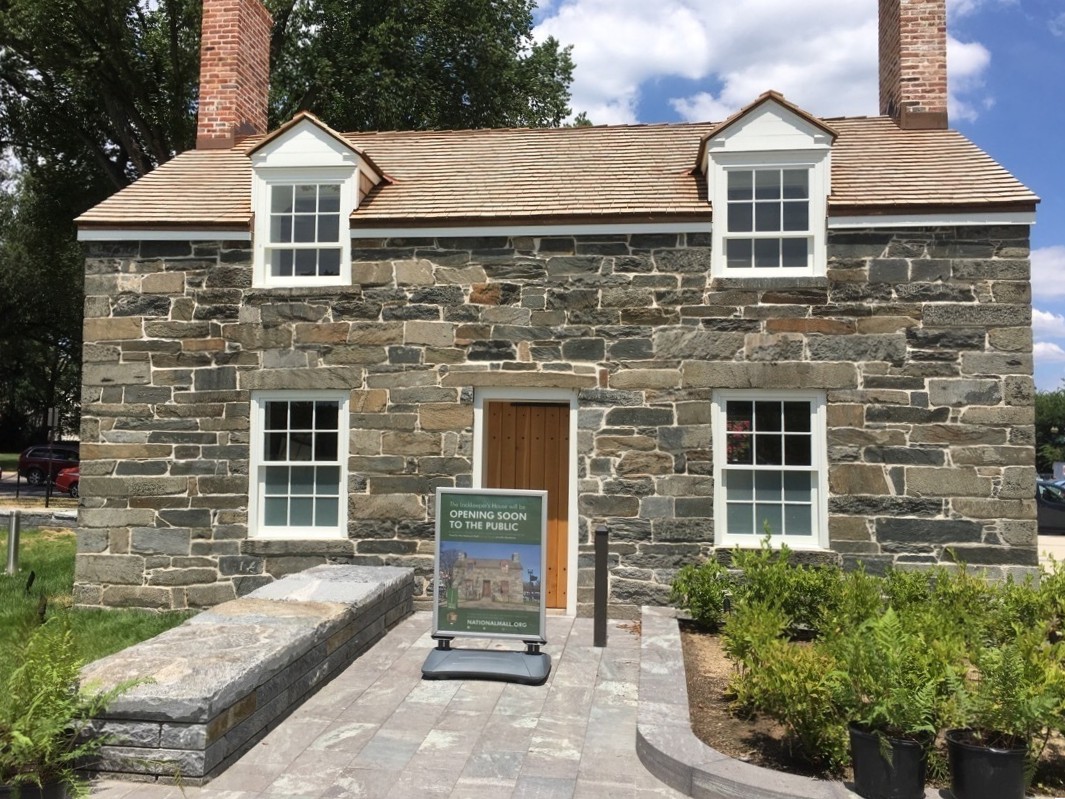
The one part of the Washington City Canal that remains intact today is the aforementioned lockkeeper’s house, which stands at the southwest corner of Constitution Avenue, N.W., and 17th Street, N.W. This house has the distinction of being the oldest existing structure on the National Mall and it is featured in the accompanying photo taken by a National Park Service employee in 2018.
Photo Credit: National Park Service
For more information on the Washington City Canal, please check out https://en.wikipedia.org/wiki/Washington_City_Canal

 Transportation History
Leave a comment