August 22, 1945
A cargo ship named after the capital of Louisiana was launched at Bethlehem-Fairfield Shipyards in Baltimore. SS Baton Rouge Victory was one of the vessels known as Victory ships. A large number of these ships were built during World War II to help transport cargo for the United States in its global fight against the Axis powers. The Wednesday afternoon launch of Baton Rouge Victory occurred a week after Emperor Hirohito announced Japan’s surrender to the Allies. (The formal surrender ceremony would be held aboard USS Missouri in Tokyo Bay on September 2.)
Notwithstanding the de facto end of the war at the time, the launch ceremony for Baton Rouge Victory took place as planned. The ship was christened by Baltimore resident Virginia F. Brown. Her husband Charles W. Brown Sr. was president of the Western Maryland Railway.
As a result of Japan’s surrender, Baton Rouge Victory was not deployed for service overseas. She was initially used instead for transporting cargo as needed on both the east and west coasts of the United States. In 1950, she was activated for military operations during the Korean War. Baton Rouge Victory made a total of eight trips to Korea between March 6, 1951, and March 28, 1952, to transport cargo such as mail and food. In addition, she became one of the merchant marine ships that were collectively responsible for transporting about 75 percent of American servicemen to Korea during that war.
Baton Rouge Victory took part in overseas military operations again in 1966, when she was activated for service in the Vietnam War. On July 28 of that year, she departed from San Francisco for Vietnam with cargo that included not only mail but also various military vehicles. There was a crew of 45 civilian sailors on board the ship for this trip.
On August 23 — just a little over 21 years after her launch — Baton Rouge Victory was severely battered by two large mines while traveling on the Lòng Tàu River. When this incident occurred, the vessel was about 22 miles (35 kilometers) southeast of what was then South Vietnam’s capital of Saigon (now called Ho Chi Minh City). Along with ripping a massive hole in the hull of Baton Rouge Victory and flooding the ship’s engine room, the mine explosions caused the deaths of seven sailors on board. This tragedy marked the largest loss of life for American merchant mariners due to a single enemy assault during the Vietnam War.
The men who died that day were:
Raymond C. Barrett (Sheboygan, Wisconsin);
John A. Bishop (New Orleans);
Earl T. Erickson (San Francisco);
James W. McBride (Hayward, California);
Timothy M. Riordan (San Francisco);
Albert J. Rowe (Los Angeles); and
Charles D. Rummel (Paradise, California).
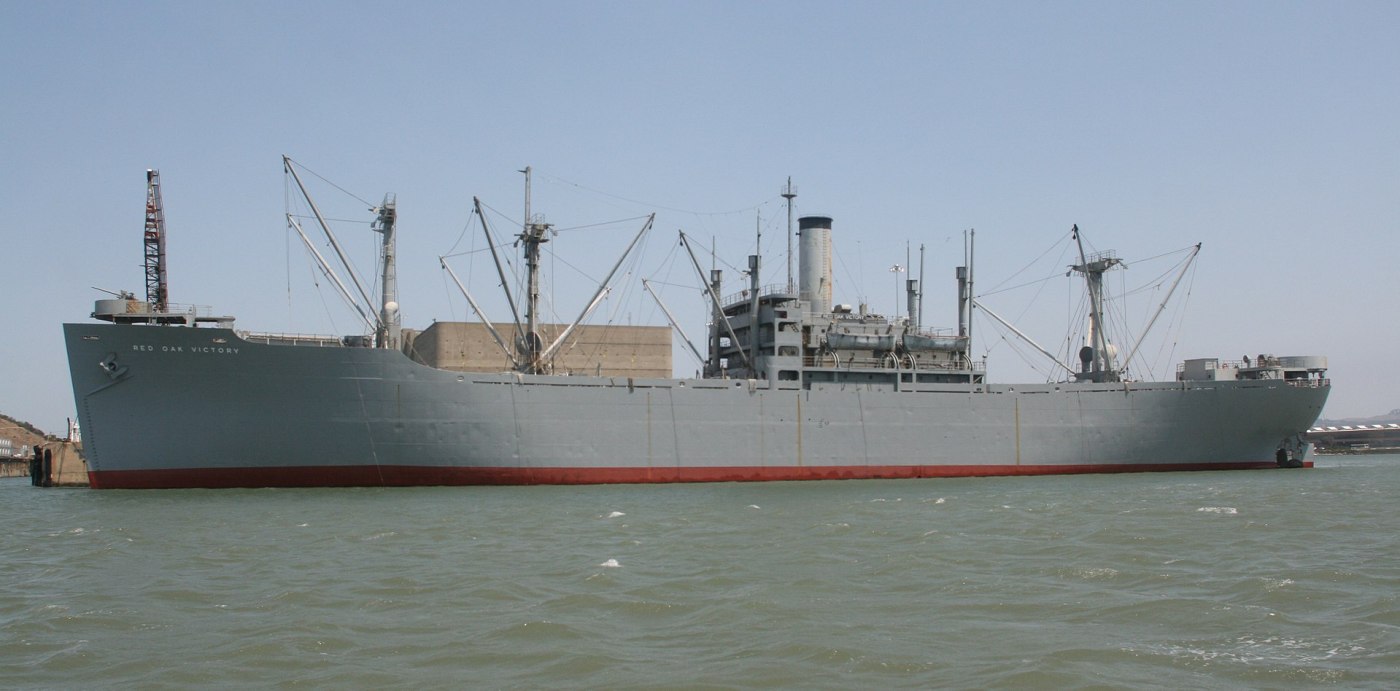
On August 30, the damaged Baton Rouge Victory was hauled to the city of Vũng Tàu in southern Vietnam. Her final fate took place in 1967, when she was towed to the Taiwanese city of Hualien to be scrapped. (The vessel depicted in the accompanying photo is SS Red Oak Victory, a still-existing Victory ship with a close resemblance to Baton Rouge Victory.)
Photo Credit: Public Domain
Additional information on the Victory ships is available at https://en.wikipedia.org/wiki/Victory_ship

 Transportation History
Leave a comment