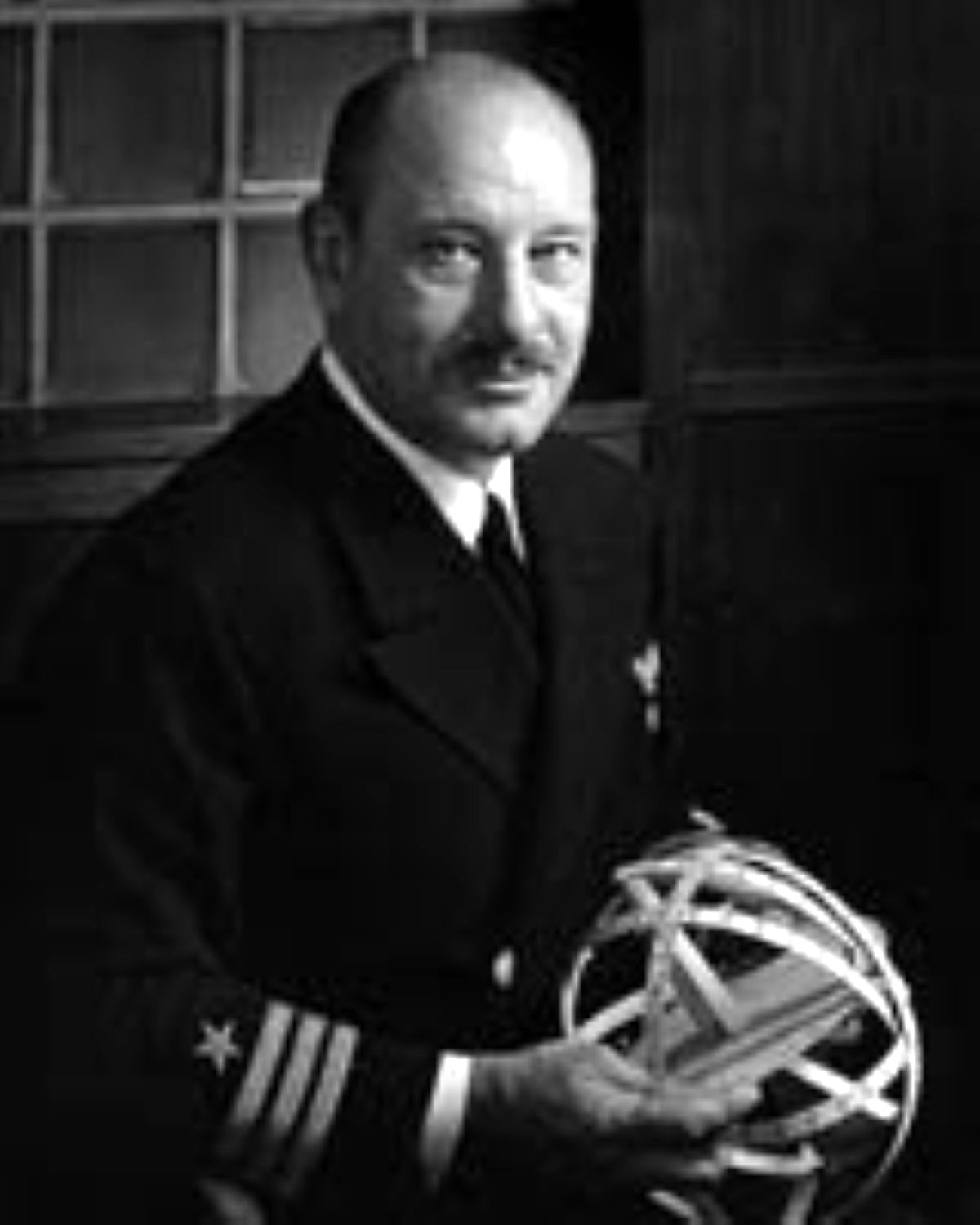
Luis Ramón de Florez, who earned renown as a U.S. Navy aviator and officer, was born in New York City on March 4, 1889. His father Raphael V. de Florez was Spanish and his mother Marie Stephanie (Bernard) de Florez was French. Luis Ramón de Florez attended preparatory schools in both Paris, France, and the Long Island village of Garden City.
In 1912, de Florez graduated from the Massachusetts Institute of Technology (MIT) with a bachelor of science degree in mechanical engineering. During his time at MIT, he wrote the first thesis on aeronautics to be presented at that educational institution. The title of this presentation was “Thrust in Flight of Propellers.” It was also in 1912 that de Florez first started flying planes. These flights took place at the plant for the plane manufacturer Burgess Company in Marblehead, Massachusetts.
Just a few years after graduating from MIT, de Florez served during World War I as inspector of naval construction (aviation) in the U.S. Navy Department’s Bureau of Construction and Repair. His major accomplishments involved organizing the bureau’s Division of Aircraft Instruments and Accessories.
De Florez’s notable aviation achievements during the time between both world wars included being granted a commercial pilot’s license in 1931 and a transport pilot’s license the following year. He was commissioned a lieutenant commander in the U.S. Naval Reserve (now known as the U.S. Navy Reserve) in 1934. During the summers of 1937 through 1939, de Florez underwent additional flight training at the Naval Reserve Aviation Base in Brooklyn, New York. He was called to active duty in April 1940.
On June 29 of that year, de Florez was officially designated a naval aviator after further training at the Naval Air Station in Pensacola, Florida. He was promoted to commander just a little over a month later. The following month, de Florez reported to the Navy Department’s Bureau of Aeronautics. He first assumed the role of special assistant to the bureau’s chief and then went on to serve in the engineering and training divisions. On November 14, 1942 – nearly a year after the United States’ entered World War II on the side of the Allies – de Florez was promoted to captain.
De Florez’s pivotal wartime contributions included stepping in as director of the Special Devices Division of the Bureau of Aeronautics in 1943. In this capacity, he took the lead in evaluating military aviation training equipment uses and needs in the various war theaters across the globe. In 1944, de Florez received the Robert J. Collier Trophy (awarded annually by the National Aeronautics Association) for his “contribution to the safe and rapid training of combat pilots and crews” and other aviation accomplishments.
De Florez’s post-World War milestones included achieving flag rank status when he was promoted to rear admiral on November 2, 1945. In addition, he served as president of the Flight Safety Foundation during the 1950s. De Florez died in November 1962 at the age of 73. He had been admitted to a hospital after being found slumped in the cockpit of his personal plane on the Fishers Island Airport runway in Suffolk County, New York.
Photo Credit: Public Domain
Additional information on Hispanic Americans who have served in the U.S. Navy is available at https://en.wikipedia.org/wiki/Hispanics_in_the_United_States_Navy

 Transportation History
Leave a comment