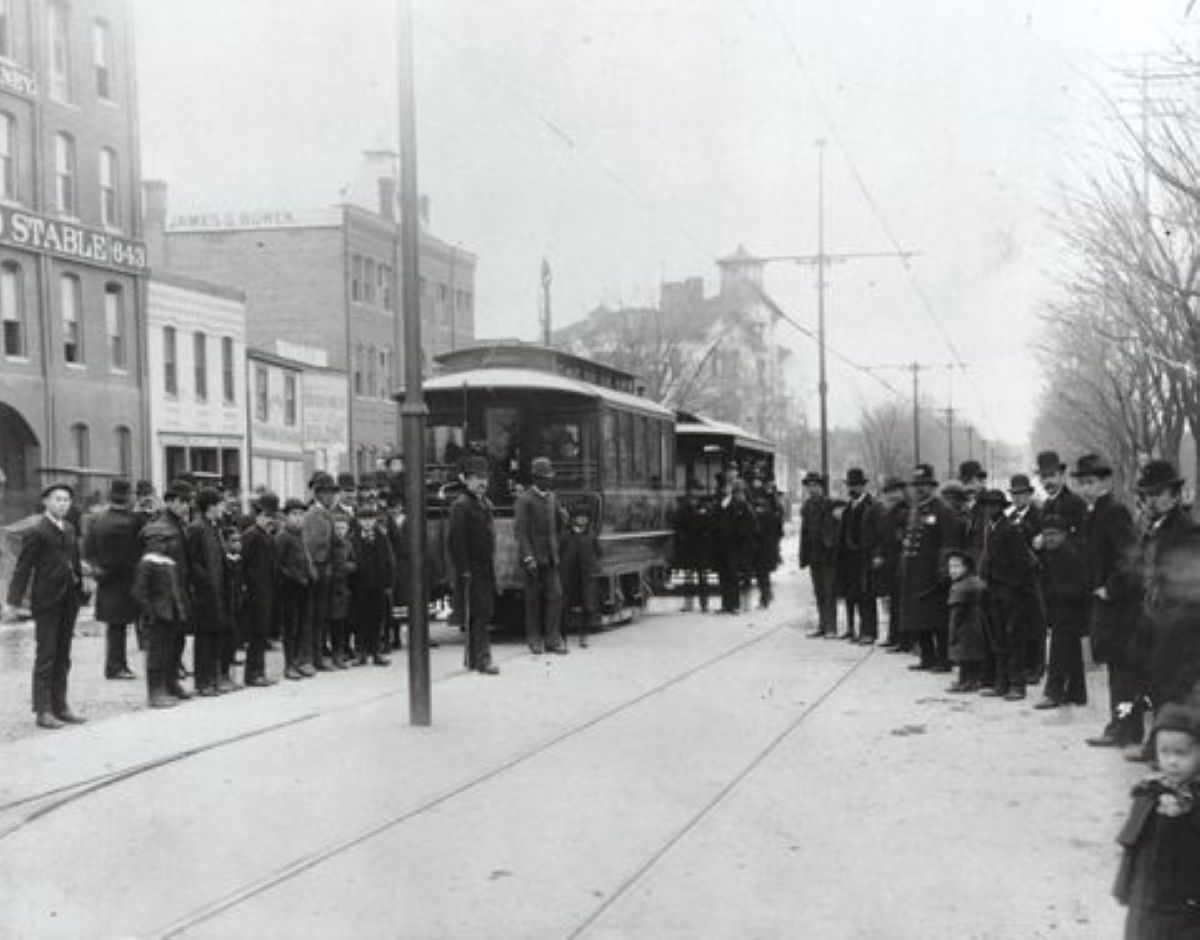
October 17, 1888
The Eckington & Soldiers’ Home Railway became the first electric streetcar service to begin operations in Washington, D.C. The company’s streetcars initially ran along tracks from the intersection of Seventh Street and New York Avenue, N.W., in the downtown area — and near the Soldiers’ Home that had been in existence in that vicinity since 1851 — to a car barn at Fourth and T Streets, N.E., in the heart of the Eckington neighborhood. (In 1889, this line would be extended up Fourth Street to Michigan Avenue, N.E., and the recently established Catholic University of America.) The original cost for a one-week pass to ride on these streetcars was $1.25.
The charter for this pioneering streetcar service had been granted in June of that year. Just a few months prior to that, inventor Frank J. Sprague installed new kind of streetcars system in Richmond, Virginia. These experimental streetcars relied on overhead wires for electricity that proved to be more reliable than a third rail between two riding rails for moving vehicles forward. This successful streetcar model opened a new world of public transit possibilities. Similar networks were soon adopted in a large number of municipalities, including the nation’s capital.
The debut of the Eckington & Soldiers’ Home Railway was greeted with a great deal of enthusiasm in Washington, D.C. Approximately 5,000 passengers rode on the company’s streetcars on the opening day alone. The accompanying photo of this railway line was taken on that day.
In reporting on one of the first runs of these streetcars, the Washington-based Evening Star captured the breathtaking technological novelty and sheer excitement of the city’s newest type of public transportation. “Flying along New York avenue, which is brilliantly lit at night by the cluster of electric lights at the top of the iron poles, the occupants of the car became conscious that they were creating something of a sensation,” asserted the newspaper. “People came rushing out from their houses and crowded along the line of the road to see this new prodigy – and they saw it. They saw a brilliantly lighted car filled with people flying along the streets with no apparent motive power.”
The Evening Star further noted, “Some cheered and clapped their hands. Others got down on their knees to see what contrivance beneath the car made the wheels go round, while others tiptoed up to inspect the top and try to discover the secret there.”
The major force behind this trailblazing streetcar line was Eckington resident and real estate entrepreneur George H. Truesdell, who sought a means of rapid transport between the city center and his growing community. The Eckington & Soldiers’ Home Railway also set the pace when it came to harnessing and using electrical power in general within Washington, D.C. About two years after the company’s streetcars began running, for example, the White House was first wired for electricity.
Photo Credit: Public Domain
For more information on the Eckington & Soldiers’ Home Railway, please check out https://planning.dc.gov/sites/default/files/dc/sites/op/publication/attachments/Eckington_Brochure.pdf and https://ggwash.org/view/74449/how-dcs-first-electric-streetcar-helped-build-eckington-washington-dc

 Transportation History
Leave a comment