November 19, 1914
The week before Thanksgiving, several race car drivers were gathered in the city of Corona, California, to get ready for the big day. They were not focused on generous helpings of food and gratitude, but rather on something far different: practice runs in their automobiles for that following Thursday’s 109-lap, 300-mile (482.8-kilometer) competition known as the Great Corona Speed Contest.
By this time, the love affair that many Americans had with automobiles extended beyond just using those vehicles for their own business and recreational purposes. It also included enjoying increasingly popular car races. The Indianapolis Motor Speedway had been built about five years earlier, for example, and the first version of the Indianapolis 500-Mile Race took place there in 1911.
Another major car racing event in the United States that had taken firm hold in the public mind by that time was the Vanderbilt Cup; the film Kid Races at Venice, which was released earlier in 1914 and introduced the world to Charlie Chaplin (1889-1977) as his now-iconic Little Tramp character, was shot during an actual junior-level version of that competition for younger would-be drivers.
The citizens of Corona, seeking to both capitalize on that national race-car craze and bolster the financial fortunes of their community, decided to launch their own racing competition. The city’s circular main street of Grand Boulevard, a dirt road which had been designed by civil engineer Hiram Clay Kellogg (1855-1921) and measured 2.8 miles (4.5 kilometers) around an even mile (1.6 kilometers) in diameter, was adapted for use as an automotive race course.
The first races there took place in September 1913 and proved to be a big success. At least 65,000 people attended the event, and Corona Auto Club netted $1,571.75 for itself. In addition, several new world racing records were set by the participating drivers. The winner of the main event, the “free-for-all” race, was Earl Cooper (1886-1965) driving a Stutz automobile.
Given the huge popularity of this inaugural race, there was no doubt that a similar event would take place in 1914. The date for those races, however, was pushed ahead to Thanksgiving on the theory that the leisurely pace of that holiday would encourage even larger attendance.
Quite a few race car drivers again converged on Corona for the big event and, by November 19, were very much in preparation mode for hoped-for moment of Thanksgiving glory. The Los Angeles Times reported, “Twelve of the gasoline speed kings who are entered into the Corona races engaged in some spectacular brushes today.”
These drivers performing test runs around the course included Eddie Pullen, (1883-1940), who circled around that road at 96 miles (154.5 kilometers) per hour in his Mercer automobile. Then there was defending champion Cooper, who sped along one lap in his Stutz at what the Los Angeles Times called “a ninety-mile [144.8-kilometer] gait.”
The driver who outdrove all of them during that November 19 practice was 24-year-old Eddie Rickenbacher (1890-1973), who had participated in the previous year’s competition and now — in the words of the Los Angeles Times — “electrified the race fans” by negotiating a lap of that course in one minute and 39 seconds and at an average speed of 100 miles (160.9 kilometers) per hour while behind the wheel of a large Peugeot automobile.
“Eddie Richenbacher [sic] Shatters Records on Corona Circle,” proclaimed the headline for the Los Angeles Times article on that dry run. Smaller headlines beneath that one included “Gee, Whiz!,” “Peugeot Will Be Sensation,” and “Makes Wonderful Time When Trying Out.”
Rickenbacher would slightly modify his last name just a few years later to “Rickenbacker” and earn considerably more fame for his contributions to another mode of transportation. As a World War I airplane pilot, he became that military conflict’s most successful fighter ace and a legendary Medal of Honor recipient. He went on to distinguish himself even further as an air transportation pioneer, particularly as the longtime head of Eastern Air Lines. (To avoid potential confusion, he will continue to be mostly referenced as “Rickenbacher” in the remainder of this post.)
As of 1914, Rickenbacher was best known for his accomplishments with automobiles. That means of transportation, as a matter of fact, was both his livelihood and passion. As far back as his childhood, he had a great deal of enthusiasm for machines. In his quest to better understand how machines work, Rickenbacher even enrolled in a correspondence course on engineering. His strong interest in this subject area inevitably drew him to automobiles. Rickenbacher found employment with the Columbus Buggy Company, ultimately becoming a salesman for that business, and eventually embarked on a career as a race car driver.
Nicknamed “Fast Eddie” for his exploits behind the wheel, Rickenbacher participated in numerous races — including the Indianapolis 500 in 1911, 1912, and 1914 — prior his second go-around on the course in Corona. An estimated 100,000 people showed up for that holiday competition to watch 19 drivers race against each other.
While dazzling both the crowd and the press during the November 19 practice, Rickenbacher fell short in the actual “free-for-all” event on Thanksgiving. He initially led the race, but the drive shaft in his Peugeot failed after only 37 laps around the course. He finished in 15th place. That year’s victor was Pullen, who won in three hours and 26 minutes and at an average speed of 87.8 miles (141.3 kilometers) per hour.
Even though he focused more on aviation in the next few years and achieved lasting fame with that transportation mode, Rickenbacher did not forsake automobiles altogether. He launched the Rickenbacker Motor Company and manufactured technologically advanced automobiles that incorporated several car-racing innovations. These innovations included the first commercial four-wheel-brake system, which is now a standard feature of American motor vehicles.
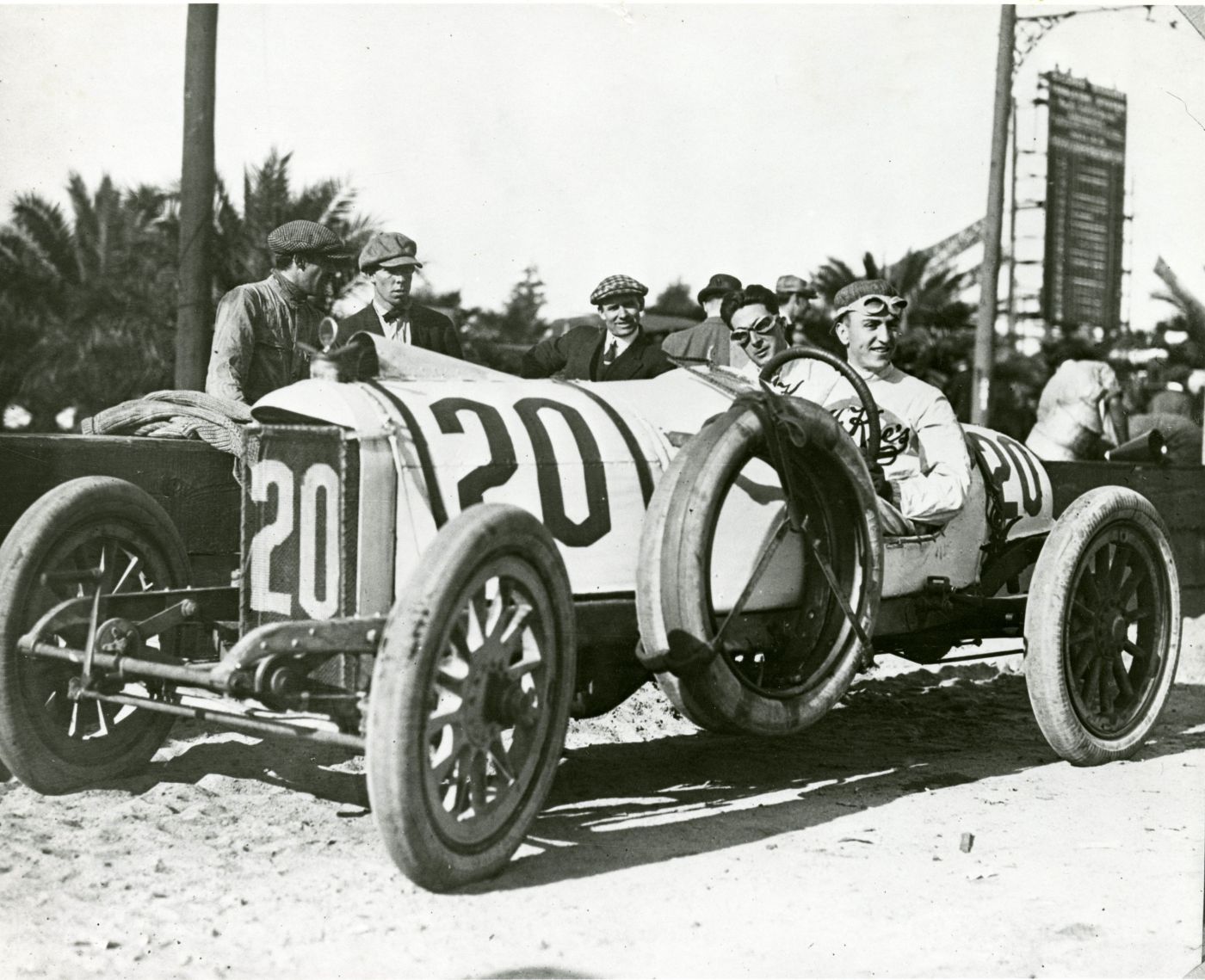
In 1927, Richenbacher bought the Indianapolis Motor Speedway and oversaw many improvements to that facility during the decade-and-a-half that he owned it. In 1994 — just a little over two decades after his passing — he was inducted into the Motorsports Hall of Fame of America. (The accompanying photo of Rickenbacher behind the wheel of a race car — believed to be either a Duesenberg or Mason — was taken sometime around 1914.)
Photo Credit: The Auburn University Libraries (https://content.lib.auburn.edu/digital/collection/eddier/id/906)
For more information on the car racing career of “Fast Eddie” Rickenbacher (better known today as Eddie Rickenbacker), please check out https://www.nationalmuseum.af.mil/Visit/Museum-Exhibits/Fact-Sheets/Display/Article/1419324/eddie-rickenbacker-race-car-driver/ and https://www.vanderbiltcupraces.com/drivers/bio/rickenbacker

 Transportation History
Leave a comment