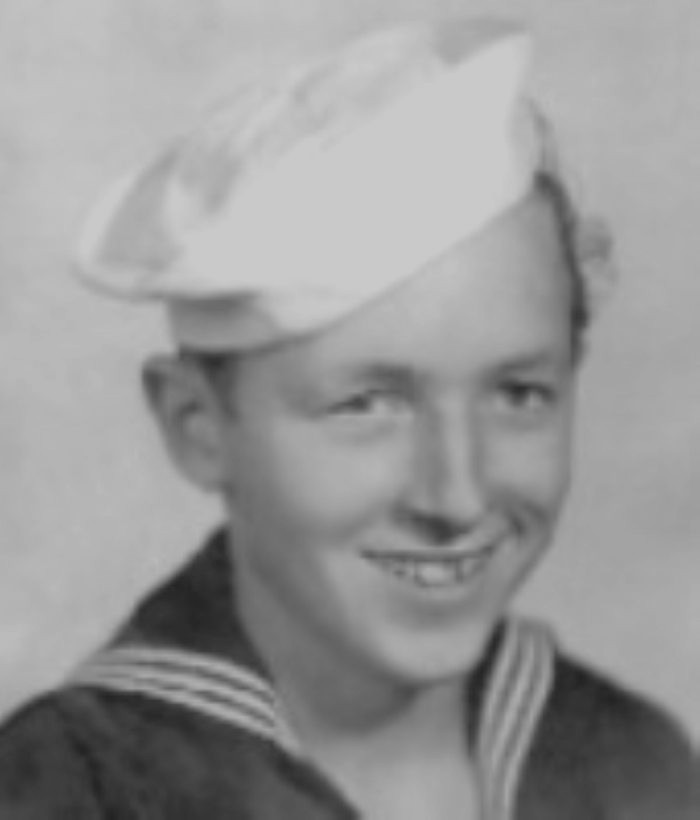
In 1943, James Joseph “Jim” Leftwich became the youngest known enlistee in the U.S. Coast Guard (USCG). Leftwich, a member of the Chickasaw Nation (a federally recognized tribe), was only 14 at the time.
In a 1968 interview with Baltimore Sun reporter Alan Z. Forman, Leftwich addressed how — despite being younger than the legal minimum age for enlistment — he was able to join the USCG. Leftwich asserted that what made this possible in the first place was the fact was that, with the country heavily embroiled in World War II, the U.S. military was “slack on birth-certificate requirements” at the time. Forman noted in his subsequent article, “Leftwich said his reason for enlisting — and falsifying his age — was America’s critical wartime need for merchant seamen.”
Leftwich was born in Waco, Texas, on February 3, 1929. He spent much of his youth in Tulsa, Oklahoma, where he attended school up until he joined the USCG. While serving as a seaman first class in the Pacific Theater in 1944. Leftwich suffered combat wounds during the Battle of Eniwetok Atoll within the Marshall Islands. He subsequently set a still-intact record as the youngest-ever coast guardsman to be awarded the Purple Heart.
Leftwich remained in the USCG after the end of World War II. When he was promoted to chief boatswain’s mate in 1954, he became only the third Native American to achieve this rank. In 1957, Leftwich achieved yet another milestone when he was among the officer candidates to be commissioned ensigns at the U.S. Coast Guard Academy. This elevation in rank made him the second known Native American officer in that uniformed service. In addition, Leftwich graduated at the top of his class with an academic average of 88.9 .and was given the Superintendent’s Award (an engraved officer’s sword) for this accomplishment.
In 1964, Leftwich retired from the USCG with the rank of lieutenant (junior grade). Over the next several years, his employers included the Texas Highway Department (the present-day Texas Department of Transportation). Ulitmately, however, Leftwich decided to return to maritime life. “It kind of gets in your blood,” he said about the sea during his 1968 interview with Forman.
Leftwich sought to join the Merchant Marines, a longtime organization consisting of non-military mariners who serve on board both civilian and federally owned vessels. The mission of these mariners includes carrying cargo via navigable waters of the United States. To receive the needed certification, Leftwich studied at the Masters, Mates and Pilot Academy in Baltimore. He eventually transported oil and chemicals for companies such as Keystone Shipping and Sabine Towing & Transportation. The vessels under his command during this stage of his career included SS Brazos and SS Keystoner.
In a letter that was published by the Waco Tribune in 1977, Leftwich made clear his strong commitment to the Merchant Marine. “The Merchant Marine played a vital part in achieving and maintaining the independence and prosperity our country enjoys,” stated Leftwich. “We feel entitled to share in those blessings in proportion to our efforts, our skills, and the risks and hardships we assume in pursuing our profession in marine transportation – the most hazardous and demanding.”
Leftwich’s service on behalf of this organization also involved being a member of the Merchant Marine Personnel Advisory Committee. This committee, sponsored by the USCG, was created to advise the U.S. Department of Transportation on Merchant Marine matters that pertain to training, qualifications, certification, and fitness standards.
In 1994, Leftwich retired from the Merchant Marine. He died on March 27, 2012, in the city of Hewitt, Texas. Both Leftwich and his wife Mamie, who passed away in 2014, are buried at Waco Memorial Park in the nearby city of Robinson.
Photo Credit: U.S Coast Guard
For more information on James J. Leftwich, please check out https://www.vlm.cem.va.gov/JAMESJLEFTWICH/36AB4B and https://www.findagrave.com/memorial/87468251/james-joseph-leftwich
Additional information on Native Americans who have served in the U.S. Coast Guard is available at https://www.mycg.uscg.mil/News/Article/3960619/native-americans-in-the-coast-guard/

 Transportation History
Leave a comment