January 14, 1890
The Board of Commissioners governing Washington, D.C. at the time officially authorized changing the name of Boundary Street in the city. The origins of this street can be traced to January 24, 1791, when President George Washington (1732-1799) selected portions of both Maryland and Virginia as the site for the new capital city of the then-fledgling United Station.
Washington’s decision took place more than a half-year after Congress had formally approved the creation of a capital somewhere along the Potomac River. Less than eight months after Washington chose the location for the capital, the three commissioners overseeing the construction efforts officially named the city after our first president.
As part of his urban design for the city, French-born artist and military engineer Pierre Charles L’Enfant (1754-1825) identified one of the major streets to be built as Boundary Street. This street was so named because it would form the planned city’s northern boundary. It was not until 1818 that the first segment of Boundary Street — a section between North Capitol Street and 2nd Street, N.E. — was opened. Within the following decade, the street was extended as far as 19th Street, N.W.
As the nation’s capital subsequently continued to expand beyond L’Enfant’s original blueprint for it, Boundary Street no longer marked the northern edge of the city. This ultimately became the key reason why the Board of Commissioners gave the street a new name in 1890. “Boundary Street No Longer,” announced a headline in the Washington Post the day after that decision was made. “It Will Be Known as Florida Avenue in the Future.”
This article confirmed that “the Commissioners decided that the name of that street, which extends from the Benning’s road northeast to the Massachusetts Avenue northwest, shall be changed to Florida avenue and the engineer department will have the name changed on all the lamp posts along the street in accordance with the Commissioners’ decision.”
The Washington Post also made clear that, nearly a century after Boundary Street was first referenced as a component of the L’Enfant Plan, local residents played a decidedly assertive role in having that thoroughfare renamed something else. The newspaper reported, “For some time past the Commissioners have been receiving complaints that the mere name Boundary street has caused property in that section to deteriorate in value, and many requests have been received for the change which has at length been made.”
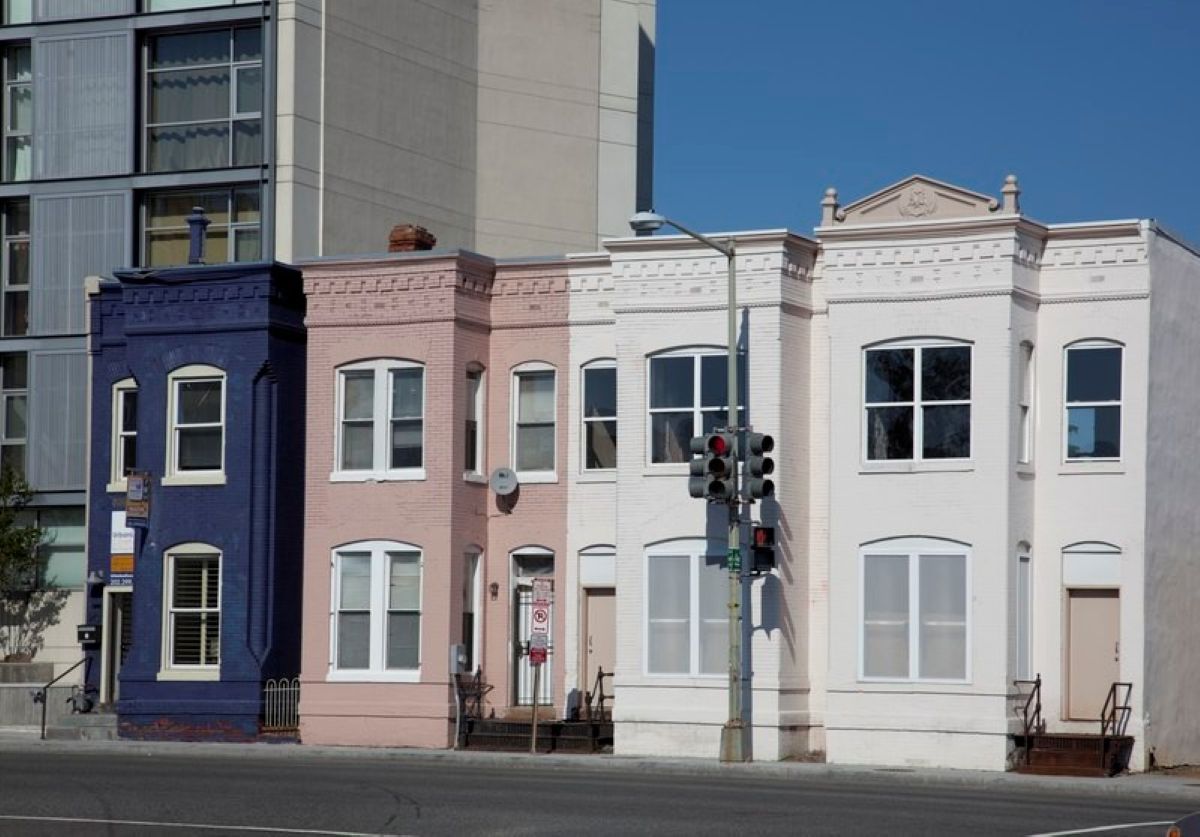
In other words, ongoing concerns about the peripheral connotation of the very name “Boundary Street” — especially after the route was no longer the northernmost point of the city — led to strong demands to replace that appellation with something more inviting. All these years later, Florida Avenue remains the name for what was once known as Boundary Street. This street now bearing the Sunshine State’s name has also become one of the busiest crosstown thoroughfares in Washington. (The accompanying picture of rowhouses along Florida Avene, N.W., was taken by photographer and author Carol M. Highsmith [born in 1946].)
Image Credit: The George F. Landegger Collection of District of Columbia Photographs in Carol M. Highsmith’s America, Library of Congress, Prints and Photographs Division; forms part of the George F. Landegger Collection of District of Columbia Photographs in Carol M. Highsmith’s America Project in the Carol M. Highsmith Archive (https://loc.gov/pictures/resource/highsm.09969/).
For more information on Florida Avenue in Washington, D.C., please check out https://en.wikipedia.org/wiki/Florida_Avenue

 Transportation History
Leave a comment