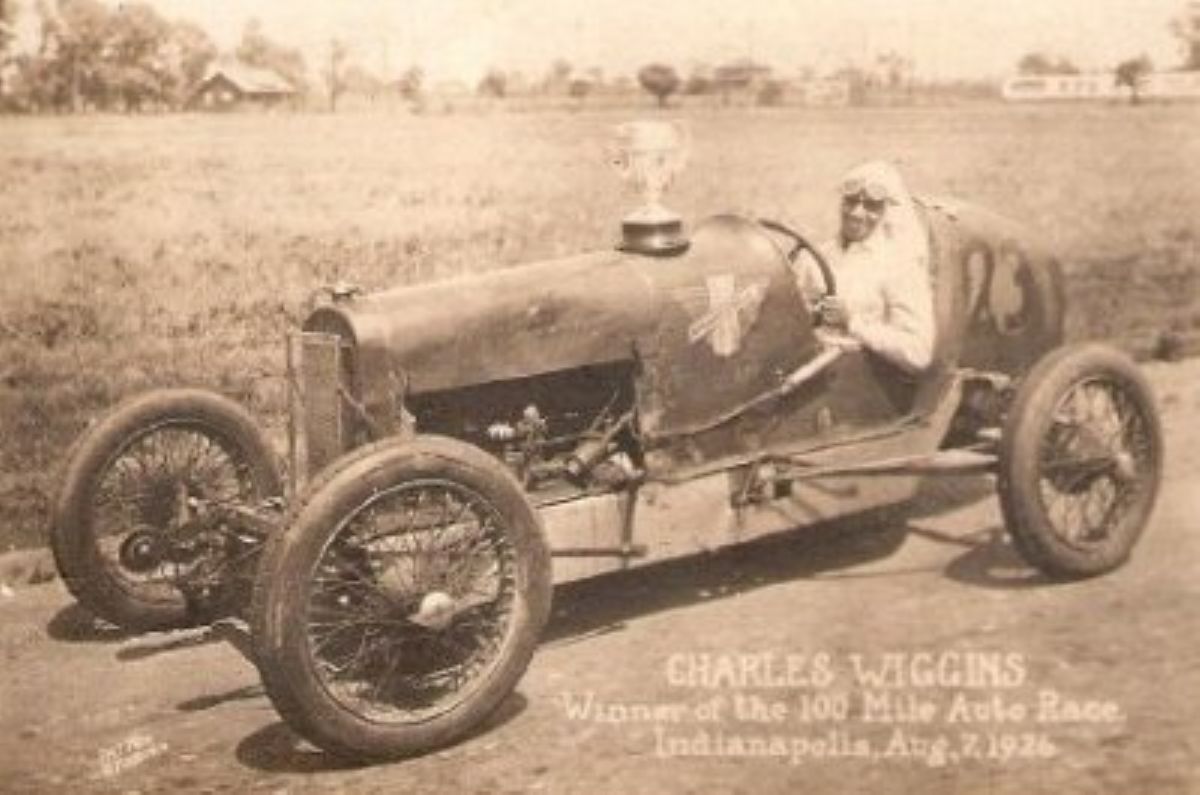
Charles Edwin “Charlie” Wiggins gained an enviable reputation when it came to automobiles, whether his endeavor at any given time involved repairing and refining those motor vehicles or competing in car races. He was born on July 15, 1897, in Evansville, Indiana. Wiggins’ mother died when he was only nine years old, and he stopped going to school at the age of 11 so that he could work to help financially support his father and siblings.
Charlie ended up shining shoes to earn money. He set up a shoeshine stand for this job outside an automobile dealership. During his downtime from polishing footwear at that location, Wiggins would closely observe mechanics working on automobiles in the dealership’s service shop. This was his introduction to that trade and both the diagnostic and technical skills needed for it, and he eventually persuaded the dealership’s management to hire him as an apprentice in that shop. Within just a few years, Wiggins — the only black person in an otherwise all-white crew of mechanics — became the lead technician on the shop floor.
In 1922, Wiggins and his new wife Roberta moved to Indiana’s capital city of Indianapolis so that he could use his now-formidable technical expertise to pursue even better job opportunities. He ultimately secured a high-ranking position at an automobile repair garage in the Southside area of the city. When the owner of this garage retired a couple of years later, Wiggins bought out the business from him.
It was during this decade that Wiggins first developed a strong interest in competing in car races. Since he was barred from participating in the International 500-Mile (804.7-Kilometer) Sweepstakes Race at the Indianapolis Motor Speedway due to the color of his skin, Wiggins instead focused on events open to black competitors.
In 1925, Wiggins made a promising but ultimately unsuccessful attempt to finish first in that year’s Gold and Glory Sweepstakes race of the Colored Speedway Association (CSA). This annual event, which involved requiring racecar drivers to cover a total of 100 miles (160 kilometers) in order to have a chance of winning, was held on a mile (1.6-kilometer)-long oval-shaped dirt track at the Indiana State Fairgrounds in Indianapolis.
Wiggins, motivated by the speed and skills that he had shown during that race, took part in the entire season of CSA competitions in 1926. In doing so, he proved to be virtually unbeatable in just about every racing event. Wiggins, driving his automobile with a uniquely fuel-efficient engine that he had built, won that year’s Gold and Glory Sweepstakes by two indisputable laps. He also emerged victorious in at least seven other CSA races during this season.
Wiggins went on to win three more Gold and Glory Sweepstakes races. As further testimony to his topnotch mechanical abilities and well-earned reputation for high-quality preparation when it came to car races, he was recruited as part of the crew for William “Wild Bill” Clarence Cummings at the 22nd International 500-Mile Sweepstakes Race at the Indianapolis Motor Speedway. Cummings, driving at an average speed of 104.9 miles (168.8 kilometers) per hour, won this race. Despite Wiggins’ role in helping to make this triumph possible, segregationist practices in effect at the time at the speedway prevented him from standing in Victory Lane with his fellow crewmates after the race.
Wiggins’ own racing career came to an end during the second lap of the 1936 Gold and Glory Sweepstakes. He was among those involved in a 13-car accident that took place after another driver lost control of his own vehicle. As result of this chain-reaction collision, Wiggins lost his right eye and eventually had to have his severely injured right leg amputated.
Wiggins, who had no other choice but to retire from racing altogether, remained in constant pain throughout the remainder of his life. Along with the physical struggles resulting from that fateful accident, he had to contend with costly medical bills that left him nearly penniless. Notwithstanding these hardships, Wiggins found later-in-life purpose as a mentor for young racecar drivers and a staunch opponent of policies in this motorsport that discriminated against blacks. He also continued repairing automobiles.
Wiggins died in Indianapolis on March 11, 1979, at the age of 81. Since their loved ones could not afford to purchase a headstone, both Wiggins and his wife Roberta — who passed away in 1998 at the age of 102 — were buried in an unmarked grave. In 2003, though, a headstone for this couple was finally donated to the surviving members of the Wiggins family at a memorial ceremony at Crown Hill Cemetery in Indianapolis. This headstone features a photo of Charlie and Roberta Wiggins in his racecar following his victory in the 1926 Gold and Glory Sweepstakes; the trophy that he was awarded can be seen atop the vehicle. In 2021, Charlie Wiggins was inducted into the Automotive Hall of Fame in Detroit.
Photo Credit: Public Domain
For more information on Charlie Wiggins, please check out https://indyencyclopedia.org/charles-edwin-charlie-wiggins/

 Transportation History
Leave a comment