March 25, 1940
An open house for the public was held for a recently completed Greyhound bus terminal at 1100 New York Avenue in northwest Washington, D.C. This open house, which was formally classified as a public preview, took place between 4:00 and 9:00 p.m. on the day before the actual start of bus operations at the terminal.
Thousands of people showed up to check out the newest transportation facility in the nation’s capital. “Souvenirs were distributed to the public during the late afternoon and evening preview,” reported the next day’s edition of the Washington-based Evening Star. “An orchestra and a number of swing dancers entertained visitors.”
This well-attended public preview had been preceded by inaugural festivities held from 2:00 to 4:00 that afternoon for Greyhound officials and their special guests. The company’s officials in attendance included Eric Wickman (1887-1954), the founder and president of Greyhound Lines; Orville Caesar (1892-1965), an inventor serving as Greyhound’s vice president; and Swan Ruben Sundstrom (1897- 1956), head of the company’s large-scale operations in Pennsylvania.
Another Greyhound official on hand for this big Monday afternoon event was Linwood C. Major (1893-1961), who wore a few hats for the company. Along with serving as the treasurer and assistant secretary for Greyhound, Major was the general manager for the company’s operations in the vicinity of Richmond, Virginia. In addition, he had taken on the managerial duties for Greyhound services in Washington and the surrounding area. As if all of these wide-ranging roles and responsibilities were not enough for him, Major was also the master of ceremonies for the VIP celebration of the soon-to-be-opened transportation infrastructure.
The other dignitaries on hand for this event included U.S. Army Colonel David McCoach Jr. (1887-1951), engineer commissioner for the District of Columbia; and Arthur M. Hill (1892-1972), the founder and president of the National Association of Motor Bus Operators. With the stage set by both this event and the public preview that followed, operations at the terminal began very early the next day — when the first bus arrived there at a minute past midnight, to be exact.
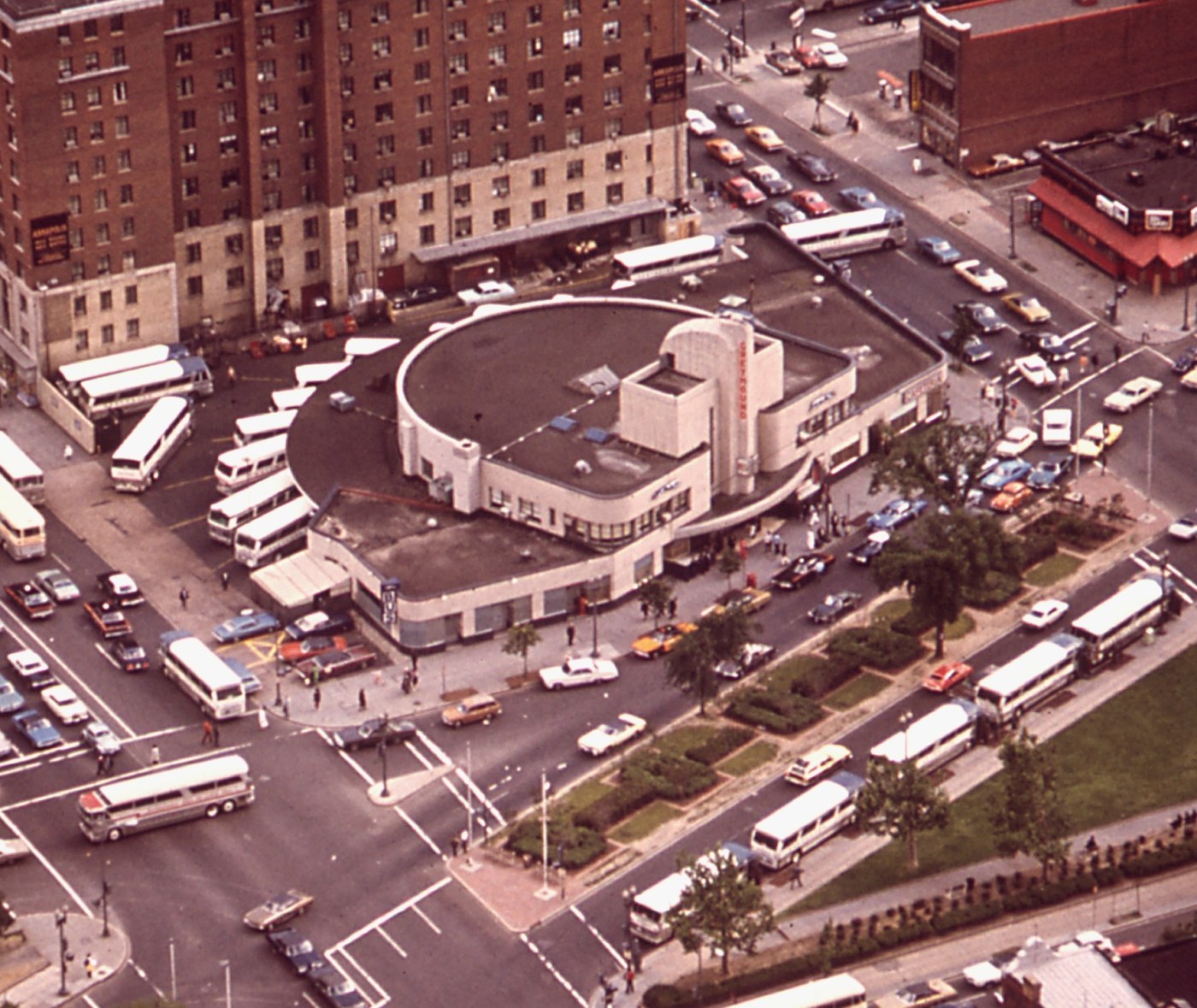
This Art Deco-style building was designed by the prodigious architect William S. Arrasmith (1898-1965), who performed this type of work for numerous Greyhound bus stations across the United States. (The accompanying aerial view of the terminal in Washington — complete with several buses outside it — was taken in 1973.) The Evening Star described at least some of the key features of the structure at the time of its 1940 debut. “The main waiting room has space for accommodating several hundred persons,” reported this newspaper. “There are eight ticket windows, many lockers, and several rest rooms . . . Also occupying space on the ground floor are a restaurant and ground floor.” The Evening Star further stated, “The building, constructed of Indiana limestone, concrete and steel, is fireproof and air-conditioned. The walls of the main waiting room are finished in walnut, as are the waiting room benches.”
Less than two years after the terminal first went into service, the United States entered World War II on the side of the Allies and — as a result — this facility was soon heavily used by both the military and civilians alike as many people relied on buses for traveling throughout the country in support of the global fight against the Axis powers. The terminal also played a historic role in 1961, when it became the point of departure for one of the buses that transported the civil rights activists known as the Freedom Riders into the Deep South to protest racial segregation.
This terminal was extensively remodeled starting in 1976, but its bus operations were shut down altogether in the following decade. A group of preservationists were instrumental in preventing the structure from being demolished and it is now part of a high-rise office building.
Photo Credit: Public Domain
Additional information on the building now known as the Old Greyhound Terminal in Washington, D.C., is available at https://en.wikipedia.org/wiki/Old_Greyhound_Terminal_(Washington,_D.C.)

 Transportation History
Leave a comment