April 13, 1934
President Franklin D. Roosevelt (1882-1945) signed into law a bill changing the name of South B Street in Washington, D.C., to Independence Avenue. This redesignation took place a little over three years after Roosevelt’s predecessor Herbert Hoover (1874-1964) signed into law the bill changing the name of North B Street to Constitution Avenue.
Plans to replace the name of South B Street began in 1930, along with preparations for the National Capital Park and Planning Commission (NCPPC) to widen that longtime route and make it appear more imposing than before. Lucius C. Dunn (1885-1963), who had the distinction of being one of the U.S. Navy’s earliest submarine commanders, was abundantly clear about his choice of a name for the revamped street. He highlighted his preference in a letter that was published by the Washington-based Evening Star in January 1931.
Dunn rather eloquently asserted in that letter, “Instead of naming the new ceremonial avenue through the Capitol Park grounds after a particular state, historic figure, etc., why not give it a name which dynamically synonymous with the very heart, soul and spirit of our entire Union?” Dunn then stated, “Accordingly, the undersigned respectfully suggests ‘Independence Avenue’ as appropriate for the majestic thoroughfare now in the making in the Nation’s beautiful capital.”
Ultimately, with the NCPPC’s robust support, “Independence Avenue” did indeed emerge as the top choice for what the expanded version of South B Street should be called. The road to having this new name officially adopted on Capitol Hill, however, was not exactly smooth or short. The original bill authorizing this name change was introduced by Arthur Capper (1865-1951), a Republican senator from Kansas, and favorably reported on February 23, 1933, by the Senate Committee on the District of Columbia. The bill hit a dead end, however, when Congress adjourned on March 3 without any further action on Capper’s measure.
On February 2 of the following year, a new bill changing the name of South B Street to Independence Avenue was submitted. James J. Davis (1873-1947), a Republican senator from Pennsylvania, was the sponsor this time around. His bill was passed by the full Senate on February 6 and then went to the House of Representatives for consideration. The bill was favorably reported by the House Committee on the District of Columbia, but then — along with other legislation specifically involving the District of Columbia — languished while the full Houss ended up debating a major tariff bill instead.
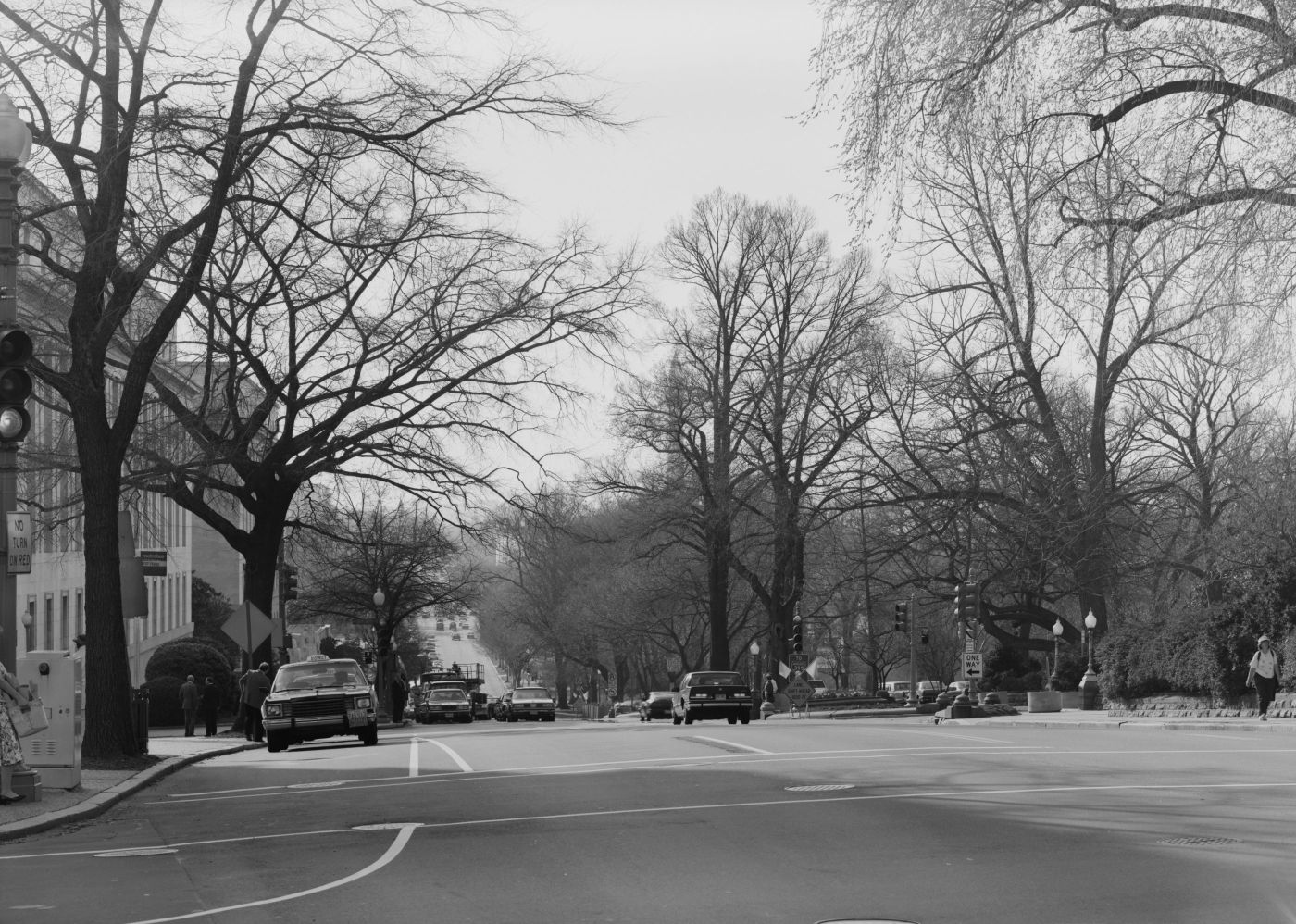
It was Mary Norton (1875-1959), a Democratic congresswoman from New Jersey and the chair of that committee, who finally cleared the bottleneck by prevailing on the House leadership to allow those local bills to go to the entire chamber for consideration. The bill changing the name of South B Street to Independence Avenue subsequently passed the full House on April 5, thereby paving the way for Roosevelt to sign it into law a few days later. “New Street — Signs Placed for Independence Ave.,” proclaimed a headline in the Evening Star later that month. (The accompanying photo of Independence Avenue was taken in 1992.)
Photo Credit: Public Domain
Additional information on Independence Avenue and its origins is available at https://mallhistory.org/items/show/312 and https://www.ncpc.gov/docs/Independence_Ave_SW_Study_2025.pdf
Videos about this street can be viewed at https://www.youtube.com/watch?v=ImiSwnf8gFM and https://www.youtube.com/watch?v=YE7rl7v7a-4

 Transportation History
Leave a comment