July 22, 1940
The Bantam Car Company submitted to the U.S. Army a prototype design for a new vehicle. World War II had erupted elsewhere by that time and, while the United States remained officially neutral, the Army realized the need to be ready to fight in that military conflict against Nazi Germany. The Army therefore sought to have a vehicle that could be mass-produced quickly and would also be fast, lightweight, and able to travel upon most kinds of terrain.
The Army issued a call to 135 companies to provide proposals for such a vehicle. Only two companies, Bantam and Willys-Overland, responded. The financially struggling Bantam recruited freelance engineer Karl Probst to come up with a design. Probst, working hard to quickly meet the Army’s tight deadline, took only a few days to prepare his plans for a prototype and estimate the costs for that vehicle. Using Probst’s work, Bantam submitted its bid and blueprints to the Army.
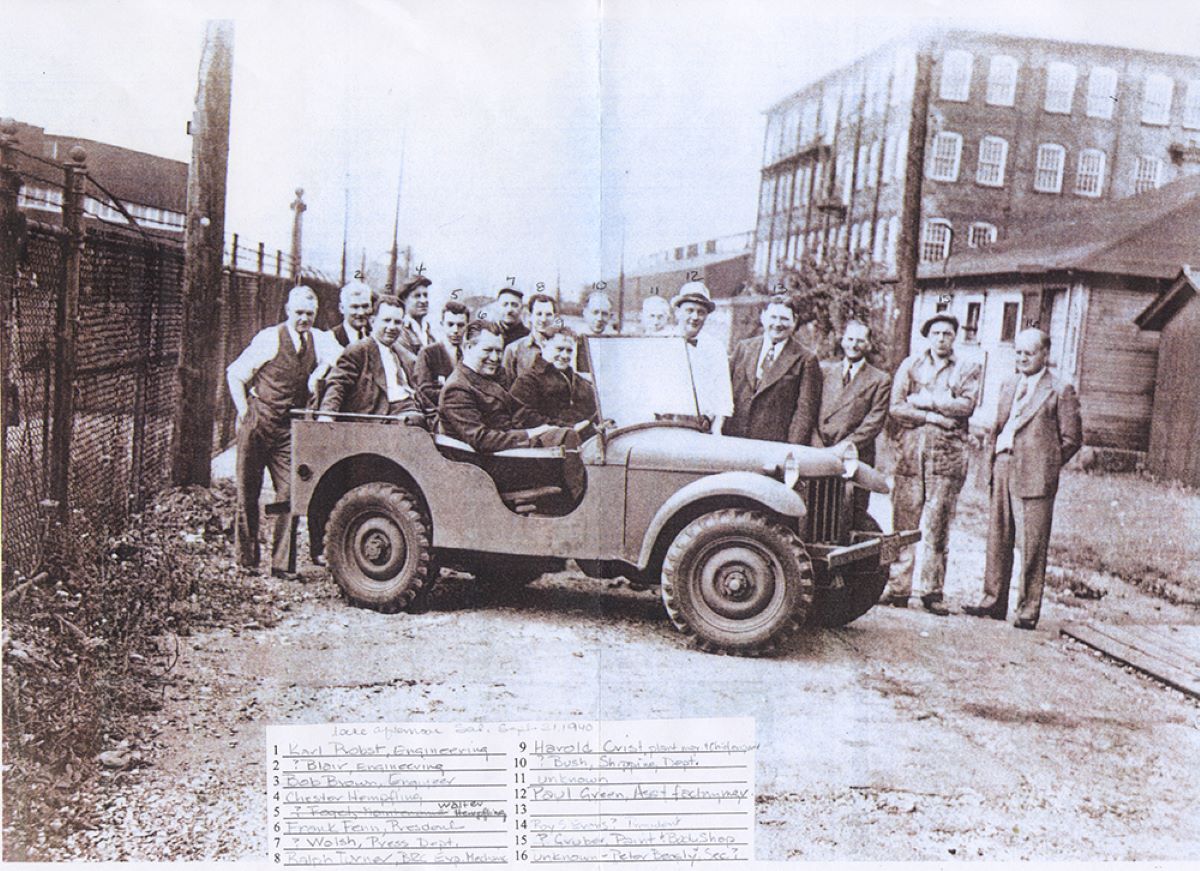
The Army approved the design, and Bantam built a prototype for testing. This prototype is considered to be the first-ever jeep. (The above photo taken in September 1940 shows Bantam employees posing with the prototype outside the company’s factory in Butler, Pennsylvania.)
The Army subjected the prototype to many rigorous trials, and ultimately reported that “this vehicle demonstrated ample power and all requirements of the service.” Due to Bantam’s financial and labor challenges, however, the Army awarded the mass-production contract for the vehicles to Willys-Overland instead. Willys-Overland and the Ford Motor Company became the producers of the jeep, with Bantam instead building heavy-duty trailers for the Army.
By the time the United States entered World War II on the side of the Allies in 1941, jeep production was in full swing. Approximately 640,000 jeeps were manufactured during the course of the war. In the time since then, the jeep has remained very much in use for military and civilian purposes alike.
Photo Credit: Smithsonian Institution
For more information on the origins of the jeep, please check out http://nusafm.org/Willys-Jeep.aspx and https://www.hemmings.com/stories/article/the-jeep-story


#15 Nicholas P. Oesterling – the Gardener pulled into project to help fix the issues with the clutch and steering systems that plagued the project. Was pulled into the photo (notice he isn’t wearing a suit and tie) by the gentleman standing next to him. He told my grandfather, Nicholas, that the prototype would have never happened without his help.
LikeLike
A belated thanks, Penny, for your comments on the AASHTO Transportation History blog post “The Stage is Set for the Modern-Day Jeep.” I appreciate your information about your grandfather Nicholas P. Oesterling and his pivotal role with respect to that prototype. I will be sure to incorporate that interesting and helpful information about him in a revised version of that post.
LikeLiked by 1 person