June 5, 1935
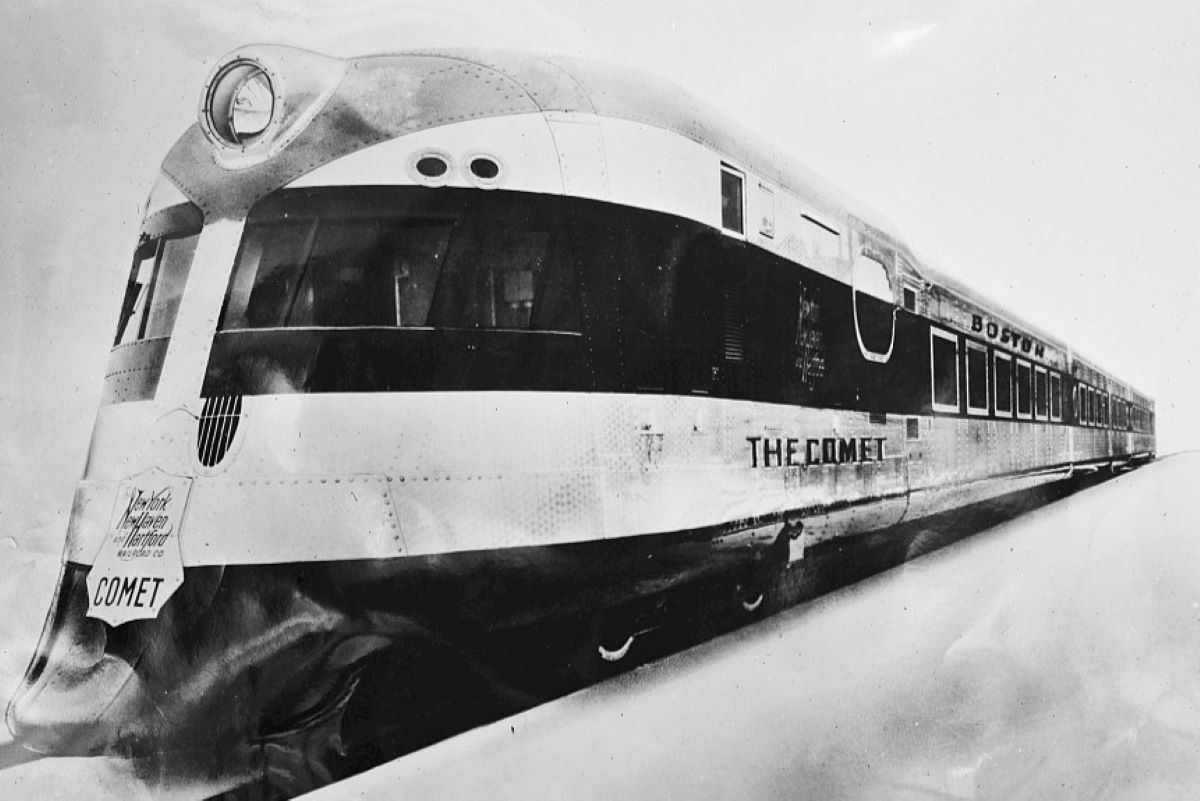
The New York, New Haven & Hartford (NH) Railroad officially introduced its double-ended diesel electric passenger train Comet for service between Boston, Massachusetts, and Providence, Rhode Island. This streamliner — a high-speed railway vehicle designed to provide reduced air resistance and also the precursor to a later era’s “bullet train” — had been built by the Goodyear-Zeppelin Company. Those working on board the Comet during its first regularly scheduled run included A.E. Bernard, engineer; Thomas E. Lyons, pilot; and Robert J. Pelloquin, conductor.
The formal debut of this train attracted not just regional interest but also national attention. “Powered by two 400-horsepower [405.6-metric horsepower] engines, the latest train will carry passengers over the forty-three mile stretch between Boston and Providence in forty-five minutes,” reported an article in Popular Mechanics magazine at that time. “The three-car train, built in the factory that produced the airships ‘Akron’ and ‘Macon,’ has features borrowed from the airship and the airplane.”
Those wind tunnel-tested features included having each train car constructed in the style of a tube, with the entire framework covered with heavy-gauge aluminum sheets forming a complete shell held in place by that framework as well as bulkheads and window posts. The train was further distinguished by raked “chin” pilots at either end, a gray enamel roof, and color bands of bright blue at window height and dark blue at wheel level. The train’s biggest selling point, however, was that it was capable of operating in either direction without needing to be turned around at destinations — something ideal for the NH’s notoriously cramped terminus at South Station in Boston.
The “rail Zeppelin,” as that Popular Mechanics article called it, also achieved fame as the first lightweight train placed into service in all of New England. The train’s Providence-Boston service continued until the start of World War II when it was reassigned to local commuter runs in the Boston area only. The Comet was withdrawn from service altogether in 1951 and subsequently scrapped.
Photo Credit: Public Domain
Additional information on the Comet is available at https://streamlinermemories.info/Reports/Report1938.pdf

 Transportation History
Leave a comment