July 10, 1908
The Thamshavn Line, Norway’s first electric railway, made its debut. The initial segment of this trailblazing line was formally opened by Norway’s King Haakon VII (1872-1957).
This railway was built to carry ore from the mines at the village of Løkken Verk in central Norway to the ports of Orkanger and Thamshavn for subsequent shipment overseas. The first locomotive used along the line was Kvenna (the Coffee Grinder). The Thamshavn Line was also used to transport passengers. This passenger service continued until 1963. The trains along the line stopped operating altogether in 1974.
On the 75th anniversary of the inaugural runs of the Thamshavn Line’s trains, however, sections of that route were reopened as a heritage railway. The line now has the distinction of being the world’s oldest railway running on its original alternating current electrification scheme, specifically 25 Hz 6.6 kV AC.
The Thamshavn Line is also the world’s only railway combining that sort of electric power with a metre gauge of 1,000 millimeters (3 feet and 3⅜ inches). Three of the original passenger cars made available for the line’s 1908 opening remain in use today for the heritage railway.
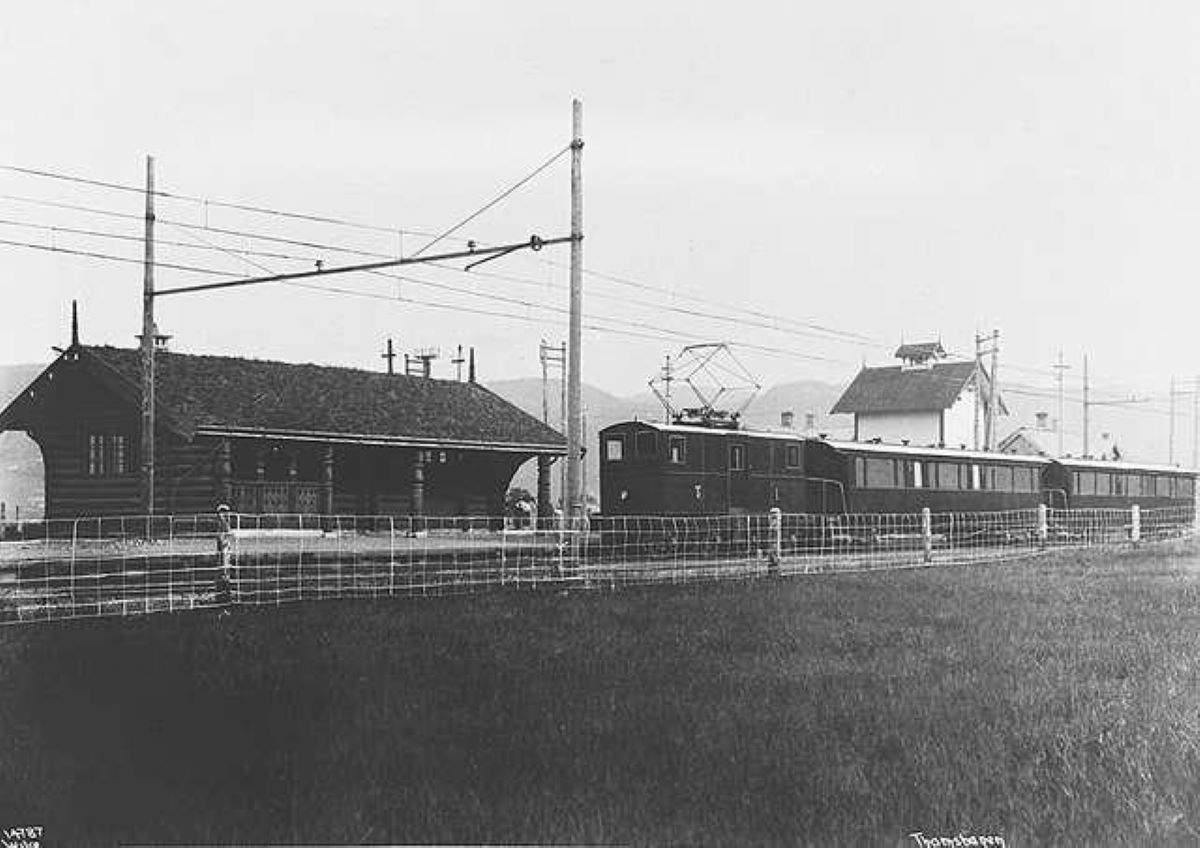
(The accompanying photo of the Thamshavn Line’s Bårdshaug railway station in what was then the municipality of Orkdal was taken in 1912 by Anders Beer Wilse [1865-1949].)
Photo Credit: Anders Beer Wilse (Public Domain)
A list of railway lines in Norway is available at https://en.wikipedia.org/wiki/List_of_railway_lines_in_Norway

 Transportation History
Leave a comment