August 9, 1943
With the United States deeply embroiled in World War II at the time, the U.S. Navy purchased the steamship Zizania for military use on the home front. This acquisition marked only the latest of several major milestones for this longtime and multi-faceted vessel.
The origins of Zizania, which owed her name to a species of wild rice that was first cultivated by Native Americans, can be traced to the late 1880s. She was commissioned by the U.S. Lighthouse Service on November 12, 1888, in Baltimore. USLHT Zizania was subsequently assigned to operate as a lighthouse tender in the 4th Lighthouse District, an area covering much of the Middle Atlantic region. During this tour of duty, Zizania was homeported at Wilmington, Delaware.
As a lighthouse tender, Zizania was extensively used to both set up and maintain buoys. In addition, her crew routinely delivered food, water, wood, coal, fuel, and various other supplies to lighthouses in that part of the world. Over the years, Zizania also carried out several rescue missions as needed. A notable example of this took place in October 1898, when the British oil steamship Weehawken caught on fire while traveling on the Delaware River. The Delaware Gazette and State Journal described the events following the start of that conflagration on board Weehawken.
This newspaper reported, “After the members of the crew had become settled in the lifeboats, they remained as close to the burning ship as long as possible, but just as it was about to become too hot for them and they were compelled to stand off some distance on account of the heat and from fear of an explosion, they were picked up by the lighthouse tender Zizania, which was coming from the Winter Quarter Shoals off the Virginia shore to Wilmington for supplies.”
The Delaware Gazette and State Journal further recounted, “Capt. C.W. Atkins of the Zizania was on deck when he noticed the steamer being on fire, and realizing that there was danger for the members of the crew, gave orders for his boat to their assistance. He was about two miles [3.2 kilometers] from the burning boat when he discovered the fire and it was a matter of only a few minutes when he was alongside and had the members of the tanker safely aboard the government boat.”
That same year, Zizania was first deployed for wartime service. This occurred when, as a defensive action during the Spanish-American War, the steamship was used to lay mines off Fort Delaware on Pea Patch Island in the Delaware River.
A new chapter for Zizania opened in 1913, when she was permanently reassigned to operate in the 1st Lighthouse District (an area covering much of New England). After the United States entered World War I on the side of the Allied Powers in April 1917, President Woodrow Wilson issued an executive order placing quite a few lighthouse tenders—including Zizania — in military service. Zizania was temporarily transferred to the U.S. Department of War. She remained in the New England region, however, and for the most part essentially continued her work as a lighthouse tender.
Throughout her years in that area of the United States, Zizania earned yet more acclaim for the high-risk lifesaving efforts of her crew. Examples of these efforts were highlighted by the Evening Express (based in Portland, Maine) on March 2, 1923.
This newspaper noted that Zizania was “on her way westward to Portland, after about 10 days strenuous work breaking ice and freeing vessels along the Maine coast.” The Evening Express went on to state, “The schooner Leona Marion, which was reported in great danger from ledges while caught in a floating ice field at Southwest Harbor, was released from the ice and taken out of the danger zone yesterday by the tender.”
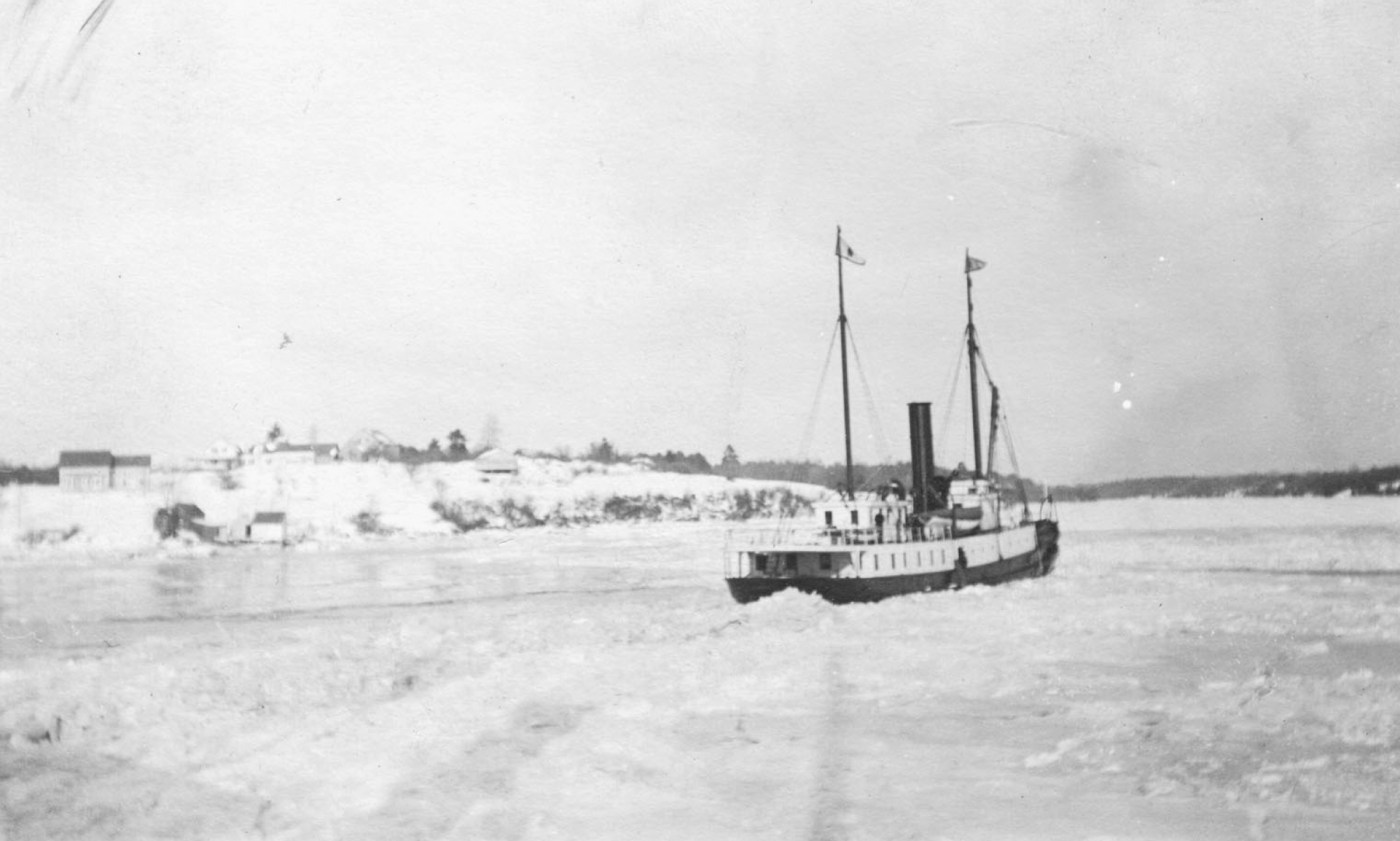
The article did not stop with that rescue mission. “Among other creditable work performed by the tender was the breaking out of the ice and towing the [flat-bottomed barge] Ajax to Vinalhaven,” reported the Evening Express. “This [vessel] was loaded with coal and provisions.” This newspaper added, “The Zizania has also been busy replacing buoys and resetting buoys which have been capsized by the ice.” (The attached photo of Zizania breaking ice was probably taken at some point during that decade.)
In 1924, though, Zizania was retired from service as a lighthouse tender so that a larger ship could take over those duties along the New England coast. “For many years the Zizania has operated from Portland, performing wonderful work even in the thick ice of winter,” noted the Evening Express in announcing the vessel’s retirement. “Several times she has lent a hand to disabled vessels, rescuing many lives while in service here.” Zizania was decommissioned on November 18 of that year.
Zizania was sold early the following year to the Boston firm Thomas Butler & Company. She was eventually sold by that firm to James A. Ross, who remained owner of the steamship until 1938. The following year, Zizania was acquired by the Miami-based Pan American Shippers, Inc. In 1942 – not long after the United States’ entry in World War II on the side of the Allies – Zizania was acquired by the U.S. War Shipping Administration (WSA). Early the following year, Zizania was assigned to the Philadelphia Derrick & Salvage Company.
Not long after her purchase by the Navy in August of that year, Zizania was recommissioned as USS Adario (YNT-25). The vessel spent the remainder of the war operating out of Norfolk, Virginia. She was initially assigned to both lay and remove nets in the water as defensive measure. By the time the war ended in 1945, however, the vessel had been reclassified to perform tugboat duties instead.
Just as she was during her existence as the lighthouse tender Zizania, though, Adario ended up being utilized to assist other vessels as needed in emergency situations. In February 1944, for example, Adario was one of three net tenders that helped rescue USS Aucilla (AO-56) after that fleet oiler became ensnared in an underwater communications cable in the vicinity of Hampton Roads, Virginia.
As a result of the Navy’s significant post-war reduction of its fleet, Adario was removed from military service on April 17, 1946. She was eventually turned back over to WSA, which sold the vessel to Norfolk resident W.B. Fountain. He sold the ship once known as Zizania to a Baltimore-based salvage company in 1948; that company reportedly scrapped the vessel not long afterwards.
Photo Credit: Public Domain
For more information on the steamship originally named Zizania, please check out https://en.wikipedia.org/wiki/USLHT_Zizania and https://www.history.navy.mil/research/histories/ship-histories/danfs/z/zizania.html

 Transportation History
Leave a comment