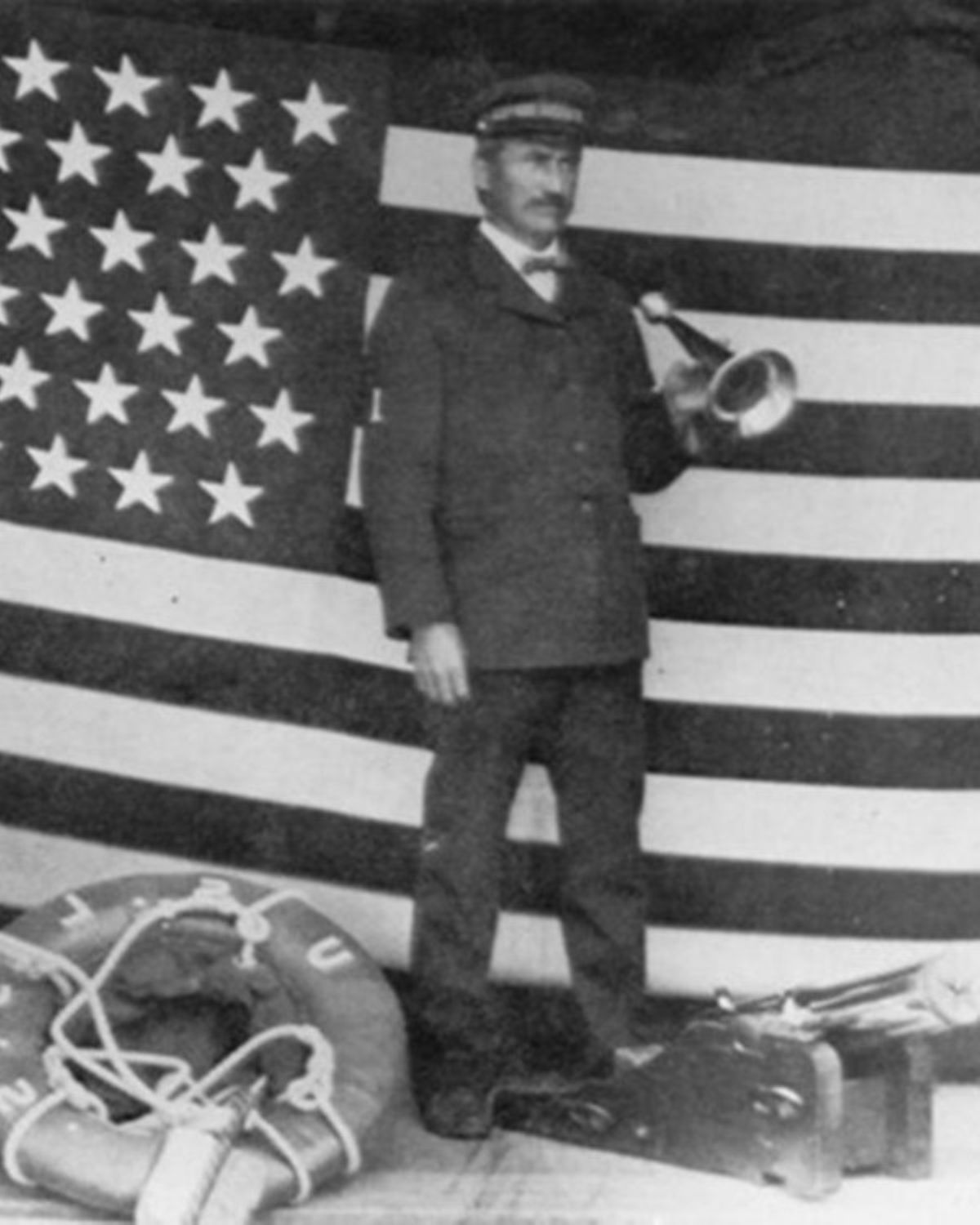
Charles Robinson, who had a longtime career with life-saving stations in his home state of Michigan, was born on May 5, 1874, in the city of Grand Haven on the eastern shore of Lake Michigan and in the west-central section of the Wolverine State’s Lower Peninsula. Robinson was partly of Odawa ancestry. The Odawa — also called the Ottawa — are a Native American people who have long resided in regions that now constitute both Michigan and the Canadian province of Ontario.
Robinson’s career with the U.S. Life-Saving Service, the federal government agency established in 1848 to rescue shipwrecked mariners and passengers, began in 1900. He initially worked at the Grand Haven Life-Saving Station as one of the surfmen there. As the members of a life-saving station’s crew, surfmen used surfboats or other types of watercraft to go out to sea (often in turbulent weather) to retrieve as many imperiled individuals as possible and bring them safely to shore.
In 1902, Robinson and his family moved to the Sleeping Bear Point Life-Saving Station in the northwestern part of the Lower Peninsula. He worked there as surfman #1, which was second only to that of keeper as the highest-ranking position at a life-saving station. Robinson’s exemplary actions and hard work in the midst of often hazardous conditions led to his being promoted to keeper at Sleeping Bear Point Life-Saving Station in 1913. In this role, he was responsible for the maintenance of that facility and the training of surfmen under his command. A couple of years after Robinson became keeper, the Life-Saving Service was combined with the U.S. Revenue Cutter Service to form the U.S. Coast Guard (USCG).
In 1916, Robinson was reassigned to the Frankfort Life-Saving Station (about 30 miles [48.3 kilometers] south of Sleeping Bear Point) to serve as that facility’s keeper. By 1930, Robinson had transitioned from keeper to warrant officer. His duties as warrant officer included providing technical advice to USCG personnel; and helping with the more complicated rescue missions.
Robinson retired from USCG in 1932. He died in Empire, a village located in the vicinity of Sleeping Bear Point, on August 14, 1950.
Photo Credit: Public Domain
For more information on Charles Robinson, please check out https://www.nps.gov/people/charles-robinson.htm

 Transportation History
Leave a comment