March 3, 2014
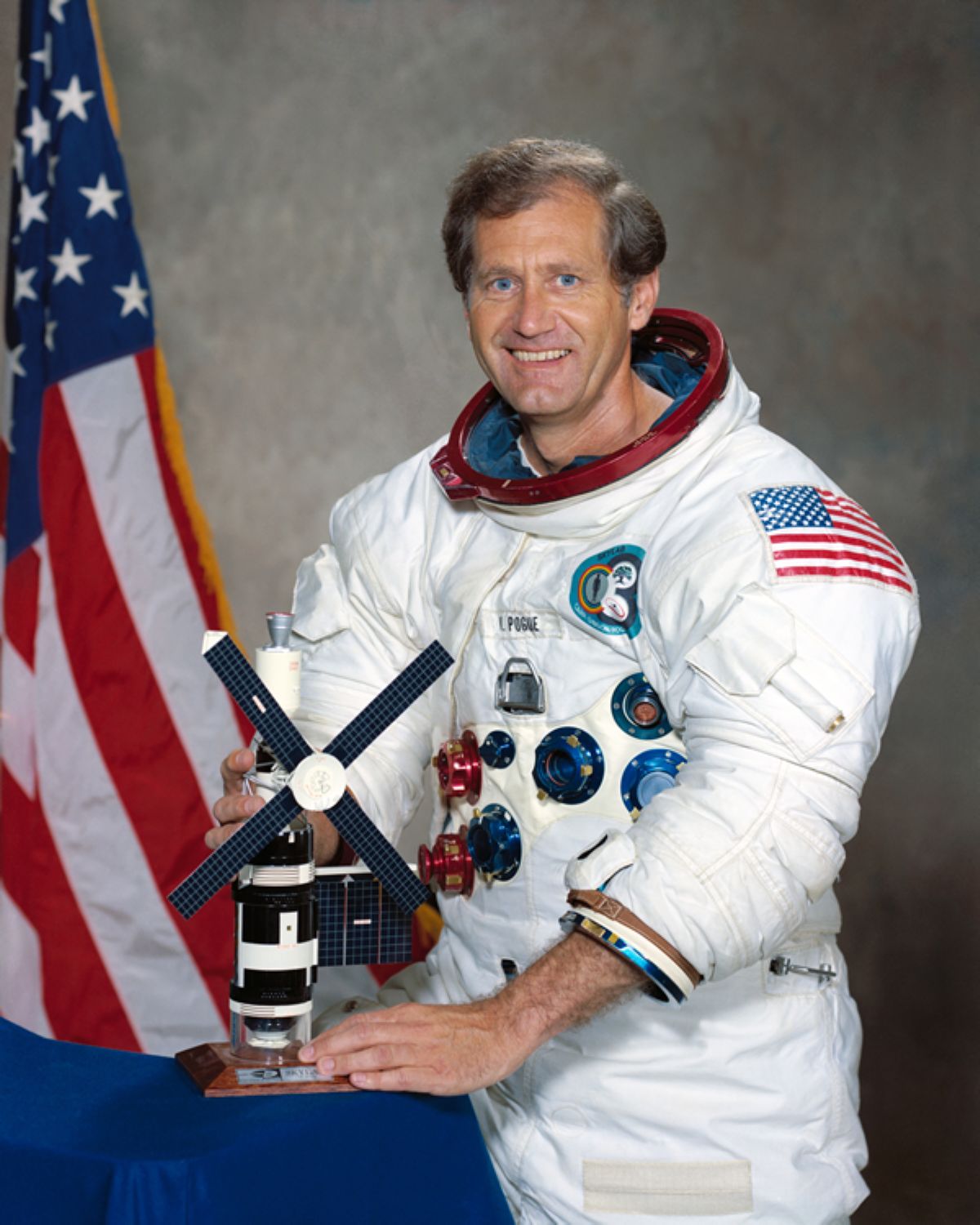
William “Bill” Reid Pogue, whose extensive flight achievements included service as both a U.S. Air Force (USAF) officer and NASA astronaut, died at his home in Cocoa Beach, Florida. He was 84.
Pogue started out life on January 30, 1984, Okemah, Oklahoma. He was of Choctaw ancestry, even though he never became an enrolled member of the Choctaw Nation. Pogue graduated from Oklahoma Baptist University with a B.S. degree in education in 1951, and then — having developed a strong enthusiasm for flying as far back as his early teenage years — he enlisted in the USAF.
As a USAF pilot, Pogue flew a total of 43 combat missions during the Korean War. He also flew for a couple of years with the USAF Air Demonstration Squadron (popularly known as the Thunderbirds), a flying aerobatic team that was formed in 1953. After graduating from Oklahoma State University with an M.S. degree in mathematics in 1960, Pogue served as a professor in that subject at the USAF Academy in Colorado until 1963. Pogue also became a test pilot; his service in this capacity included a two-year tour of duty with the British Ministry of Aviation as part of an exchange program between the USAF and Royal Air Force.
In 1966, Pogue was accepted into NASA’s astronaut program as a trainee in 1966 (four years after his first application for this program had been rejected). His NASA career ultimately included contributing as a member of the astronaut support crews for the Apollo 7, 11, 13, and 14 missions into space.
Pogue also served as the pilot for the Skylab 4 mission from November 16, 1973, to February 8, 1974. This 84-day mission, during which Pogue and his fellow crew members Gerald P. Carr (commander) and Edward Gibson (science pilot) conducted dozens of in-orbit research experiments, became the longest crewed flight in NASA’s history up to that time.
On September 1, 1975, Pogue retired from the USAF as a colonel. He also retired from NASA on that same date. By this time, Pogue had logged a total of 7,200 hours of flight time — 4,200 of those hours were in jet aircraft and another 2,000 hours involved his time in space. Pogue’s considerable amount of post-retirement activities include writing extensively about both aviation and aeronautics. He was also a consultant for aircraft manufacturers such as the Martin Marietta Corporation (now part of the Lockheed Martin Corporation) and the Boeing Company. Pogue found time as well to continue giving flight-oriented presentations at numerous schools and civic clubs across the United States.
“He was constantly on the go,” said Pogue’s widow Tina in a Florida Today interview published three days after his death. Tina Pogue also stated, “He absolutely loved when kids would ask him questions. And he’d take the time to sign autographs and things for them with a smile on his face.”
Over the decades, Pogue was the recipient of multiple awards for his accomplishments. These honors included being given the Johnson Space Center Superior Achievement Award in 1970. In 1973, he was among the members of the Skylab crews to be awarded the Robert J. Collier Trophy. He and both of his fellow Skylab 4 crewmates were presented with the NASA Distinguished Service Medal by President Richard M. Nixon and the De la Vaux Medal by the Paris-based Fédération Aéronautique Internationale (FAI). At around that same time, a municipal airport in Osage County, Oklahoma, was renamed in his honor.
In addition, Pogue was inducted into the Five Civilized Tribes Hall of Fame in 1975; the Oklahoma Aviation and Space Hall of Fame in 1980; and the U.S. Astronaut Hall of Fame in 1997. Pogue was also awarded the Clarence E. Page Memorial Trophy by the Oklahoma Aviation and Space Museum but passed away eight days before it was scheduled to be formally presented to him.
Photo Credit: NASA
For more information on Bill Pogue, please check out https://en.wikipedia.org/wiki/William_Pogue

 Transportation History
Leave a comment