December 24, 1915
At 4:00 p.m., a recently finished masonry arch bridge in northwest Washington, D.C., made its ceremony-free debut. This Christmas Eve opening was authorized by U.S. Army Major Charles W. Kutz (1870-1951), the military civil engineer member of the three-person Board of Commissioners that governed the city at that time.
The completion of the supporting infrastructure for this bridge was definitely a rush job. That day’s edition of the Washington Times reported, “For ten days the contractors, by direction of Engineer Commissioner Kutz, have been hurrying the work in order that the bridge will be ready for traffic by Christmas Day.”
The next day’s edition of the Washington Post announced, “The District of Columbia gave itself a Christmas gift yesterday when the new Q street bridge, spanning Rock Creek, was formally opened . . . For the present it is lighted by 100-candle-power incandescent lamps placed centrally in the roadway.”
The Q Street Bridge was built as a transportation link between the Washington neighborhoods of Dupont Circle and Georgetown. This bridge was designed by architects Glenn Brown (1854-1932) and his son Bedford Brown (1880-1952). The bridge’s engineering design, the part of the process that focuses on the long-term functionality and strength of a structure rather than its aesthetics, was developed by civil engineer Daniel B. Luten (1869-1946).
Construction on the Q Street Bridge had begun in March 1914. While the bridge itself was actually completed by October 1915, it would take the next couple of months to fully grade and pave the segments of roadway leading up to the new structure.
Another milestone for the bridge took place on June 5, 1916, when the Board of Commissioners officially named it the Dumbarton Bridge. In a written statement, they explained that this name was selected to commemorate a key part of the region’s history: the 795-acre tract of land in present-day Georgetown that had been granted in 1703 to Ninian Beall (1625-1717); he called that land grant “The Rock of Dumbarton” after a large stone monolith in his native Scotland.
Throughout the years, the Dumbarton Bridge has also become widely known as the Buffalo Bridge. This is because of the four buffalo sculptures on prominent display at the bridge. Two sculptures each can be found at both ends of the Dumbarton Bridge. These bronze figures were created by animal sculptor Alexander Phimister Proctor (1860-1950). He also created tiger sculptures for the 16th Street Bridge, which is likewise located in northwest Washington.
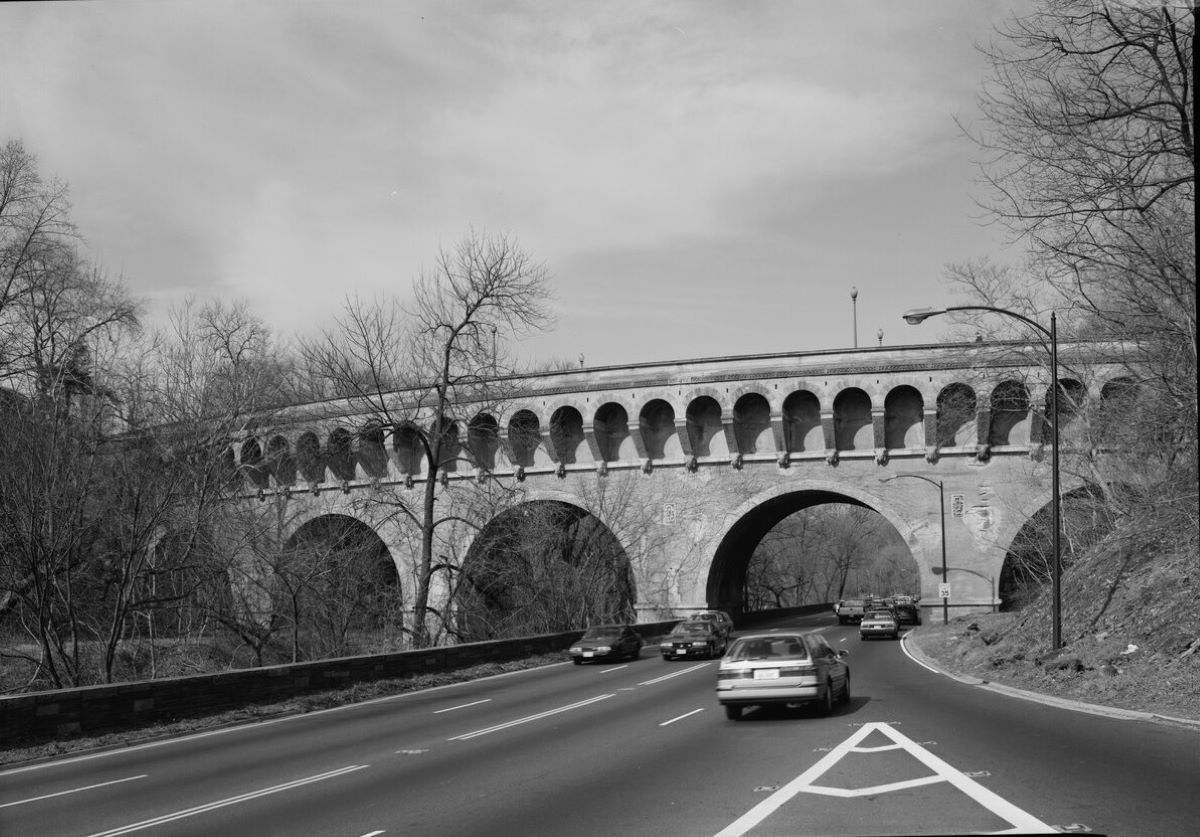
The Dumbarton Bridge remains in service today. It now crosses over the Rock Creek and Potomac Parkway, which was completed in 1936 and is maintained by the National Park Service as part of Rock Creek Park. (The accompanying photo of both the bridge and parkway was taken in 1993.) The Dumbarton Bridge was added to the National Register of Historic Places on July 16, 1973.
Photo Credit: Public Domain
For more information on the Dumbarton Bridge in Washington, D.C., please check out https://en.wikipedia.org/wiki/Dumbarton_Bridge_(Washington,_D.C.)

 Transportation History
Leave a comment