January 31, 1901
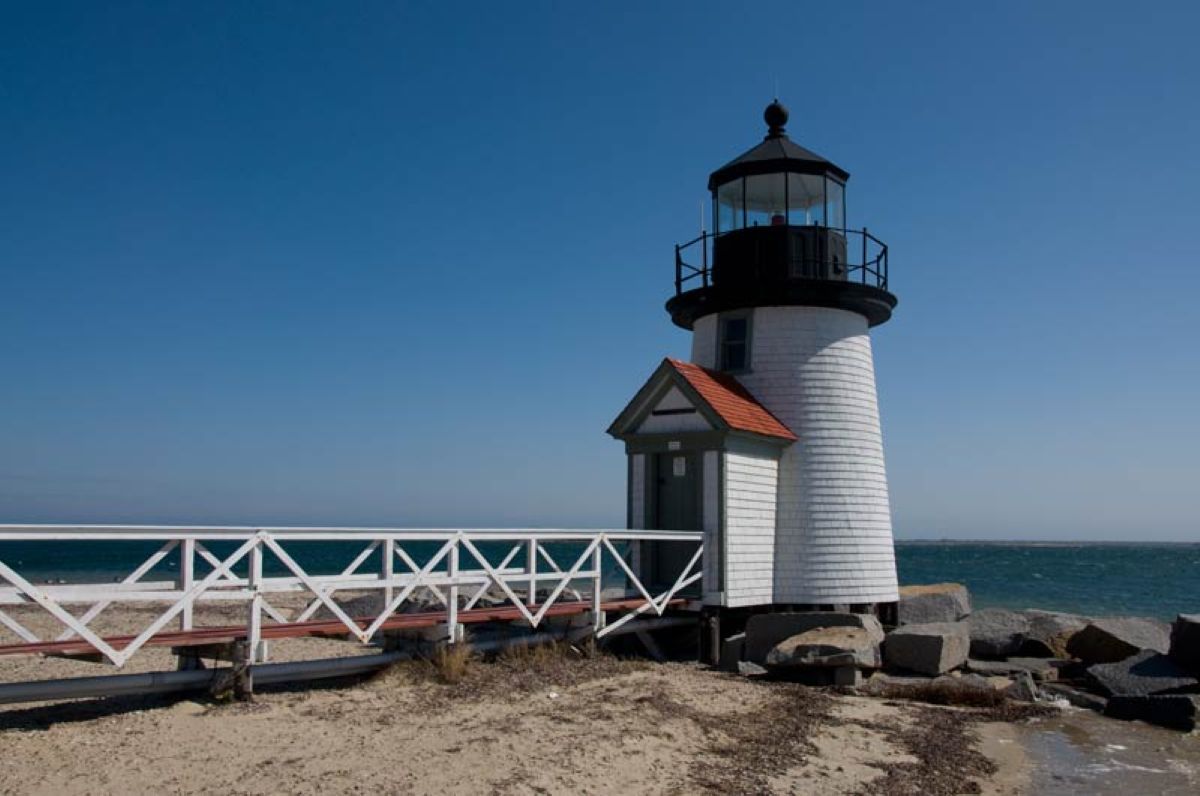
In the northern part of the Massachusetts island of Nantucket, operations began for the current version of a lighthouse at Brant Point on the south side of the island’s harbor. (Nantucket is approximately 30 miles [48 kilometers] south of the Bay State’s Cape Code peninsula.) The New York Times provided details about Brant Point’s 10th navigational aid just a few days before it officially went into service. “The new tower is a white, shingled, cylindrical structure, on a pile foundation, surmounted by a black lantern,” reported this newspaper. “A long foot-bridge connects the new tower with the higher part of the shore.”
The predecessors to the present-day Brant Point Light were as follows:
- A wooden tower that was built in 1746 – becoming second only to Boston Light as the oldest lighthouse in what is now the United States — and destroyed by fire in 1758;
- A second wooden tower that went into service in 1759 and was blown down in 1774 by what the Massachusetts Gazette and the Boston PostBoy and Advertiser described as “a most violent Gust of Wind that perhaps was ever known there”;
- A third wooden tower that was installed in 1774 but burnt to the ground in 1783;
- A wooden lantern with glass windows that was set up between two spars (thick poles) in 1783 and stayed in place until 1786;
- A frame constructed in 1786 that was slightly more elaborate than the 1783 lantern but wrecked during a heavy storm in 1788;
- A tower that was built sometime between 1788 and 1795, but ultimately condemned as unsafe in 1825;
- The framework of a tower that was installed in 1825 but rotted out by deterioration by 1853;
- A still-standing brick tower that began operations in 1856 and served as Brant Point Light until being deactivated in 1900; and
- A lantern located about 600 feet (180 meters) from the 1856 tower and set up in 1900.
When the 10th and final incarnation of a beacon at Brant Point made its debut in 1901, the keeper stationed at that location was John M. Chapman (1840-1907). He continued to serve as the keeper there until his death. His wife Mary A. Foley Chapman (1856-1932) subsequently took over those responsibilities for a brief time.
The keepers at Brant Light over the next few decades included Richard F. “Cap” Dixon (1877-1939), who served in the role from 1911 to 1926. One of Dixon’s notable lifesaving efforts took place towards the end of his tour of duty there, when he rescued two men from a motorboat that sank in the area after being damaged by ice.
Dixon was succeeded as keeper at Brant Light by Gerald M. Reed (1887-1959), whose own tenure lasted until sometime during the 1940s. Reed’s rescue missions as keeper involved not only vessels out at sea but also at least one mode of surface transportation. That land-based mission for Reed took place starting at about 11:30 one night in August 1928, when he heard a loud explosion and headed out into the nearby Brant Point neighborhood to investigate the cause. The explosion turned out to be the result of someone’s automobile catching on fire, and the quick-thinking Reed used an extinguisher from the lighthouse to put out those flames.
The current version of Brant Point Light, which was automated in 1965, remains in operation today. Along with the 1856 tower, this structure was added to the National Register of Historic Places in 1987.
Photo Credit: Denimadept (licensed under the Creative Commons Attribution-Share Alike 3.0 Unported license at https://creativecommons.org/licenses/by-sa/3.0/deed.en
For more information on the present-day version of Brant Point Light as well as its predecessors, please check out https://en.wikipedia.org/wiki/Brant_Point_Light

 Transportation History
Leave a comment