February 20, 1943
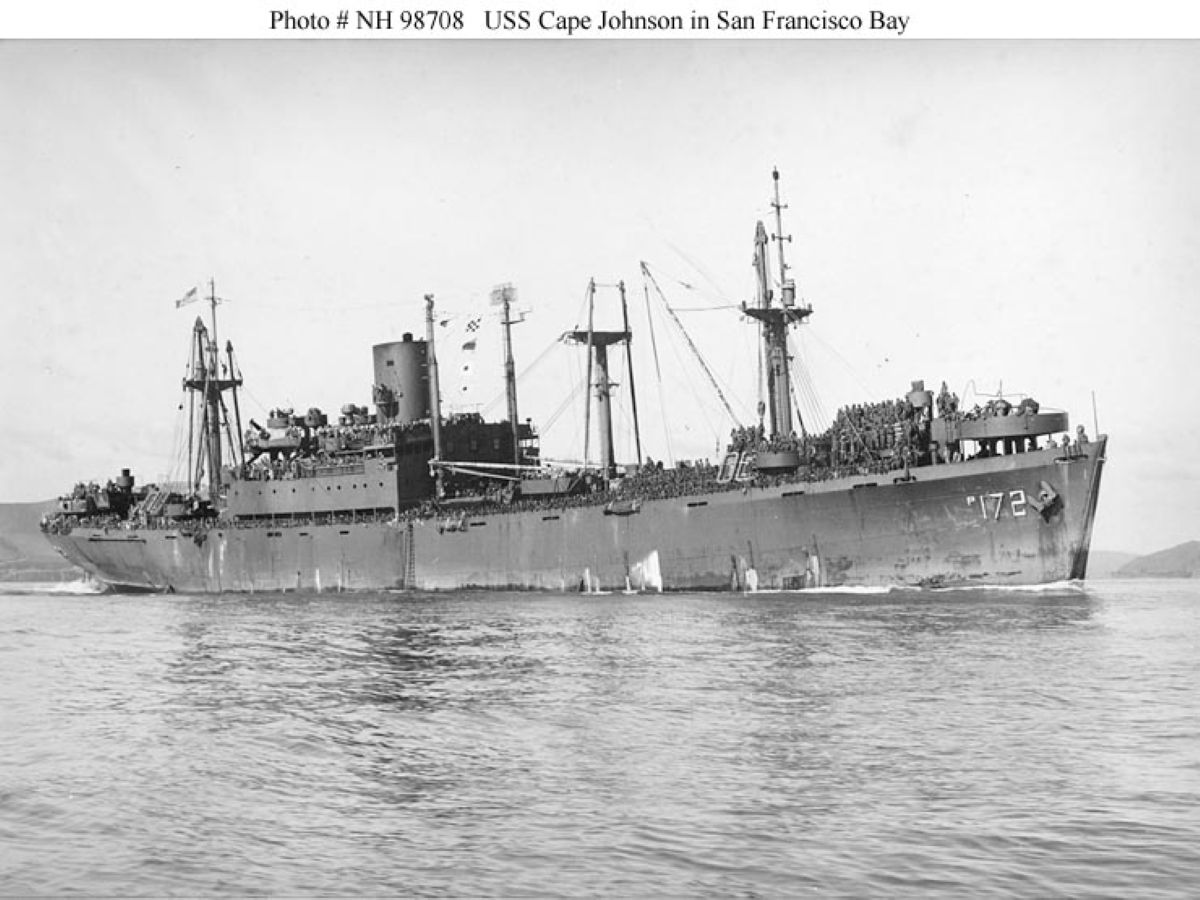
With World War II very much underway across the globe, the ship SS Cape Johnson was launched at 11:00 a.m. at Consolidated Steel Corporation’s shipyard in the Los Angeles neighborhood. This ship, which was named after a cape off the coast of Washington state, was the 26th combination cargo-passenger vessel to be built by Consolidated Steel. In addition, she was the second of four vessels that were launched on that Saturday at the Wilmington shipyard.
The christening duties for Cape Johnson were handled by Ruth Stewart (1910-1965), a resident of the Los Angeles-area city of Pasadena and someone who was significantly involved in local civic affairs. Her husband Arthur C. Stewart (1905-1998) was a director of Consolidated Steel. The News-Pilot (based in the Los Angeles neighborhood of San Pedro) confirmed that she “cracked the bottle of champagne on the ship’s bow.” This ceremony was indeed a family affair for Mrs. Stewart; her mother Ruth Arnold Nicholson (1880-1965) served as the event’s matron of honor. Alden G. Roach (1901-1956), the president of Consolidated Steel, took time during the ceremony to address those in attendance.
Cape Johnson was subsequently modified to serve as a troop transport ship capable of carrying up to 1,575 people on board. This conversion was done by Los Angeles Shipbuilding & Dry Dock Company. After being commissioned into the U.S. Navy as USS Cape Johnson (AP-172) on June 1, 1944, the ship was assigned to the Pacific Fleet.
Over the next several months, Cape Johnson was extensively used to transport both U.S. Army and U.S. Marine Corps servicemen between military bases in the Pacific Theater. The ship also carried troops to assault areas for major military operations such as the Invasion of Lingayen Gulf and the Battles of Luzon, Leyte Gulf, and Iwo Jima.
At the time that she was commissioned Cape Johnson was placed under the command of Lieutenant Louis C. Farley (1882-1961). Farley continued in this role until May 1945, when Lieutenant Commander Harry Hammond Hess (1909-1969) became the ship’s commander.
Hess’s tour of duty as commander resulted in a major scientific breakthrough. He used Cape Johnson’s state-of-the-art sonar technology to painstakingly track the travel routes of the ship to Iwo Jima, the Philippines, and the Marianas. These unofficial scientific surveys allowed Hess to collect ocean floor profiles throughout much of the Pacific. A key outcome of those profiles was the discovery of flat-topped underwater volcanoes, which Hess named “guyots” in honor of the renowned Swiss-American geographer and geologist Arnold Henry Guyot (1807-1884). Hess’s scientific discovery during his time on board Cape Johnson ultimately proved to be a critical development in the study of plate tectonics.
After World War II ended with Japan’s surrender to the Allies, Cape Johnson was among the vessels used for the large-scale return trips of servicemen back to the United States from the Pacific Theater. This ship, which earned two battle stars for her wartime service, was decommissioned on July 25, 1946. She was sold to the Oregon-based Zidell Explorations, Inc. for scrapping on June 10, 1963.
Photo Credit: Public Domain
For more information on USS Cape Johnson (AP-172), please check out https://www.navsource.org/archives/09/22/22172.htm and https://cdnc.ucr.edu/?a=d&d=SPNP19430220.2.8&srpos=3&e=——194-en–20–1–txt-txIN-cape+johnson+ship+stewart—-1943—
Additional information on Harry Hammond Hess is available at https://en.wikipedia.org/wiki/Harry_Hammond_Hess

 Transportation History
Leave a comment