March 5, 1890
Alan Brebner, a Scottish civil engineer who left a considerable legacy when it came to the development of lighthouses, died in Edinburgh at the age of 63. “He had a ready and retentive memory, and was expert in methods of calculation,” noted his obituary in the London-based monthly magazine The Engineer. “Though reserved in manner, he was a warm-hearted friend, able and willing to give sound advice.”
Brebner was born in Edinburgh on August 4, 1826. His father Alexander Brebner (1776-1859) was a mason whose accomplishments included working for Robert Stevenson (1772-1850), the engineer for the Northern Lighthouse Board (NLB), in the construction of the Bell Rock Lighthouse. This lighthouse, which was completed in 1810 and is located off the northeastern coast of Scotland, has been called one of the Seven Wonders of the Industrial World.
Following in his father’s footsteps, Alan Brebner became a mason. The construction expertise that he acquired in this work ultimately paved the way for his career as a civil engineer. Stevenson, who undoubtedly remained appreciative of Alexander Brebner’s noteworthy contributions to the building of the Bell Rock Lighthouse, took on Alan Brebner as an apprentice.
This apprenticeship would mark the start of Brebner’s longtime association with Robert Stevenson and his sons and fellow civil engineers Alan Stevenson (1807-1865), David Stevenson (1815-1886), and Thomas Stevenson (1815-1887) in the creation of lighthouses. Brebner’s one extended hiatus in these efforts took place from 1848 to 1850, when he served instead as an engineer for railway projects between the village of Thornton and city of Dunfermline in Scotland.
A prominent example of Brebner’s work on lighthouses involved the construction of such a navigational aid on the small rocky island (skerry) of Muckle Flugga, located north of Unst (one of the Shetland Islands of Scotland). With Thomas and David Stevenson designing this far-flung lighthouse, Brebner served as the resident engineer for building the structure.
This project was carried out in formidable conditions that included both the remoteness of Muckle Flugga and the frequently hazardous weather in that region between the Atlantic Ocean and North Sea. One of the most daunting challenges involved manually transporting more than 100 tons (90.7 metric tons) of construction materials such as cement, coal, glass, and iron all the way up to the cliffs of Muckle Flugga.
North Unst Lighthouse (renamed Muckle Flugga Lighthouse) was completed in 1857 and it first went into service on New Year’s Day of the following year. In a letter that he wrote to the NLB commissioners, David Stevenson specifically praised Brebner for his leadership and skills in making this lighthouse a full-fledged reality despite all of the difficulties that he encountered throughout the project.
Brebner served in a similar capacity for a lighthouse that was designed by Thomas Stevenson for the remote skerry of Dubh Artach off Scotland’s west coast. Construction on this lighthouse took place between 1867 and 1872, with Brebner supervising about 50 workers. These men built cottages on Erraid, an islet located 14 miles (22.5 kilometers) from Dubh Artach, as their temporary housing. In addition, they built a wood-and-iron barrack on Dubh Artach itself.
As a result of the ferocious seas in that area during most of the year, actual work on the lighthouse was mostly restricted to just the summer months. Even that time of the year had its own share of terrifying weather challenges, though, with gales severely pounding Dubh Artach. As a result of one of these gales, Brebner and 13 of his workers ended up being stranded in their barrack for six days.
Brebner’s efforts in overseeing the completion of the lighthouse against all odds was subsequently underscored in a letter written by Thomas Stevenson. “It would be ungenerous if a great and dangerous work like this were brought unsuccessfully to an end and no praise should be given to such men as Mr. Brebner the resident Superintendent,” asserted Stevenson in this letter.
Incidentally, Thomas Steveson’s son Robert Louis Stevenson (1850-1894) was a worker for this project for three weeks in 1870. Robert Louis Stevenson ultimately did not join others in his family in the design and construction of lighthouses and instead went on to achieve literary fame. Stevenson’s brief time working on the lighthouse on Dubh Artach clearly left a lasting impression on him, however; Erraid served as the inspiration for the island in his short story The Merry Men and it was featured by name in his now-classic novel Kidnapped.
Over the years, Brebner earned widespread renown for his innovations and recommendations with respect to construction projects for not only lighthouses but also canals and harbors. His well-received paper “Modern Harbour Construction” was presented to the Royal Scottish Society of Arts, for example, and he was awarded the Telford Medal of the British Institution of Civil Engineers for his paper “Relative Power of Lighthouse Lenses.”
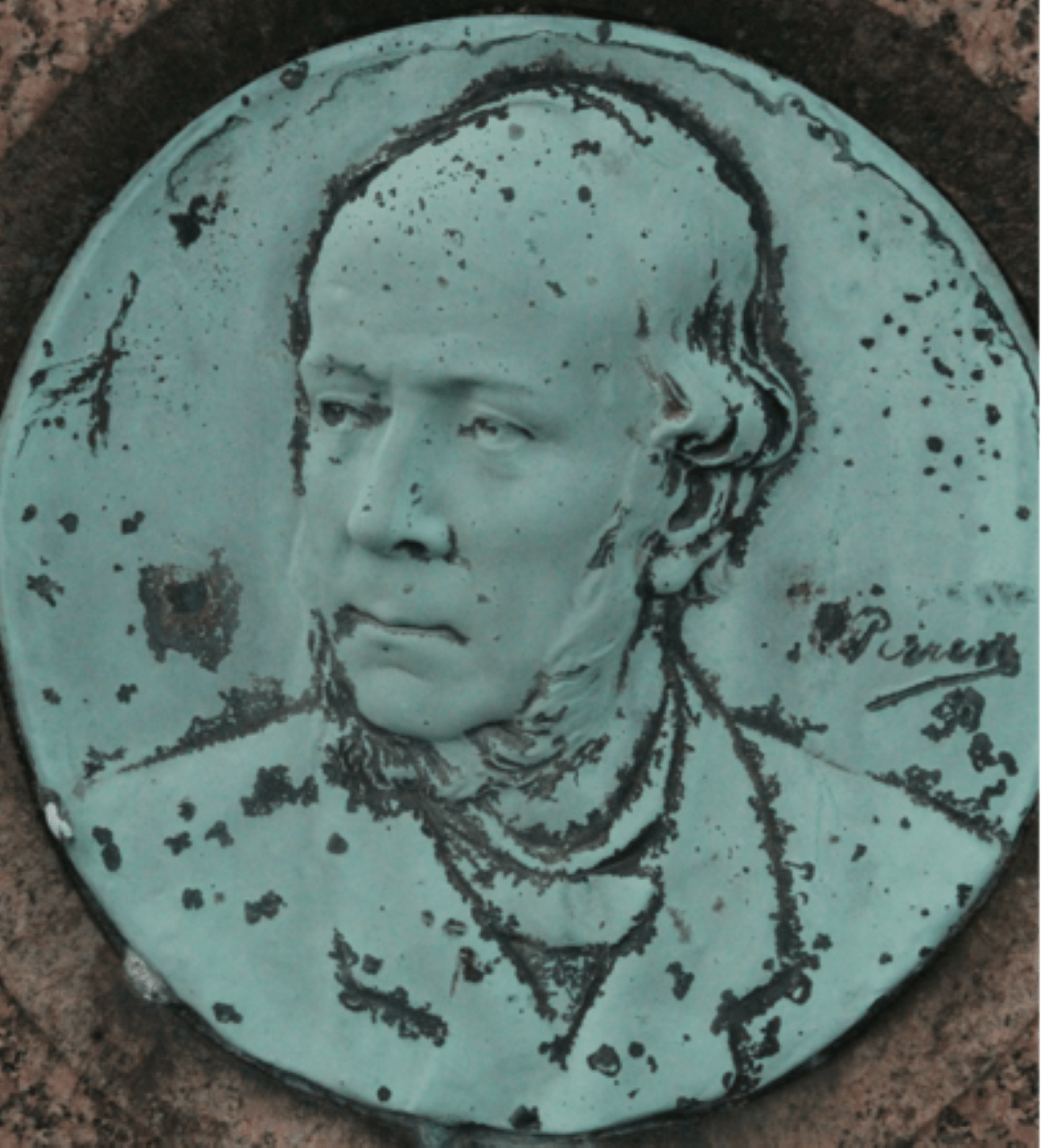
Brebner was buried at Rosebank Cemetery in Edinburgh. The accompanying image of him appears on his gravestone.
Photo Credit: Stephencdickson (licensed under the Creative Commons Attribution-Share Alike 4.0 International license at https://creativecommons.org/licenses/by-sa/4.0/deed.en)
An obituary for Alan Brebner is available at https://www.gracesguide.co.uk/Alan_Brebner

 Transportation History
Leave a comment