July 7, 1942
Exactly seven months after Japan’s attack on Pearl Harbor, Gulfport Army Airfield in southern Mississippi was opened as a small but still pivotal part of the United States’ overall involvement in World War II on the side of the Allies. This airport in the city of Gulfport was built by the U.S. Army Air Forces as a training base for the flight crews of bomber aircraft such as the Boeing B-17 Flying Fortress; the Consolidated B-24 Liberator; and the Boeing B-29 Superfortress. Gulfport Army Airfield also served as a training center for soldiers specializing as mechanics responsible for the repair and maintenance of military transport and cargo planes.
During the war, various individuals stationed at Gulfport Army Airfield were highlighted in newspapers across the country. Those individuals included three who hailed from the Pennsylvania borough of Berwick. A February 1943 edition of the Berwick Enterprise reported, “Three Berwick men have been graduated from Gulfport army airfield in Mississippi as airplane mechanics and are ready to take their places on the far-flung services lines of this global war.” These soldiers were Paul R. Davis (1919-1996), Henry Wilbur Long (1912-1978), and Samuel S. Sabrick (1921-1998).
In October of that year, another person serving at Gulfport Army Airfield received considerably wider press coverage. She was Manilla G. Rupert (1898-1967), a resident of Elwood City, Pennsylvania, and the mother of two Army soldiers — Private First Class Charles E. Rupert (1916-1945), who was stationed in England; and Private Earl K. Rupert (1922-1968), serving at a classified location overseas. Mrs. Rupert was also the grandmother of three. “Grandma Joins Her Sons in War Service,” proclaimed a headline in the Washington-based Spokesman Review.
As a private in the Women’s Army Corps, Manilla G. Rupert worked as a cook at Gulfport Army Airfield’s hospital. According to the Associated Press story about her, she “joined Uncle Sam’s forces after 27 years as a housewife ‘to help get the boys back home in a hurry.’” (Tragically, however, her son Charles was killed in a car accident not long after the war ended and he had returned home to Pennsylvania.)
In 1949, the U.S. War Assets Administration transferred the airfield to the city of Gulfport for use as a civilian airport. The airport subsequently regained a military presence, though, with the deepening of the Cold War. As Gulfport Air Force Base, the facility was available for use by not only military personnel but also civilians. While it is no longer an air force base, this facility — now known as Gulfport-Biloxi International Airport — is still used extensively for both military and civilian purposes.
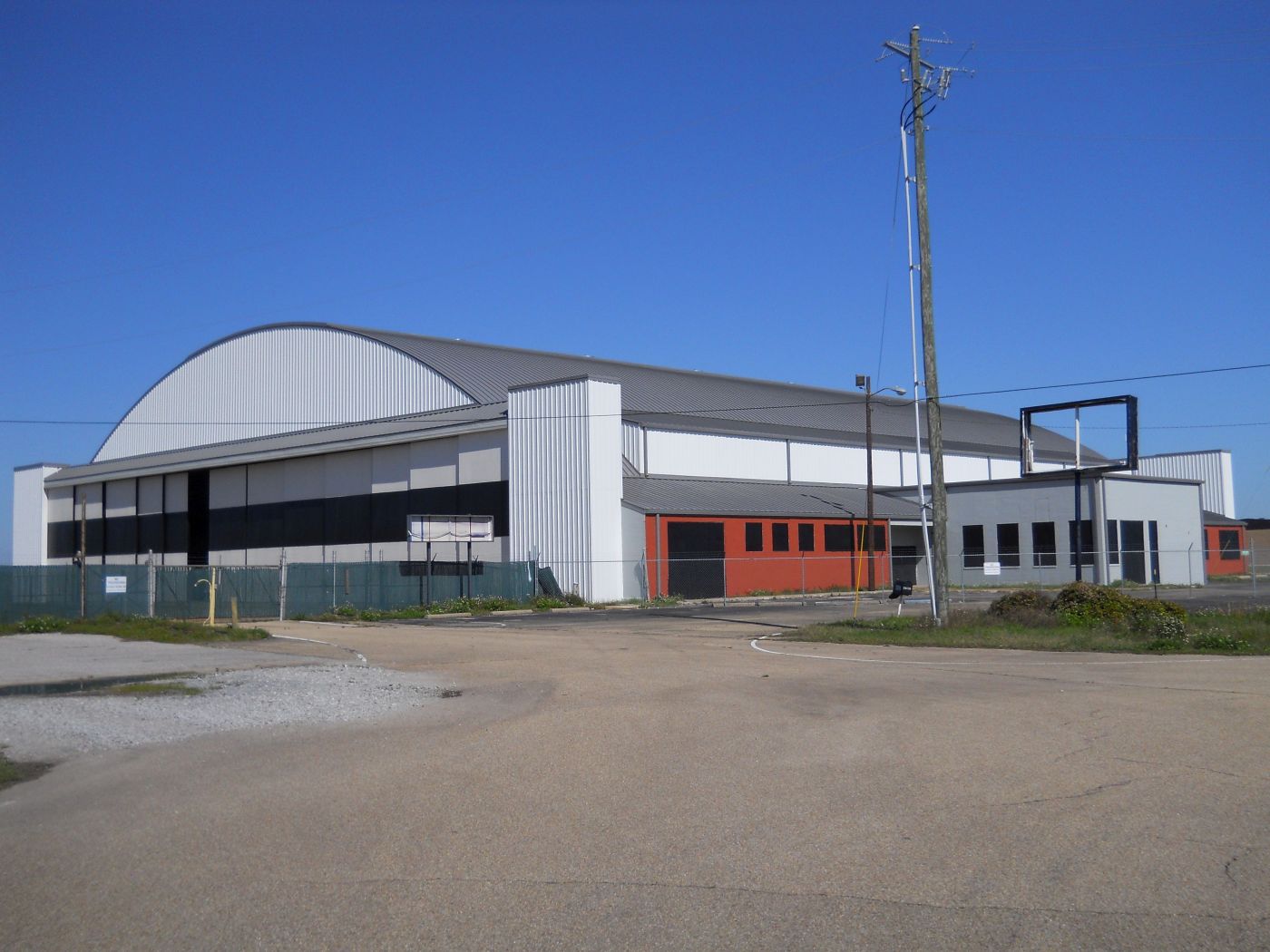
The hangar shown in the accompanying 2016 photo was built as part of the Gulfport Army Airfield in 1944-45 to accommodate the Boeing B-29 Superfortress. This hangar was added to the National Register of Historic Places in 2011 and, the following year, designated as a Mississippi Landmark.
Photo Credit: Woodlot (licensed under the Creative Commons Attribution-Share Alike 3.0 Unported license at https://creativecommons.org/licenses/by-sa/3.0/deed.en)
For more information on the Gulfport Army Airfield (present-day Gulfport-Biloxi International Airport), please check out https://www.hmdb.org/m.asp?m=218826 and https://www.flygpt.com/about-gpt/history/
Additional information on airports in Mississippi is available at https://en.wikipedia.org/wiki/List_of_airports_in_Mississippi


Leave a Reply