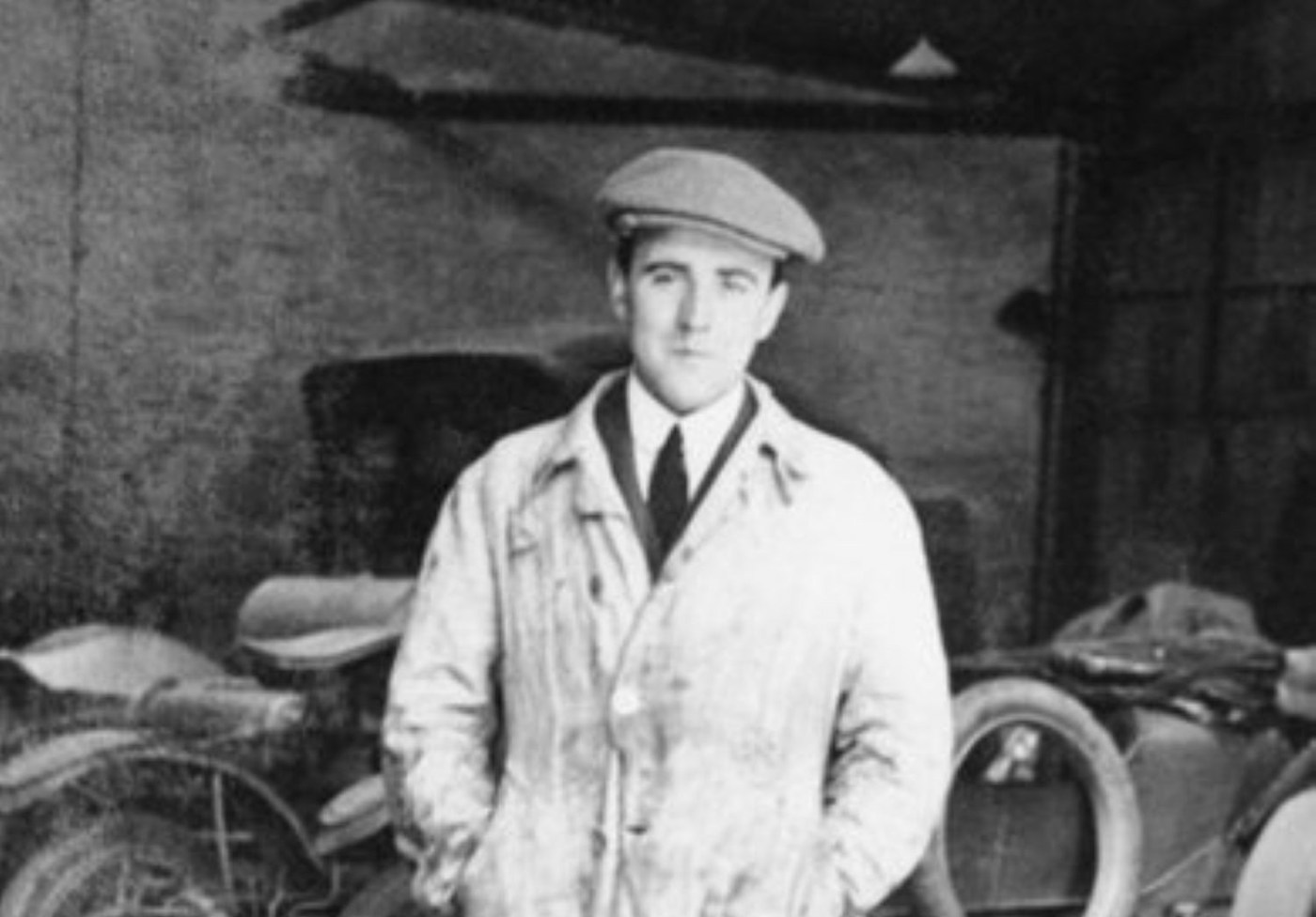
August 12, 1971
Walter Owen “W.O.” Bentley, who achieved renown for the automobiles that he designed and built, died in a nursing home in northwestern England’s town and borough of Woking. He was 83.
Bentley was born on September 16, 1888, in the Hampstead area of London. He attended Clifton College in Bristol from 1902 to 1905. At the age of 16, Bentley left this public school to begin service as an apprentice engineer with the Great Northern Railway (GNR) at its workshop in northeastern England’s city of Doncaster. His duties during this five-year apprenticeship included greasing steam engines. Bentley’s time with GNR also provided him with a wealth of technical knowledge and practical hands-on experience in the design and construction of complex machinery.
After the completion of his apprenticeship during the summer of 1910, Bentley decided not to pursue a railways career. He instead made his way back to the southern part of England. Bentley’s transportation-oriented activities at this point in his life involved competing in motorcycle races.
Bentley eventually studied theoretical engineering at King’s College, London. In addition, he was hired as assistant to the works manager of the London-based National Motor Cab Company. One of Bentley’s major responsibilities in this position entailed overseeing the maintenance and operation of hundreds of Unics — French-built motor vehicles — that were placed into service by the company as taxis.
In 1912, Bentley further pursued his strong enthusiasm for automobiles by partnering with his brother Horace to form a company that sold cars produced by the French manufacturer Doriot, Flandrin & Parant (DFP). The brothers named their company “Bentley and Bentley.”
W.O. Bentley was not satisfied with the overall on-the-road performance of those DFP cars. He therefore sought ways to help make these vehicles faster and therefore more marketable in England. In 1913, Bentley came up with an answer when he developed a type of aluminum alloy for pistons made for internal combustion engines. A DFP car subsequently outfitted with these pistons as well as a modified camshaft broke several speed records at Brooklands motor racing circuit in southwestern England.
After England entered World War I on the side of the Allied Powers, Bentley was commissioned into the Royal Naval Air Service. Bentley, drawing on his technical expertise and in particular his experience with modifications to DFP cars, advocated for the use of aluminum alloy pistons in military plane engines to help facilitate higher speeds and sustain the overall durability for such aircraft.
The use of aluminum alloy as a lightweight alternative to steel or cast-iron for pistons was widely adopted by companies manufacturing aircraft engines for England’s wartime effort. A notable example of this innovation was the Eagle, an engine developed by Rolls-Royce Limited for military planes. Bentley was awarded the MBE (Most Excellent Order of the British Empire) for his pivotal contribution to England’s fight against the Central Powers.
Following the end of the war, Bentley fully resumed his career in the automobile industry with enviable energy and resolve. He founded a sports car company bearing his name in the early part of 1919. Those joining him in this enterprise were Frank Burgess, Harry Varley, and Clive Gallop. “To build a good car, a fast car, the best in class,” was Bentley’s motto.
The company’s first completed automobile was outfitted with a Bentley 3 Litre engine. This car began undergoing road tests in January 1920 and the first production version of it was ready for use by September of the following year. The Bentley Motors Limited cars that were equipped with that engine proved to be both fast and sturdy when raced in hill climbs and at Brooklands. One of these vehicles — at an average speed of 75 miles (120.7 kilometers) per hour — finished 13th out of 27 cars competing in the 1922 running of the International 500-Mile Sweepstakes Race (now called the Indianapolis 500). Two years later, one of these Bentleys finished first in the 24 Hours of Le Mans sports car race in France.
While W.O. Bentley’s reservoir of mechanical skills was topnotch, his knowledge of finances was woefully weak. The consequent fiscal difficulties that engulfed Bentley Motors resulted in financier and racecar driver Joel Woolf Barato purchasing the assets of the company and becoming its chairman in 1926. As one of Barnato’s employees, Bentley continued to design automobiles for the company he had founded.
In 1931, however, the company was acquired by Rolls-Royce. Bentley, who was excluded from many of Rolls-Royce’s major business activities and decisions, finally left the company in 1935. The automobile manufacturers that he subsequently worked for as a designer included Lagonda and Armstrong Siddeley.
Donald Bastow, an engineer who had worked for Bentley, eulogized his one-time boss in a tribute that was published in the London-based Times on August 21, 1971. “The six years during which I worked for ‘W. O.’ were a period of education and pleasure,” Bastow wrote. “Though normally of reflective habit his experience showed him when swift action was necessary, and he could be very determined in pursuing it. Big enough to admit mistakes when they had occurred, he also knew when to modify and when to start afresh in remedying them. It is a pity that circumstances prevented his influence on car development from being greater than it was.” In 1995, Bentley was inducted into the Automotive Hall of Fame.
Photo Credit: Public Domain
For more information on Walter Owen “W.O.” Bentley, please check out https://www.bentleymotors.com/en/about-bentley/history-and-heritage/w-o-bentley.html

 Transportation History
Leave a comment