Richard Francis “Dick” Gordon Jr., who made notable contributions as both a U.S. Navy aviator and NASA astronaut, died at his home in the city of San Marcos, California. He was 88. Gordon had been born in Seattle on October 5, 1929. After graduating from the University of Washington in 1951 with a B.S. in chemistry, Gordon joined the U.S. Navy.
In 1953, Gordon earned his wings as a naval aviator. He subsequently attended All-Weather Flight School and underwent jet transitional training. Gordon then served in an all-weather fighter squadron at Naval Air Station Jacksonville in Florida.
After attending the United States Naval Test Pilot School at Naval Air Station Patuxent River in Maryland in 1957, Gordon became a flight test pilot for a variety of military aircraft. He served in this role until 1960. He was also flight safety officer, ground training officer, and assistance operations office for the Navy’s Fighter Squadron 96 (VF-6) at Naval Air Station Miramar in California. During his time in the Navy, Gordon logged about 4,500 hours of flying time; approximately 3,500 of these hours involved piloting jet aircraft.
One of Gordon’s biggest accomplishments as a naval aviator took place in May 1961, when he won that year’s transcontinental Bendix Trophy Race by flying a two-seat, long-range F-4 Phantom II supersonic jet interceptor and fighter-bomber from Los Angeles to New York City in a record-breaking two hours and 47 minutes.
As the pilot for this flight Gordon (a lieutenant at the time) also set a coast-to-coast speed record of 869.7 miles (1,399.7 kilometers) per hour. Lieutenant (junior grade) Bobbie R. Young accompanied Gordon as the crewman and they were both awarded not only the Bendix Trophy but also the Distinguished Flying Cross of the United States Armed Forces for their airborne achievements.
Gordon’s career at NASA began in 1963, when he was selected as one of that agency’s third group of astronauts. Gordon first traveled into space in September 1966 as pilot for the Gemini 11 flight. He flew alongside Charles “Pete” Conrad Jr., who was command pilot. Gordon and Conrad had become friends while serving together in the Navy and at one point were roommates aboard the aircraft carrier USS Ranger (CV-61). In the course of the Gemini 11 mission, Gordon performed two spacewalks.
Gordon returned to space in November 1969 as part of the Apollo 12 mission. He was command module pilot for this expedition, which was the second to travel to the Moon. Those astronauts joining Gordon for the flight were Conrad as commander and Alan L. Bean as lunar module pilot. Gordon remained in lunar orbit on board the command module Yankee Clipper while Conrad and Bean walked on the Moon, but he still achieved the distinction of being one of only 24 people to date who have at least flown to that natural satellite of Earth.
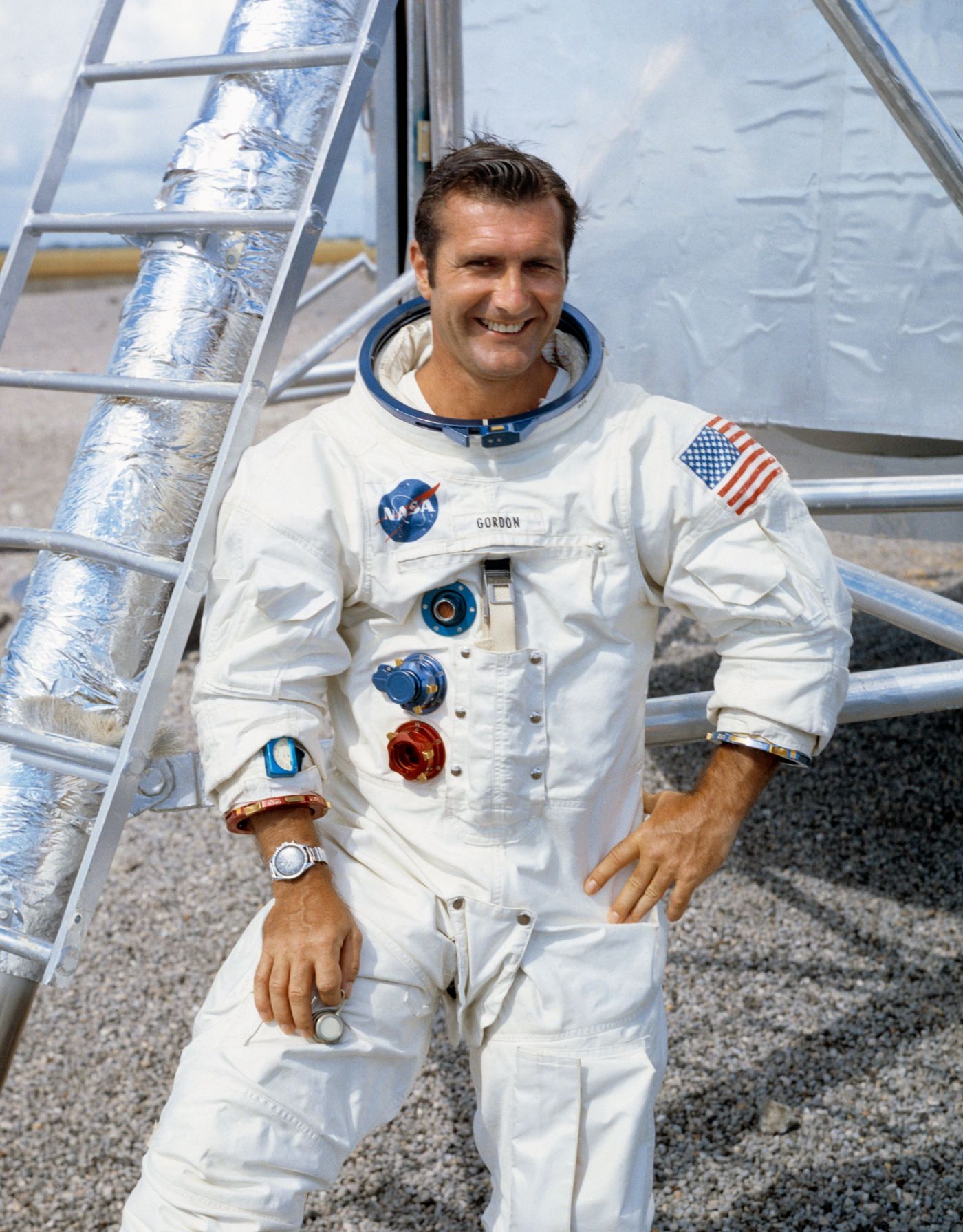
As a result of both the Gemini 11 and Apollo 12 missions, Gordon logged a grand total of 315 hours and 53 minutes in space. (The accompanying photo of Gordon shows him in his space suit for the latter of those missions.)
Gordon’s other major activities on behalf of NASA included helping to design what ultimately became the Space Shuttle, a low Earth orbital spacecraft system that was first launched in 1981 and remained in operation until 2011. Gordon retired from both NASA and the Navy in 1972. He went on to pursue a wide range of professional opportunities, one of which involved serving as executive vice president of the New Orleans Saints from 1972 to 1976. (At the time, that NFL team was a member of the National Football Conference’s Western Division.)
Gordon, who was buried at Arlington National Cemetery, received several honors besides the Bendix Trophy and Distinguished Flying Cross that he was given for his transcontinental flight in 1961. These other honors included the Navy Astronaut Wings; NASA Exceptional Service Medal; Institute of Navigation Award; and Rear Admiral William S. Parsons Award for Scientific and Technical Progress. In addition, Gordon was inducted into the International Space Hall of Fame in 1982; the United States Astronaut Hall of Fame in 1993; and the National Aviation Hall of Fame in 2020.
Photo Credit: Public Domain
For more information on Richard Francis “Dick” Gordon Jr., please check out https://en.wikipedia.org/wiki/Richard_F._Gordon_Jr.

 Transportation History
Leave a comment