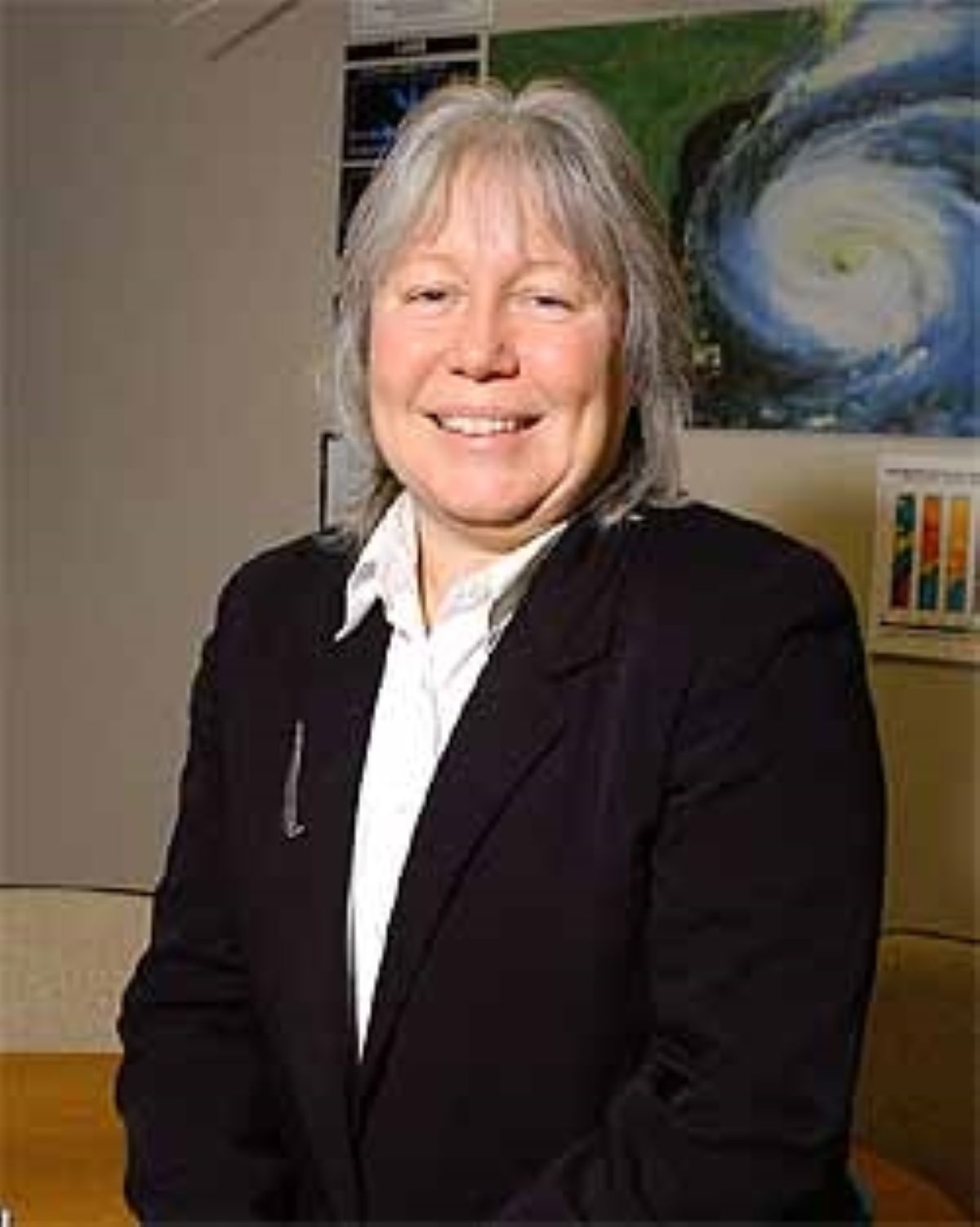
Robbie Hood, a member of the Cherokee Nation, has made notable flight-oriented contributions as an atmospheric scientist. She is a direct descendant of John Ross (1790-1866), whose tenure as principal chief of the Cherokee Nation from 1828 to 1866 was the longest of anyone serving in that role.
Ross achieved lasting prominence for his pivotal and courageous leadership in leading his people to newly designated Indian Territory west of the Mississippi River after the members of the Cherokee Nation — along with those individuals belonging to the Chickasaw, Choctaw, Muscogee, and Seminole Nations — were forcibly removed by the U.S. government from their ancestral homelands in the southeastern United States. (This forced displacement is widely known as the Trail of Tears.)
Hood was born in 1955 and grew up in both Neosho, Missouri, and Picayune, Mississippi. She earned a B.S. in atmospheric science from the University of Missouri at Columbia and an M.S. in physical meteorology from Florida State University.
In 1986, Hood began working at Marshall Space Flight Center (MSFC) in Alabama. Her responsibilities at that NASA facility eventually involved leading a team of scientists and engineers in the development of passive microwave instrumentation sensors to be used on aircraft for observing precipitation and oceanic winds. This team’s other activities included partnering with lightning researchers at MSFC to monitor electric field information while flying on board aircraft.
In a story posted on NASA’s website during this stage of her life, Hood discussed what it was like traveling aboard a DC-8 aircraft flying into a hurricane while she and others busily assessed the atmospheric data being collected via their laptops. “The view out of the aircraft windows can be somewhat boring,” she nonchalantly commented. “The aircraft is often flying through clouds so there is not much to see.”
As she also admitted, however, Hood would indeed occasionally take a respite from her airborne scientific tasks to peek out the window and — if there was enough of a break in the clouds at flight level — admire several of the clouds in the skies below. “The variety of cloud layers and types can be quite impressive,” Hood said. “It’s like seeing every cloud you could imagine all in one place.”
Another major career milestone for Hood took place in 2008, when she became the first permanent director of the Unmanned Aircraft Systems division of the National Oceanic and Atmospheric Administration (NOAA). One of her key contributions in this role entailed overseeing the deployment of high-altitude drones to measure factors such as wind speed during storms.
In the time since her retirement from NOAA, Hood has worked with the Choctaw Nation in Oklahoma to create a testing ground for automated aircraft systems. These efforts have been supported by the Federal Aviation Administration.
In a 2024 interview posted in The Front Page (an American Meteorological Society blog), Hood elaborated on the influence that her Native American heritage has had on her professional endeavors. “I credit my Cherokee mother for teaching me to listen closely to how people tell their stories and pay attention to their feelings and expressions as they talk,” noted Hood. “She thought this would help me better understand who they are and how things looked from their point of view.” Hood added, “These skills have helped me build good working relationships and strong collaborations throughout my career.”
Photo Credit: NASA
For more information on Robbie Hood, please check out https://en.wikipedia.org/wiki/Robbie_Hood and https://blog.ametsoc.org/2024/11/15/native-american-heritage-month-spotlight-robbie-hood/

 Transportation History
Leave a comment