November 25, 1823
The Royal Suspension Chain Pier in Brighton on England’s southeastern coast was opened. This pier was the first major one to be built at that seaside resort. Widely known as the Chain Pier, it was designed by civil engineer (and Royal Navy veteran) Samuel Brown (1776-1852).
Brown was a trailblazer when it came to the development and use of iron chain cables for suspension bridges and similar transportation-oriented structures. His other notable accomplishments included designing the Union Chain Bridge, which crosses the River Tweed and serves as a link between the village of Horncliffe in England and the parish of Fishwick in Scotland.
Construction on the Chain Pier began on September 18, 1822. This structure, which had a width of 13 feet (four meters) and a total length of 1,134 feet (346 meters), was owned and operated by the Brighthelmston Suspension Pier Company until those roles were taken over by the Brighton Marine Palace and Pier Company in 1889.
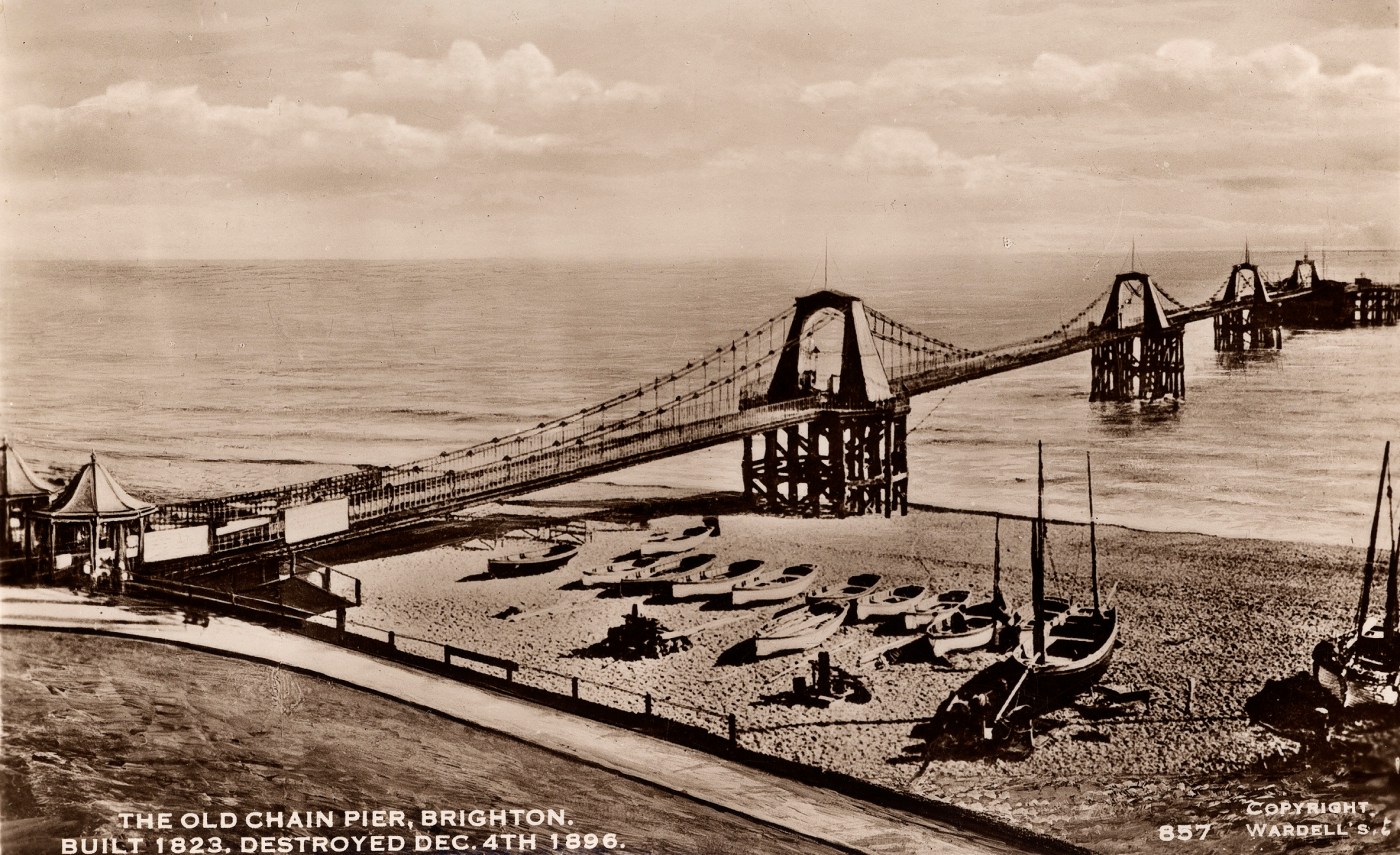
The pier was built to primarily serve as a platform for the disembarking and embarking of both passengers and cargo on board packet boats (medium-sized vessels) traveling between there and the French seaport of Dieppe on the other side of the English Channel. The packet boats arriving at and departing from the Chain Pier on a regular basis were initially powered by sails. By 1825, however, these vessels were mostly steam-powered instead and helped significantly increase the number of passengers visiting Brighton. (In the attached monochrome photographic postcard showing the pier, several fishing boats can be seen on the shore there.)
Over time, several attractions and amenities were introduced on the Chain Pier. These included a camera obscura (Latin for “dark chamber”), an optical device that was located in a building and allowed tourists to view panoramic, real-time images of the surrounding area; a regimental band that performed music; a variety of kiosks and small shops; a place for washing up; and a reading room.
Those visiting the Chain Pier included William IV (1765-1837), who reigned as king of the United Kingdom of Great Britain and Ireland and also the king of Hanover from 1830 until his death. This pier achieved further renown as the subject of paintings created by John Constable (1776-1837) and J.M.W. Turner (1775-1851).
The Chain Pier remained open to the public until October 1896, when it was closed due to concerns about possible deterioration. In December of that year, the already dire fate of this structure was sealed once and for all when it was severely damaged by a fierce storm. Within the next couple of months, most of the few surviving parts of the pier were demolished altogether.
Image Credit: Brighton Museums (https://www.flickr.com/photos/rpm-brighton-hove/33284754142/) – licensed under the Creative Commons Attribution-Share Alike 2.0 Generic license at https://creativecommons.org/licenses/by-sa/2.0/deed.en
For more information on the Royal Suspension Chain Pier, please check out https://piers.org.uk/piers/brighton-chain-pier/
Additional information on Samuel Brown is available at https://en.wikipedia.org/wiki/Samuel_Brown_(Royal_Navy_officer)

 Transportation History