December 2, 1843
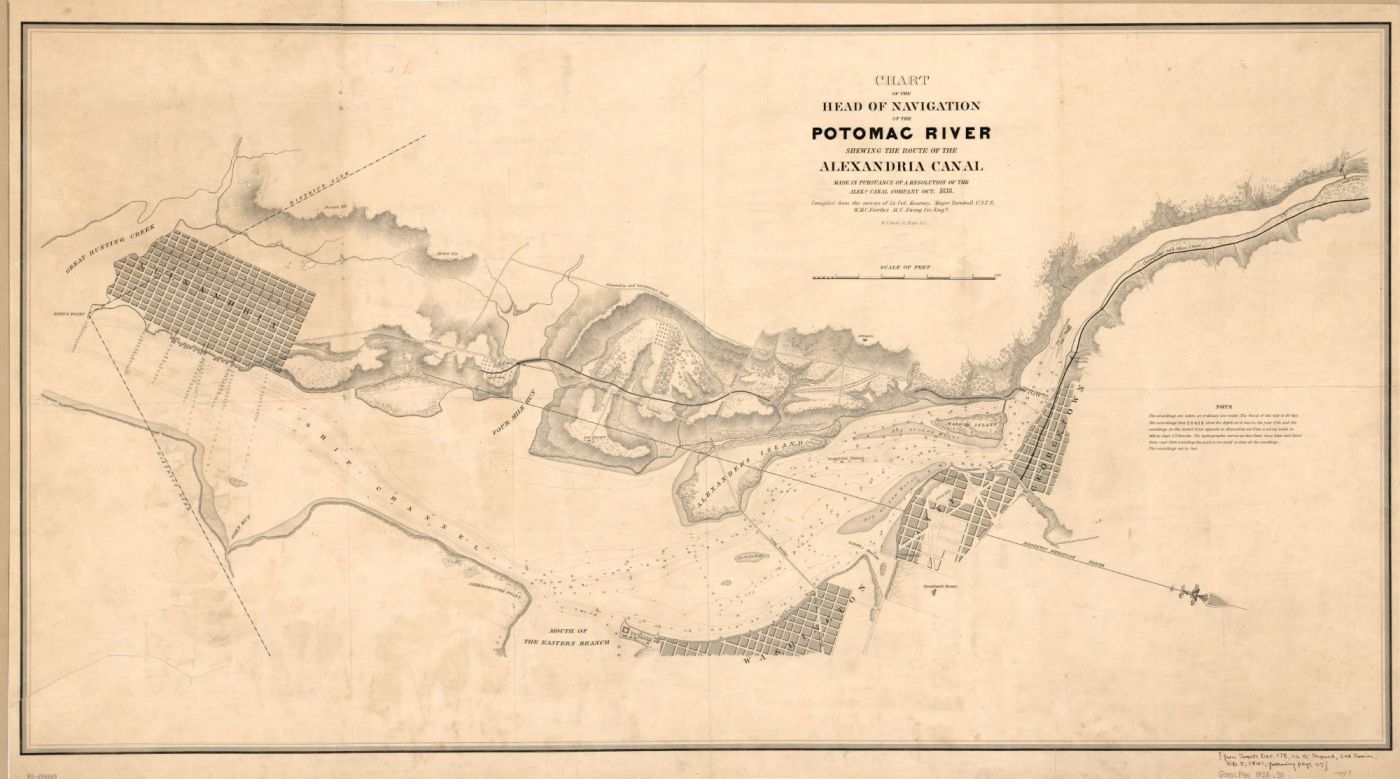
The Alexandria Canal was officially opened to trade and navigation on the Potomac River. (Alexandria was part of the District of Columbia at the time but would be returned to Virginia about two years later.) This canal, which ultimately ran southwards for seven miles (11.3 kilometers) through Alexandria and Virginia’s present-day Arlington County and connected these areas with the community of Georgetown via the Potomac Aqueduct Bridge, played an important role in the region’s commercial development over the next few decades.
For the formal debut of the Alexandria Canal, the first vessel to travel on the new water route was the aptly named boat Pioneer. Those on board this boat on that Saturday morning included Joseph Eaches (1794-1857), who had become mayor of the town (now independent city) of Alexandria nine months earlier and would remain in the position until 1846. He was accompanied on this inaugural trip by “a large number of our fellow citizens,” in the words of the Alexandria Gazette, and the directors of the Alexandria Canal Company.
The Alexandria Gazette further reported “The boat stopped amidst the cheers and congratulations of a large crowd assembled to witness the interesting sight, and the heartiest tokens of satisfaction were given on the ground, and throughout the whole town.” This newspaper then stated, “In honor of the event a salute was fired, the national flag was hoisted at the public square, and the vessels in port were decorated with flags.”
The National Intelligencer likewise highlighted the role of Pioneer during that day’s festivities in Alexandria. This newspaper proclaimed, “May numerous other well-freighted boats speedily succeed her, and may the Alexandria Canal prove as beneficial to the trade of that port as her enterprising citizens so anxiously desire.”
Over the next few decades, the commodities shipped via that waterway to Alexandria included coal, wheat, corn, whiskey, corn meal, and flour; the various products transported from this community’s wharves via the canal included fish, salt, plaster, and lumber.
The Alexandria Canal remained in service until 1886. This route has since served as a pivotal transportation link in other key respects. A decade after the waterway closed, for example, an electric trolley line running along the bed of the towpath on the canal’s west side (the current location of South Eads Street in Arlington County) was constructed.
In addition, the Pennsylvania Railroad built a branch line in that part of Virginia near and along the segment of the one-time canal route between Arlington National Cemetery and the Potomac River. A section of the Washington Metro rapid transit system’s Blue Line now travels along this route.
Image Credit: Public Domain
For more information on the Alexandria Canal, please check out https://arlingtonhistorical.com/items/show/132 and https://arlhist.org/wp-content/uploads/2017/02/1966-2-History.pdf

 Transportation History
Leave a comment