January 23, 1855
A suspension bridge across the Mississippi River was officially opened in what was then the U.S. Territory of Minnesota. (This portion of the territory was admitted to the Union as the state of Minnesota in 1858; the territory’s western region was eventually reorganized as part of the Territory of Dakota.) The bridge, which linked the present-day city of Minneapolis on the west bank with Nicollet Island, is generally believed to be the first permanent crossing over the main channel of the Mississippi River.
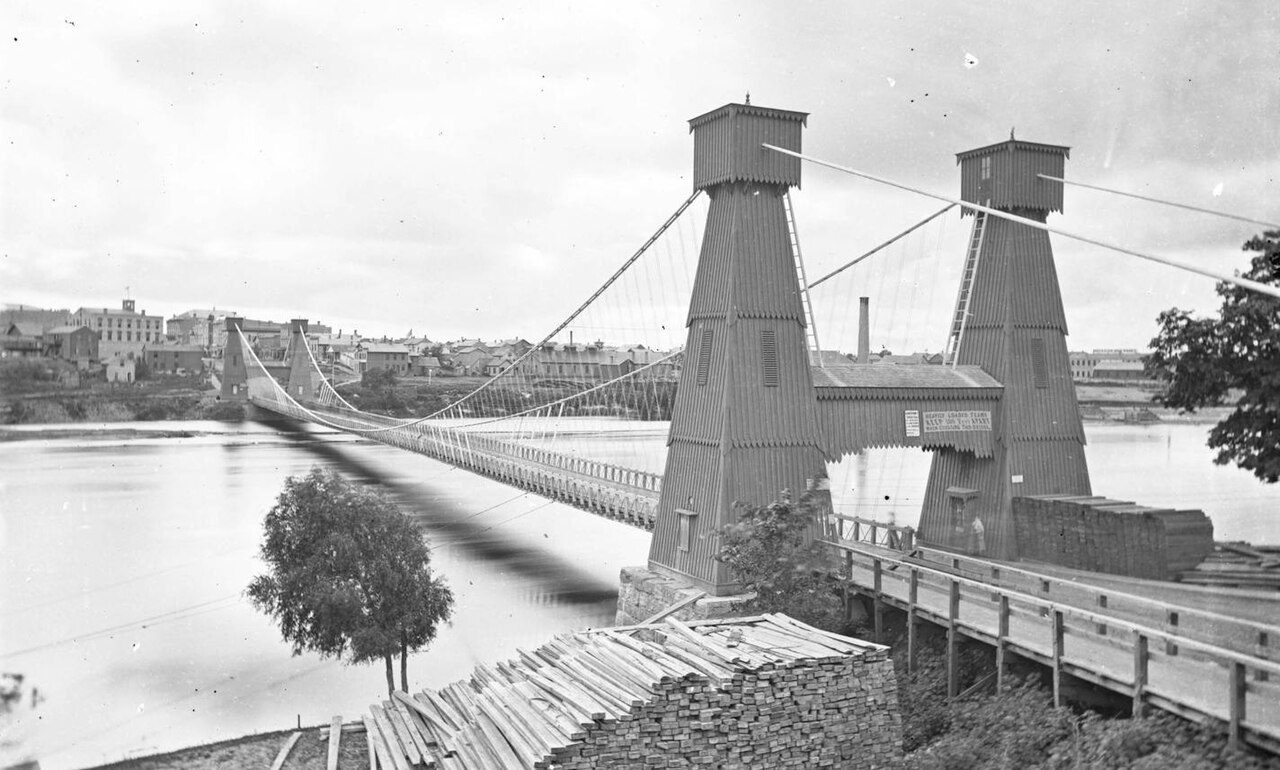
The structure measured 620 feet (190 meters) in length and featured tall wooden towers, wire suspension cables, a stone base, and cast-iron anchors. On the afternoon of this bridge’s formal debut, a large parade that included banners and a marching band — along with sleighs filled with people — gathered in front of the St. Charles Hotel in was then the community of Saint Anthony (merged into Minneapolis in 1872) on the east bank of the river.
The procession made its way over a small bridge connecting the east bank with Nicollet Island, and then onto the new suspension bridge. This parade’s participants were welcomed on board the new structure with a celebratory cannon blast. After making their way across the bridge and onto the west bank, the participants circled back to the east bank for a banquet at the St. Charles Hotel.
William Jackson Parsons (1824-1880), a prominent attorney and Saint Anthony resident who served as chairman of those festivities at the hotel, spoke rather effusively about the just-opened bridge. He asserted, “The consciousness that we all friends together, met to celebrate an event which makes an era in our local history, — an event without a parallel in the history of any Territory of the Union.”
One of the other speakers at this banquet was Willis A. Gorman (1816-1876), the territorial governor of Minnesota from 1853 to 1857. He likewise emphasized the significance of the bridge. “It is now complete, and Minnesota men, and Minnesota capital, and Minnesota enterprise, now claim the honor of being the first to span the great king of rivers,” Gorman said. “Let not the opportunity pass you of making known to the Congress of the United States the accomplishment of this great work.”
The Daily Minnesota Pioneer was similarly enthusiastic in its own account of the grand opening of the bridge. This newspaper reported, “It was a great day for Minnesota, and a signal and impressive mark of the spirit of progress which activates her people, when on the Twenty-Thirds of January of January in the good year 1855, the citizens of Saint Anthony and Minneapolis in company with those of St. Paul and other places, inaugurated the completion of a bond by which the Father of the Waters is, for the first time since its waters rolled from it source, in Itasca lake, to the mighty Atlantic, spanned by as beautiful a structure as any that have been made in the United States, with all the aids that abundant capital could render.”
The Daily Minnesota Pioneer also noted, “We were present at the Celebration, and enjoyed it keenly — albeit the weather was somewhat too cold for outdoor ceremonies. The day was a blessing in its brightness and its beauty, and a feeling of exultation pervaded all.”
The bridge was named after Father Louis Hennepin (1626-1704), a Catholic priest from Belgium whose missionary work in North America included time in what is now Minnesota. The Father Louis Hennepin Suspension Bridge that opened in 1855 remained in service until being replaced with a new bridge in 1877. That 1877 structure, in turn, was replaced by a bridge opened in 1888. In 1990, the current structure in that vicinity — the Hennepin Avenue Bridge — was dedicated. (The accompanying photo of the original bridge was taken in 1868.)
Photo Credit: Public Domain
For more information on the Father Louis Hennepin Suspension Bridge that opened in 1855, please check out https://www.mnhs.org/mnopedia/search/index/structure/father-louis-hennepin-suspension-bridge

 Transportation History