February 13, 1958
The Ford Motor Company introduced the first four-passenger model of the Ford Thunderbird (popularly known as the T-Bird) nearly four years after the original version of this automobile — which was built for two — had made its official debut. The four-passenger version marked the transformation of the T-Bird from a sports car to a luxury vehicle and further established it as a still-resonant symbol of 1950s American culture.
A major force behind the development and launch of this second-generation T-Bird was Robert S. McNamara (1916-2009), the group vice president in charge of the Ford Motor Company’s car and truck divisions. He and other company executives strongly insisted that the original version of the T-Bird ultimately restricted the sales potential for that line — especially as a vehicle for families. (In 1960, McNamara became the company’s first president from outside the Ford family in more than a half-century; he went on to serve as U.S. secretary of defense.)
While retaining the two-door design, the new T-Bird was larger and featured dual headlights, more prominent tailfins, and a bigger hood scoop. The second-generation version was also set apart from its predecessor by a design that was not rounded but rather defined by flat surfaces, sharper angles, and a square-rigged appearance. These changes earned this redesigned T-Bird the additional nickname of Square Bird.
Even though February 13, 1958, marked the formal introduction of the second-generation T-Bird, rumors of this version were reported in the press as far back as June of the previous year. It was not until October 16, 1957, that the Ford Motor Company officially acknowledged that the two-seat T-Bird would soon be replaced by something roomier. That New Year’s Eve, a sneak-peek display of this replacement took place for a small group of people at the Thunderbird Golf Club in Palm Springs, California.
About a month later, a similarly limited unveiling of the new T-Bird was held at the California Golf Club in the Golden State’s city of South San Francisco. The person officiating at this event was William Clay Ford Sr. (1925-2014), vice president and director of the Ford Motor Company. (He became the last surviving grandchild of the company’s founder Henry Ford [1863-1947].)
The next day’s edition of the San Francisco News reported on this unveiling of the latest incarnation of the T-Bird for that selective gathering. This newspaper stated, “Ford said the company has received 3000 advance orders for the new T-Bird model ‘even before there has been any advertising or promotion of the car.’”
Following its large-scale public rollout in dealer showrooms across the United States on February 13, this model was highlighted in the New York-based Syracuse Herald-Journal. “Ford’s 1958 Thunderbird is an outgrowth of public opinion polls on the successful two-passenger Thunderbird,” reported this newspaper. “Designers were given a free hand to blend their dreams with those of the consumers. A four-passenger Thunderbird is the result.”
This article further noted, “One of the main challenges was to change the Thunderbird into a four-passenger model with easy entrance and exit, but without destroying the fun-to-drive features and performance of the two-passenger model. Stylists widened the doors by more than half a foot [.02 of a meter] and installed new type seats. The two front seats are individual and separate and can be adjusted separately.”
That second-generation version, which was produced at a new Ford assembly plant in Wixom, Michigan, made history by becoming the first individual model line to earn Motor Trend magazine’s “Car of the Year” designation. Approximately 38,000 of these four-seater cars were initially purchased, outselling the original model and making that new T-Bird only one of two American automobiles to increase sales that year. This model remained in production until 1960.
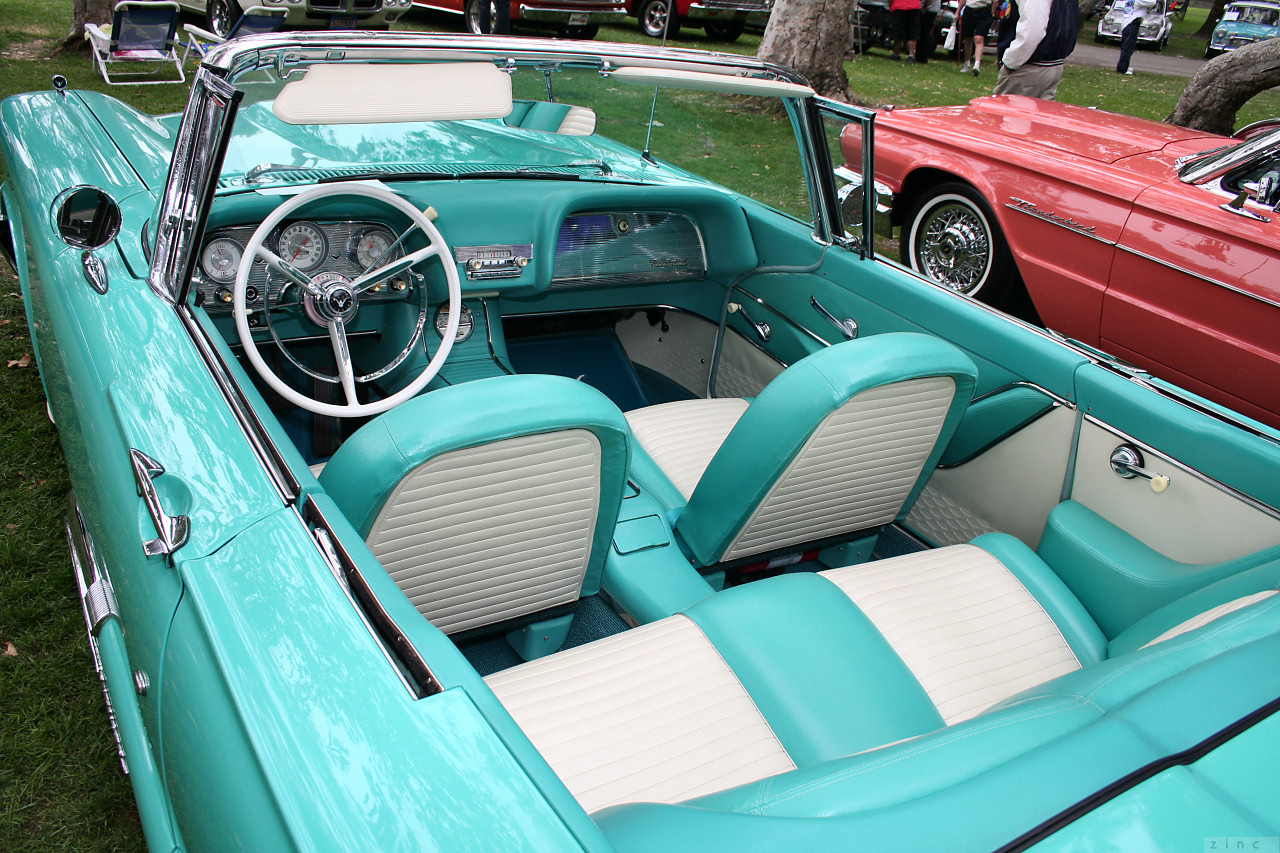
Over the next few decades, several more versions of the T-Bird were produced until the final one rolled off the assembly line in July 2005. A second-generation model made in 1960 is now on permanent display at the Heinz History Center in Pittsburgh. The accompanying photo taken in 2010 shows the interior of a version that was maufactured in 1959.
Photo Credit: Rex Gray (https://www.flickr.com/photos/25393258@N07/) — licensed under the Creative Commons Attribution-Share Alike 2.0 Generic license at https://creativecommons.org/licenses/by-sa/2.0/deed.en
For more information on the second-generation version of the Ford Thunderbird, please check out https://en.wikipedia.org/wiki/Ford_Thunderbird_(second_generation)#

 Transportation History
Leave a comment