March 10, 1906
SS Viper was launched at the shipyard of Fairfield Shipbuilding and Engineering Company (widely known as Fairfields) in the Scottish burgh of Govan. (Six years later, Govan was annexed as part of the city of Glasgow.) This steel, triple-screw, turbine-driven was built at Govan by Fairfields for use by the maritime transportation service G. and J. Burns for its Irish Channel route between the Scottish burgh (now town) of Ardrossan and the Irish city of Belfast.
“As the new turbine steamer Viper glided down the way from Fairfield Yard into the [River] Clyde on Saturday afternoon,” reported the Glasgow-based Daily Record a couple of days after this vessel’s launch, “everybody admired her fine lines and thought in anticipation of a delightful run to Belfast.” The launch took place, in the words of the Belfast Evening Telegraph, “in the presence of a large and distinguished company of invited guests.”
Alexander Gracie (1860-1930), who was director of Fairfields at the time and later became the company’s chairman and managing director, was among those on hand for this launch. The other people in attendance included James Cleland Burns, the third Lord Inverclyde (1864-1919), an avid yachtsman who had become principal director of the aforementioned maritime transportation service founded by his father and an uncle; and his wife Charlotte Mary Emily Burns, Lady Inverclyde (1865-1951), who performed the ceremonial duties for Viper’s launch.
The Daily Record recounted, “Without a hitch, the launch passed off, loud cheering following when her Ladyship had released the ship.” This newspaper also reported, “At the luncheon afterwards, Mr. Gracie proposed success to the new boat, which, he said had been specially designed for the cross-channel service. For equipment and comfort, she was not surpassed by any vessel afloat.”
Viper, which could accommodate up to 1,700 passengers and 61 crew members, served on G. and J. Burns’ Androssan-Belfast route for several years. During World War I, this vessel was placed into military service as a troopship. She had the distinction of being one of the few British troopships that did not need to be accompanied by escorts since her faster-than-average speed was deemed sufficient for evading potential assaults by enemy vessels.
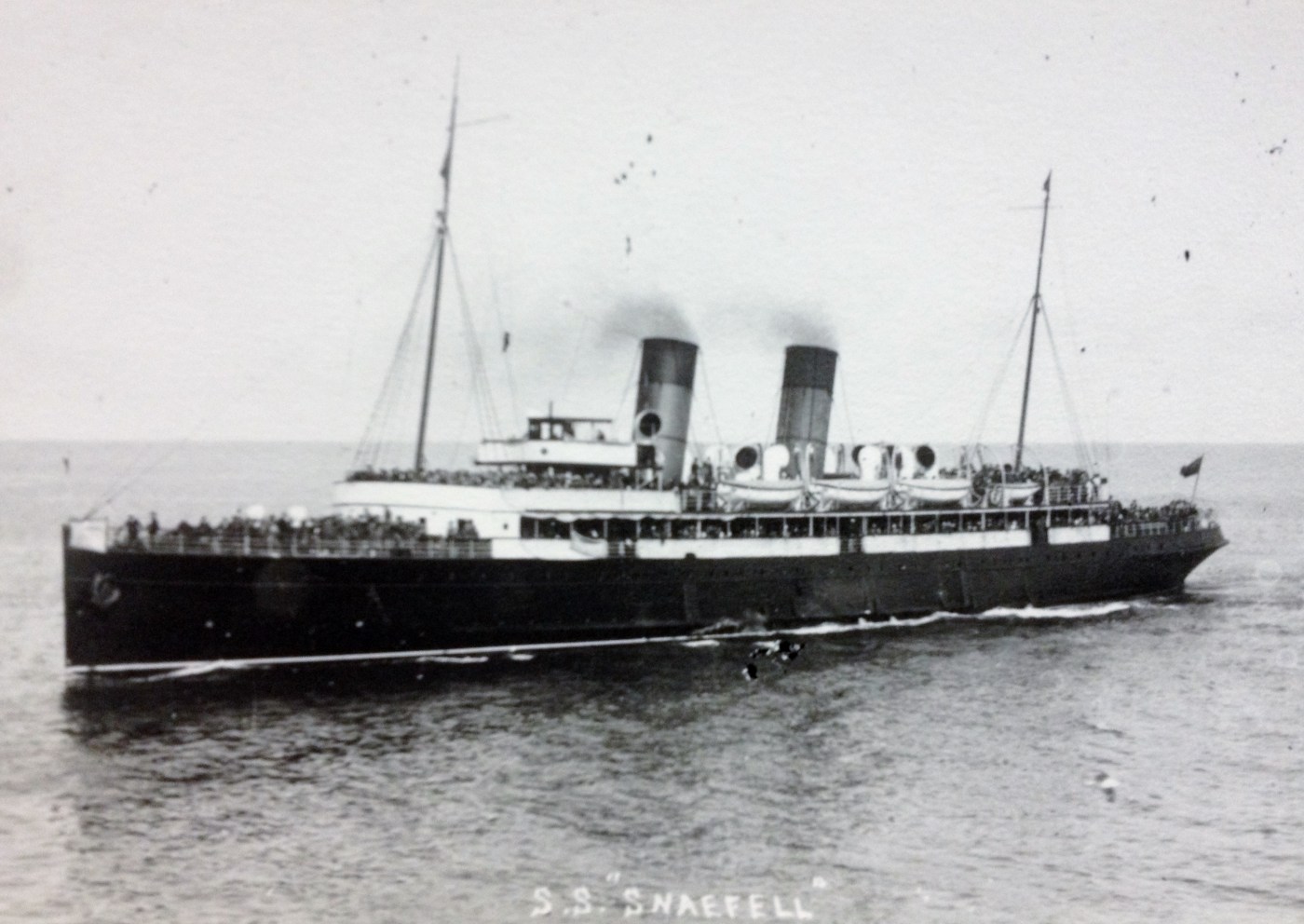
In 1920, G. and J. Burns sold Viper to the Isle of Man Steam Packet Company (IoMSPCo). The new owner of the ship renamed her Snaefell and she ended up serving on IoMSPCo’s numerous routes. (The accompanying photo was taken during that stage of the ship’s career.) Snaefell was the fourth IoMSPCo vessel to be named after the highest mountain on the Isle of Man.
After the outbreak of World War II, SS Snaefell was among the IoMSPCo ships used to help maintain vital maritime links between the Isle of Man and the British mainland. In addition, Snaefell served for one year during the war as a troopship. Following the end of that global conflict, Snaefell was retired from service altogether and sold for scrapping. This vessel would not actually be broken up until 1949, however.
Photo Credit: Public Domain
For more information on SS Viper (later renamed SS Snaefell), please check out https://en.wikipedia.org/wiki/SS_Snaefell_(1906)

 Transportation History
Leave a comment