March 20, 1956
Only four days after his 76th birthday, inventor and engineer William Bushnell Stout died of a heart attack at his home in Phoenix, Arizona. Stout, who made significant innovations in the aviation and automotive fields, had been born in 1880 in Quincy, Illinois. After graduating from the Mechanic Arts High School in Saint Paul, Minnesota, he briefly pursued his post-secondary studies first at Hamline University (likewise based in Saint Paul) and then the University of Minnesota.
Stout ultimately combined his considerable interest and expertise in mechanics with his strong enthusiasm for both airborne and surface transportation. He founded the Model Aero Club of Illinois, for example, and in 1907 began working as chief engineer for the Saint Paul-based Schurmeir Motor Car Company. In 1912, Stout became automobile and aviation editor for the Chicago Tribune. That same year, he launched the magazine Aerial Age. This magazine was among the first in the United States to be focused on aviation.
In 1914, Stout became chief engineer of the Detroit-based automobile manufacturer Scripps-Booth Company. Stout was hired two years later to serve as chief engineer at the newly formed aviation division of the Packard Motor Company (also headquartered in Detroit). In 1919, he went into business for himself by establishing Stout Engineering Laboratories.
It was during Stout’s time leading this enterprise that he developed a major part of his automotive legacy – a streamlined car that was named the Stout Scarab. Stout built the prototype for this vehicle in 1932, and it has been regarded by quite a few people as the first-ever production minivan. The Scarab’s innovative features included the maximization of interior space. This additional room was made possible by a ponton design in which running boards were left out altogether and the cabin was expanded to encompass the full width of the vehicle. Another unique feature entailed incorporating stylized versions of an ancient Egyptian scarab throughout the bodywork of the automobile (including its emblem).
Stout continued producing the Scarab after he reorganized his business as Stout Motor Car Company in the mid-1930s. One of his subsequent innovations involving this vehicle was a prototype that had the distinction of being the world’s first automobile with both air suspension and a fiberglass body shell.
Even as he vigorously pursued an automotive career, Stout also managed to invest an equally large share of his time and formidable energies into aeronautics. During World War I, he served on the U.S. federal government’s Aircraft Production Board. This board awarded Stout with a contract to construct a blended wing fuselage aircraft. He ended up developing the Stout Batwing, which became one of the earliest aircraft to be built with a cantilever wing design. (With funding from the Boston-based spark plug company Champion after the war, Stout built a high-wing, three-passenger cantilever aircraft that was called the Stout Batwing Limousine.)
Another one of his aviation endeavors took place in 1922, when he founded the Stout Metal Airplane Company. This enterprise was purchased by the Ford Motor Company two years later, and Stout joined this transportation titan as the vice president and general manager of its metal airplane division.
One of Stout’s more notable accomplishments in those roles was the development of the Ford 4-AT-A Tri-Motor plane. This pioneering plane, which made its first public flight tests in June 1926, was powered by three air-cooled Wright Whirlwind J 4 radial engines. Another distinguishing feature of the aircraft was that its fuselage and wings consisted of aluminum alloy that was corrugated for added strength – a composition that earned this type of plane the nickname “Tin Goose.”
Stout used these planes for yet another ambitious effort, namely the first regularly scheduled airline in the United States. By the end of 1927, Stout Air Services was routinely transporting passengers between Cleveland and Detroit via Ford Tri-Motors. This airline also became the first one to open a ticket office for its flights. This airline, which was tightly intertwined with the Ford Motor Company, was a trailblazer as well when it came to popularizing commercial aviation for the American public. Stout Air Services was purchased by United Aircraft and Transport Corporation in 1929.
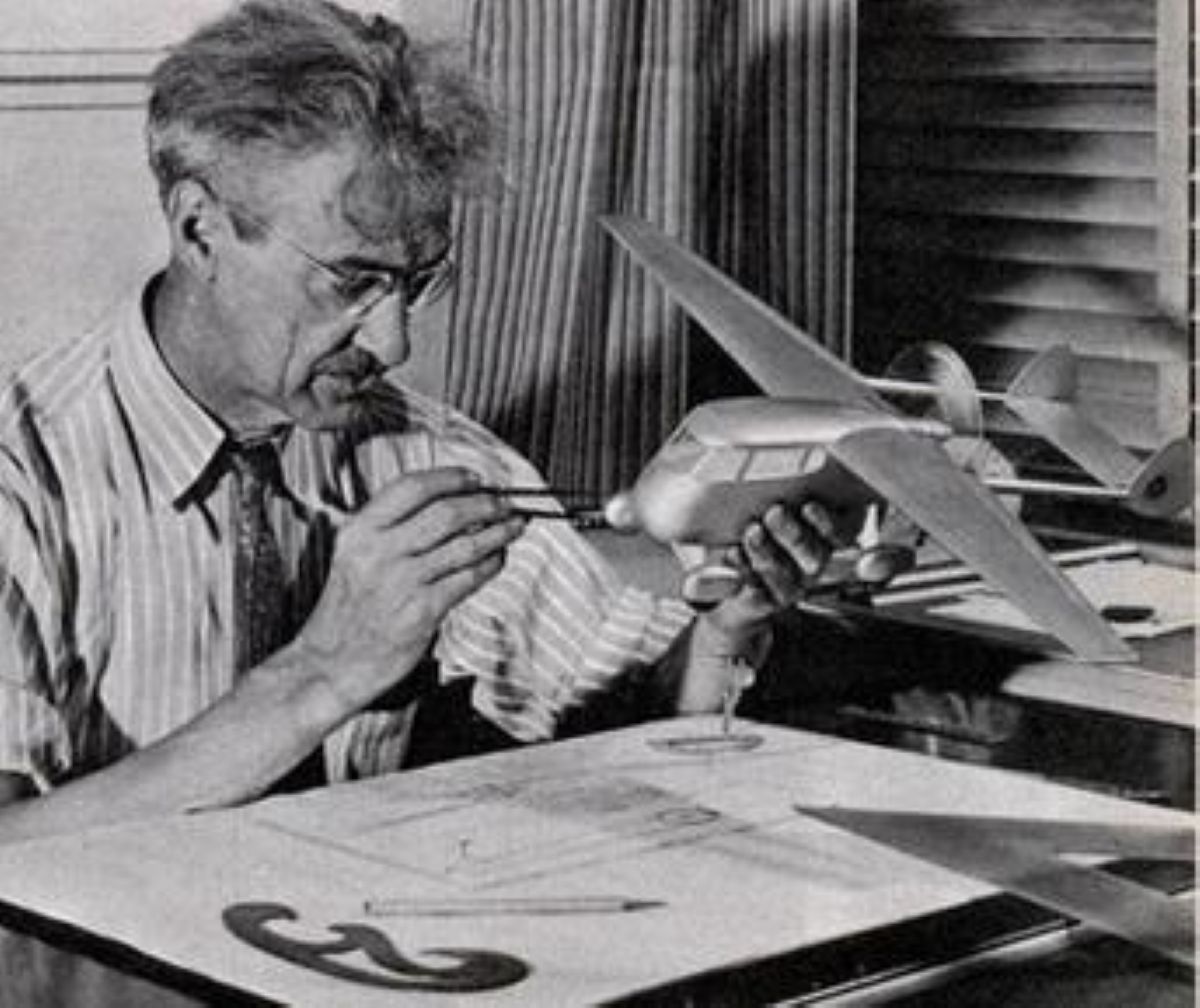
Stout remained with the Ford Motor Company’s metal airplane division until 1930. His subsequent airborne achievements included creating the Stout Skycar, a type of light aircraft that he designed to combine easy handling with an automobile-like comfort for those traveling on board it. Stout built four variations of the Skycar between 1931 and 1944.
In an editorial about Stout that was published a few days after his death, the Oregonian highlighted his contribution to air travel. “William was something of an economist as well as a dreamer and doer,” eulogized this newspaper. “Men and women of the aviation industry will mourn his passing, knowing that every airplane that flies overhead today owes some of its speed and reliability to the genius of William Bushnell Stout.” The Detroit Free Press, for its part, stated that Stout “was a man with a brilliant mind, a ‘practical visionary’ with a lovable wit.”
The Tulsa Tribune similarly weighed in on the late innovator’s legacy and personal qualities. “Bill Stout was a delightful character, a lean, tousle-haired, twinkle-eyed fellow whose enthusiasm over things and people belied his 76 years,” asserted an editorial in this newspaper. “He was a mechanical engineer, but he refused to allow any rigid rules of physics to slow down his imagination.”
Photo Credit: Public Domain – https://commons.wikimedia.org/wiki/File:William_Bushnell_Stout_(1880-1956)_with_a_model_of_his_aircar_in_Mechanix_Illustrated_on_November_1,_1943.png
For more information on William Bushnell Stout, please check out https://en.wikipedia.org/wiki/William_Bushnell_Stout

 Transportation History
_with_a_model_of_his_aircar_in_Mechanix_Illustrated_on_November_1,_1943.png)
Leave a comment