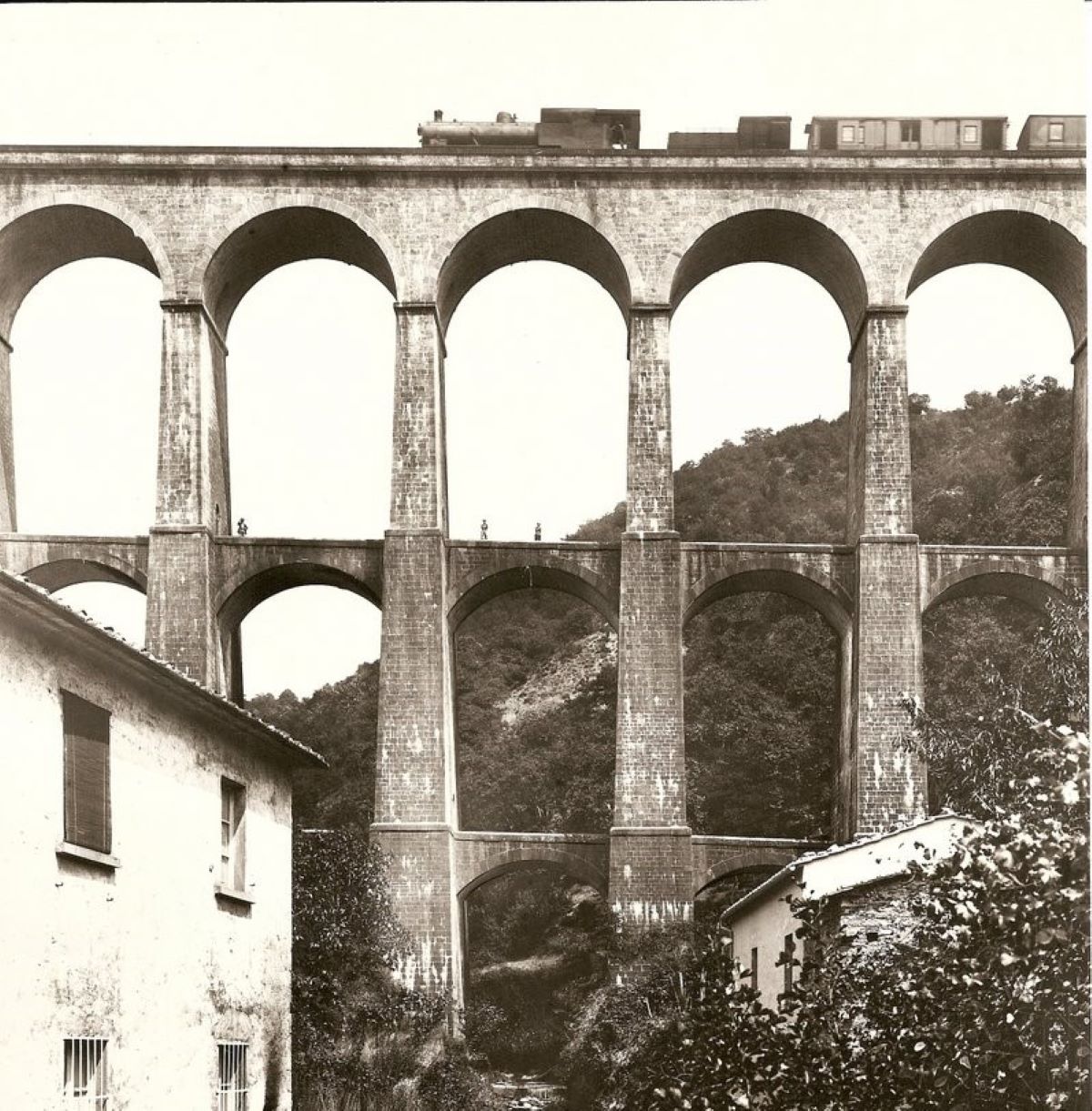
November 2, 1864
A newly completed railway in the Kingdom of Italy was officially opened. (The Kingdom of Italy existed from 1861 to 1946; it was replaced by the present-day Republic of Italy.) That 61.5-mile (99-kilometer) line connected the city of Bologna in Emilia-Romagna region with the city and comune (municipality) of Pistoia in the Tuscany region. The Pistoia-Bologna railway — formally known as the Central Italy Railway (Strada ferrata dell’Italia Centrale) — was the first line to course through the part of the Appenine Mountains in both of those regions of Italy.
French engineer and surveyor Jean Louis Protche oversaw the construction of the Pistoia-Bologna railway and to say that it was a complex and topographically daunting project would be an understatement. Ultimately, the infrastructure designed and created for this railway included at least 47 tunnels and a total of 35 bridges and viaducts.
The 24.2-mile (39-mile) section of the railway between Bologna and the comune of Vergato was completed on August 18, 1862. The segment covering 21.8 miles (35 kilometers) between Vergato and the village and frazione (hamlet) of Pracchia was completed on December 1 of the following year. Following the completion of the remaining 15.5 miles (25 kilometers) of the line, the Pistoia-Bologna railway was inaugurated by King Victor Emmanuel II of Italy on November 2, 1864.
Only about nine months later, this railway was absorbed by the Upper Italian Railways. The Upper Italian Railways, in turn, was taken over by the railway system Mediterranean Network in 1885. The section that had been built as the Pistoia-Bologna railway is now managed by Trenitalia, Italy’s primary train operator, and it is used for local traffic only.
Photo Credit: Public Domain
For more information on the Pistoia-Bologna railway, please check out https://en.wikipedia.org/wiki/Pistoia%E2%80%93Bologna_railway

 Transportation History