The Montgomery Bus Boycott, along with being a transportation-oriented protest against racial segregation practices in Alabama’s capital city, was a pivotal chapter in the larger civil rights movement in the United States.
At the time of this boycott during the mid-1950s, longstanding Jim Crow laws that enforced segregation throughout the American South were very much in evidence in the daily operations of Montgomery’s public bus system. The 10 front seats of each of those buses were reserved exclusively for white passengers, while the 10 back seats were designated for black people only. The middle section of each bus contained a total of 16 unreserved seats for both black and white passengers, but with discriminatory conditions in place.
Under those conditions, white people filled the middle seats from the front to back while black people were provisionally allowed to fill seats in that section from the back to front. If other black people boarded the bus after all the seats were taken, those individuals were required to stand. If a white person boarded a bus with every seat already filled, however, all of the black passengers in the row closest to the front part of the middle section were required to vacate their seats and stand elsewhere in the vehicle so that the row could instead be made available for white people only. (A law in effect in Montgomery at that time prohibited black and white people from sitting next to each other.)
These restrictions were all the more egregious because black people made up 75 percent of the Montgomery bus system’s ridership. In addition, black people were denied the opportunity to work as bus drivers.
A momentous challenge to the unfair treatment of black passengers on the city’s buses took place on December 1, 1955. This was when Rosa Parks, a 42-year-old seamstress and highly active member of the NAACP, boarded a bus and at in the foremost row in the middle section for black passengers. When a white man came on board the crowded bus, the driver ordered everyone in Parks’ row to vacate their seats. Parks had recently completed a course in which she learned more about nonviolent civil disobedience as a potentially effective tactic in the struggle for civil rights, and she became the only person on that fateful day who did not comply with the driver’s demand that black passengers in that particular row relinquish their seats.
As a result of her act of civil disobedience, Parks was arrested. On December 5, she was found guilty and had to pay both a fine of 10 dollars and a court cost of four dollars (a total equivalent to approximately $153 today). While there were other black city residents who previously refused to give up their seats on buses for white passengers — one such person was 15-year-old Claudette Colvin nine months earlier — it was Parks’ act that ultimately proved to be the catalyst for an organized large-scale effort undertaken to address and alleviate discriminatory treatment on Montgomery’s buses.
This effort was a boycott of those buses by a large segment of the city’s black community. This boycott formally took effect on the same day that Parks was found guilty. Over the next several months, many of Montgomery’s black residents avoided traveling on buses and instead relied more extensively than before on other mobility options. These transportation alternatives included taxis and privately owned automobiles and also non-motorized means such as walking, cycling, and even horse-drawn buggies.
The Montgomery Bus Boycott turned out to be very effective, with the city’s bus system taking a big hit financially due to the significant drop in black ridership. Another major development in this fight for equality was the related court case Browder v. Gayle, which was heard before a three-judge panel of the U.S. District Court for the Middle District of Alabama. This panel ruled on June 5, 1956, that Alabama’s racial segregation laws for buses were unconstitutional. This decision was upheld by the U.S. Supreme Court on November 13, 1956.
The combination of legal and logistical victories brought about the official end of the Montgomery Bus Boycott on December 20 of that year. As events in Montgomery over the next several years made clear, though, the desegregation of seats on the city’s buses hardly meant full-fledged racial harmony in that vicinity in the medium term. The Ku Klux Klan and other white supremacist groups in the area quickly escalated their acts of terror against black residents, for example, and Parks — weighed down by death threats and other forms of harassment — eventually left Montgomery to live elsewhere.
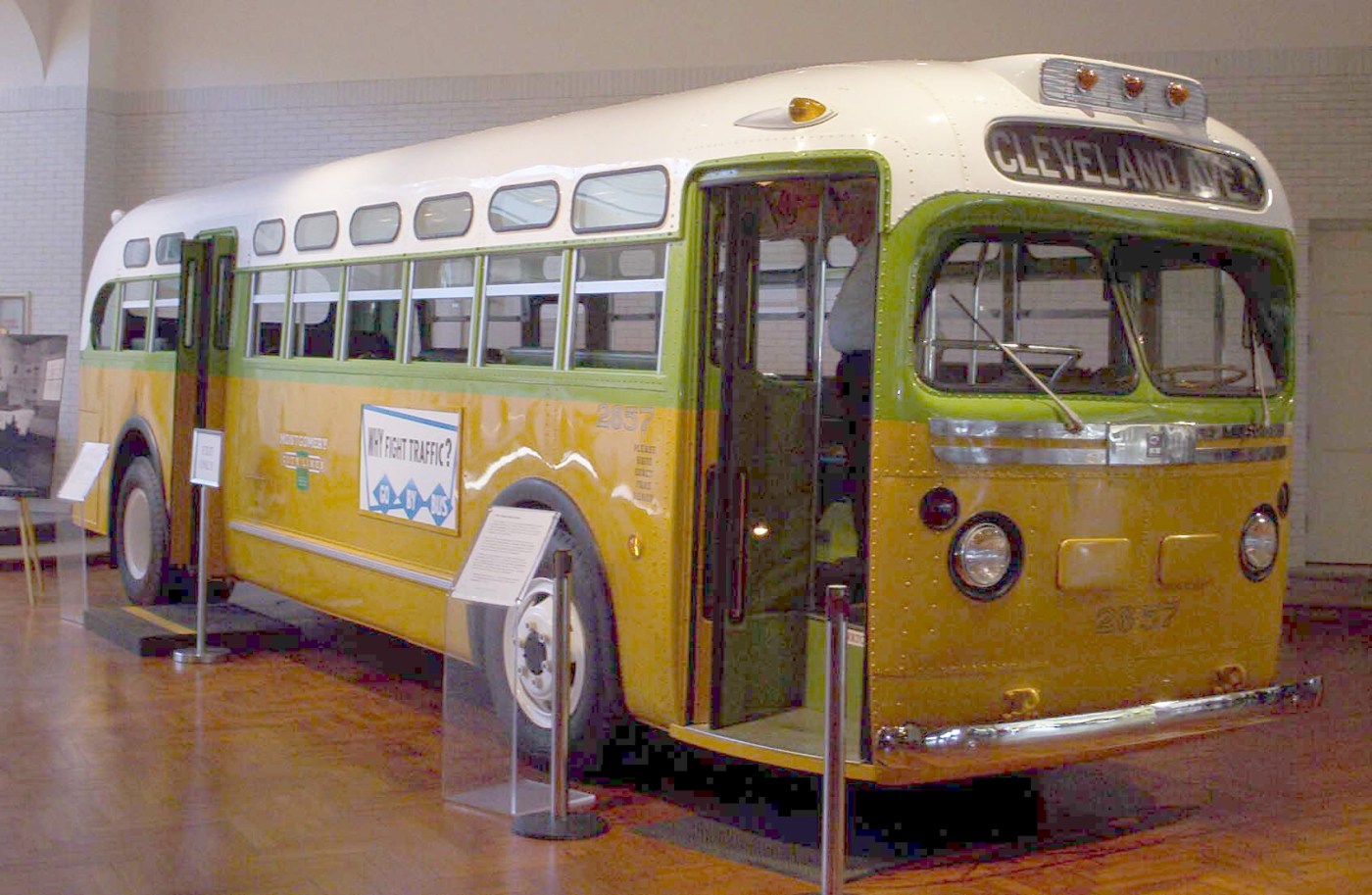
Notwithstanding these horrendous consequences, the Montgomery Bus Boycott also struck powerful chords of hope and inspiration for many Americans well beyond Alabama and helped galvanize the civil rights movement in the years that followed. One of the lasting symbols of that boycott is the bus on which Parks rode when she made her history-making decision not to give up her seat. This vehicle, which is featured in the accompanying photo, can be found today at the Henry Ford Museum in Dearborn, Michigan.
Photo Credit: Maksim (licensed under the Creative Commons Attribution-Share Alike 3.0 Unported license at https://creativecommons.org/licenses/by-sa/3.0/deed.en)
For more information on the Montgomery Bus Boycott, please check out https://www.nps.gov/articles/montgomery-bus-boycott.htm and https://en.wikipedia.org/wiki/Montgomery_bus_boycott

 Transportation History
Leave a comment