June 20, 1897
Harold Frederick Pitcairn, who made major contributions to various types of aircraft, was born in Moreland Township in southeastern Pennsylvania. In 1916, residents in the central part of this township broke away to form what is now the home-rule borough of Bryn Athyn; the following year, the remainder of the township was reconstituted as both Lower Moreland Township and Upper Moreland Township.
Pitcairn’s early interest in aviation more fully took shape during the summer of 1914, when he served as an apprentice at the Curtiss Aeroplane and Motor Company in Hammondsport, New York. A couple of years later, Pitcairn took flight lessons at the Curtiss Flying School’s Atlantic Coast Aeronautical Station in Newport News, Virginia.
After the United States’ entry into World War I on the side of the Allied Powers, Pitcairn enlisted in the U.S. Army Air Service. He underwent military flight training at Rich Field in Waco, Texas. After the armistice that ended the war went into effect, Pitcairn was honorably discharged.
Pitcairn’s considerable post-war business initiatives included founding Pitcairn Aviation, an air travel corporation that ultimately became part of Eastern Air Lines; and the Pitcairn Aircraft Company, a manufacturer of light utility aircraft. Another one of his noteworthy aviation efforts during the 1920s involved developing and opening an airfield located seven miles (11.3 kilometers) northwest of his farm in Bryn Athyn. A hangar and 2,000-foot (610-meter)-long runway were among the key features of Pitcairn Field. Pitcairn’s fleet of biplanes included a Farman FF 65 Sport; two Marinsydes; and four Curtiss Orioles.
The Pitcairn Aircraft Company’s first means of airborne transportation was built at that field in 1925. This five-passenger commercial biplane was the Pitcairn PA-1 Fleetwing. Another one of the company’s commercial biplanes, the Pitcairn PA-2 Sesqui-Wing, finished first in both the efficiency and high-speed classes of the 1926 National Air Races. Over time, Pitcairn filed a total of 30 U.S. patents for rotary-wing aircraft.
Another career milestone for Pitcairn took place in January 1927, when the U.S. Post Office Department (predecessor of the U.S. Postal Service) awarded him a contract air mail route between New York City and Atlanta. In addition, he was awarded a contract air mail route between Atlanta and Miami in November of that year. The three-seat sport utility biplane built by the Pitcairn Aircraft Company for these mail routes and others was the Pitcairn PA-5 Mailwing. This aircraft remained in use for mail delivery until 1931.
Pitcairn acquired yet another claim to fame on December 18, 1928, when he made the first flight of the Autogyro in the United States. This flight of the Autogyro – a type of rotorcraft that relies on an unpowered rotor in free autorotation in order to generate lift and propulsion – took place in the skies above Pitcairn Field. The person who created this rotorcraft (also known in generic terms as an autogiro) was Spanish pilot and civil engineer Juan de la Cierva. On February 14, 1929, Pitcairn paid $300,000 for the American rights to de la Cierva’s inventions and patents. The Pitcairn-Cierva Autogryo Company was established to license the production of the Autogryo in the United States.
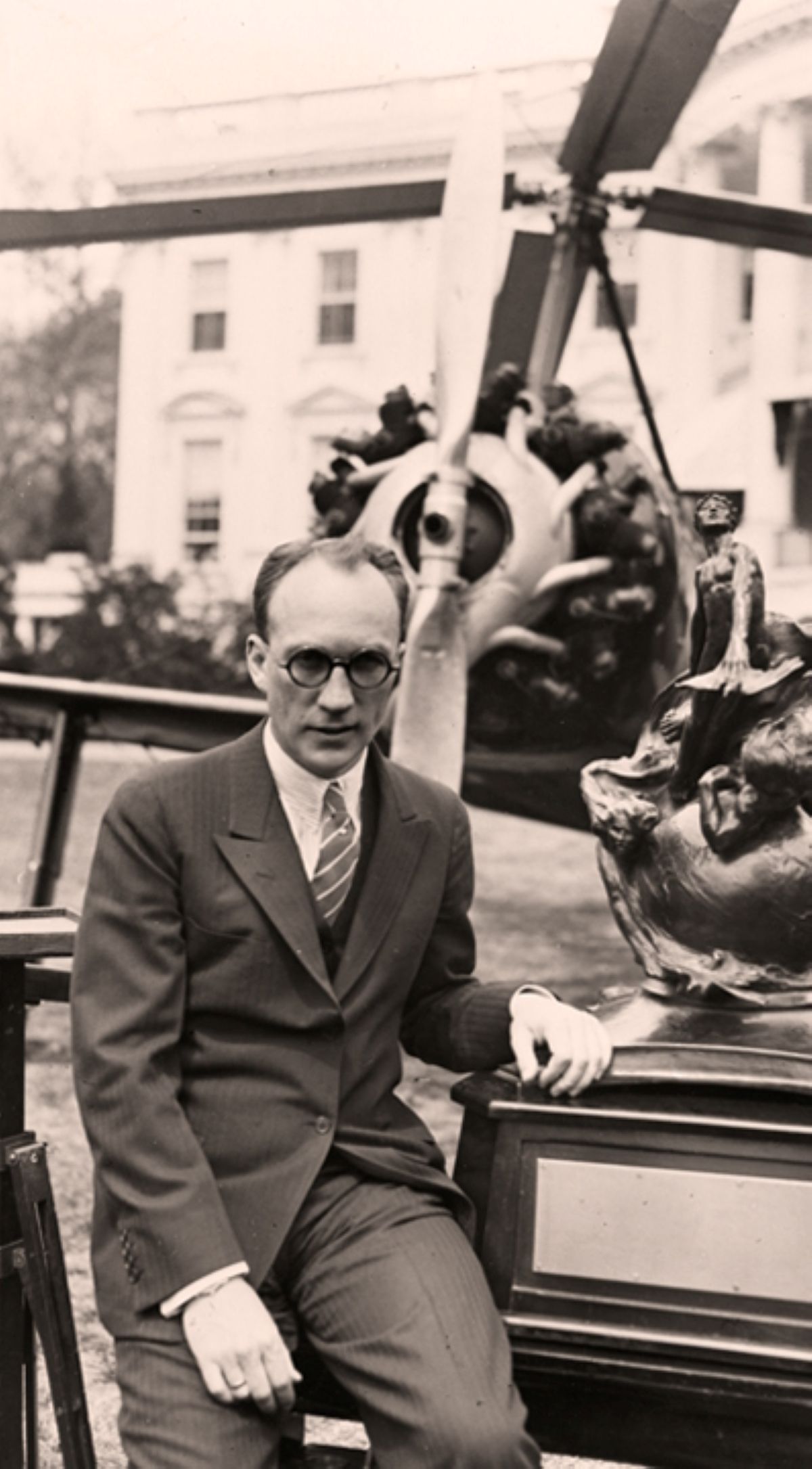
The following year, Pitcairn received the Robert J. Collier Trophy for his aviation accomplishments and specifically his contributions to further development of autogiros. (The accompanying photo shows Pitcairn with that trophy.) In 1931, the trophy was formally presented to Pitcairn by President Herbert Hoover on the South Lawn of the White House.
During this ceremony, an autogiro called the Pitcairn PCA-2 landed there. This rotorcraft was flown by James G. Ray, Pitcairn’s chief test pilot and vice president of the Pitcairn-Cierva Autogryro Company, and it marked the first landing of any kind of aircraft on the White House grounds.
It was also in 1931 that Pitcairn and de la Cierva were both awarded the John Scott Medal for their respective innovations to rotorcraft. On October 19 of the following year, Pitcairn officially introduced the largest autogiro ever built. The Pitcairn PA-19, which was outfitted with a fully enclosed cabin rather than the open cockpit typically installed in autogiros, had a length of 25 feet and nine inches (7.9 meters) and a wingspan of 38 feet and eight inches (11.8 meters).
On April 24, 1960, Pitcairn died from a gunshot to the head at his mansion in Bryn Athyn. He was 62. It was Pitcairn’s wife Clara who found him slumped in his study. While many press accounts across the country reported Pitcairn’s death as a suicide, there were at least a few people at the time who instead assessed his death as an accidental shooting caused by a faulty pistol. Pitcairn did not leave any explanatory note, these skeptics pointed out, and – just a few hours earlier – he had been in an exuberant mood at a heavily attended birthday party for his brother Raymond.
In the years since his tragic and still-controversial death, Harold Frederick Pitcairn has continued to be remembered and honored for his airborne achievements. In 1995, for example, he was inducted into the National Aviation Hall of Fame.
Photo Credit: Public Domain
For more information on Harold Frederick Pitcairn, please check out https://nationalaviation.org/enshrinee/harold-frederick-pitcairn/

 Transportation History
Leave a comment