January 2, 1923
“The old year is dead, prosperous live the new year,” asserted the Washington Post on New Year’s Day in 1923. “Now that the world is changing its calendar, writing another numeral at the end of its date lines, it is profitable to strike balances and to determine what is due in the past, in the way of progress toward permanent peace, of advance toward solution of war-inherited and what credit the present has with the future in the way of assurances of continuing improvement.”
The American Association of State Highway Officials (AASHO), just a little over eight years after being officially formed during a meeting at the Raleigh Hotel in the nation’s capital, began 1923 with an all-out drive to pursue its own “assurances of continuing improvement.” A huge and promising step for AASHO in that direction took place on New Year’s Day itself, when William Colfax Markham (1868-1961) officially assumed his duties as the association’s first executive secretary. This position was the forerunner to the current position of executive director.
For about two decades, Markham served in this first-of-a-kind role for AASHO. (Since 1973, this organization has been formally known instead as the American Association of State Highway and Transportation Officials [AASHTO].) Markham, a natural-born leader brimming with tremendous energy and dreaming up plenty of ideas on how to make a promising enterprise even better, was a pivotal force in AASHO’s continued growth and influence.
To say that Markham pursued a vast range of professional and personal endeavors would be an understatement. His highway-oriented career, for example, included not only being AASHO’s first executive secretary but also serving as the first secretary-director of the Kansas State Highway Commission (replaced by the Kansas Department of Transportation in 1975). In addition, Markham worked at various points in his life as the publisher and editor of a newspaper; a postmaster who took on national leadership duties for that group; an artist; a poet; and a playwright who both staged and directed his own historical productions. Markham was eulogized for “nearly a century of life and accomplishments” when he died just short of his 93rd birthday.
Markham’s journalistic background was clearly reflected in one of his key accomplishments on behalf of AASHO — the launching of what became the association’s longtime magazine American Highways, which he established just before becoming executive secretary and further strengthened after he stepped into that position.
The start of Markham’s long and consequential tenure as executive secretary was not the only significant change that AASHO experienced by the early part of 1923. Another major milestone was duly reported that February by Engineering News-Record. “The American Association of State Highway Officials has opened general offices in Washington, D.C.,” this weekly magazine reported at that time.
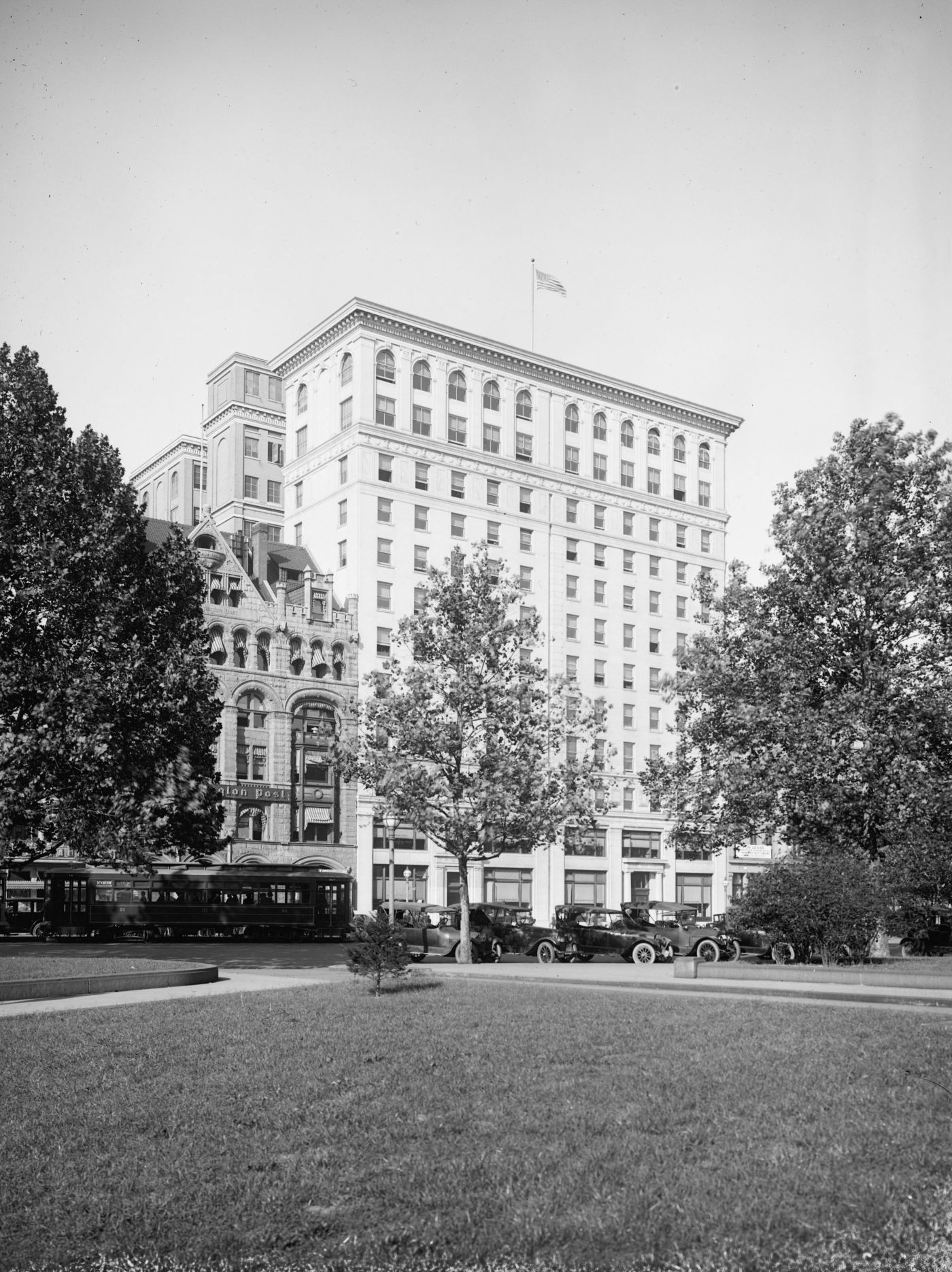
AASHO’s first-ever actual workplace was based in the Munsey Trust Building at 1329 E Street, N.W., in Washington, D.C. (between 12th and 13th Streets). This site is no more than 500 feet (152.4 meters), or a two-minute walk, from where AASHTO’s present-day headquarters has been located since 2020. From the time that AASHO was established in 1914 until it acquired that office space in the Munsey Trust Building, there had not been any fixed location or even regular staff for the association. All AASHO files were maintained by the association’s secretaries. These secretaries were state officials who held that non-paying job on an annual basis and basically worked out of their own offices and briefcases.
The origins of the Munsey Trust Building can be traced to 1905. This is when newspaper and magazine publisher Frank A. Munsey (1854-1925) arranged for the construction of that building. His main reason for building such a structure was to have a home base for one of his prominent newspaper acquisitions, the Washington Times. (There is no connection between this newspaper and the current one in the nation’s capital.)
In a development that was likely not lost on one-time publisher and editor Markham, the Munsey Trust Building’s neighborhood was well-established as a sort of “Newspapers Avenue” by the early 1920s. The Washington Post building was only a few doors down from the Munsey Trust Building, for example, and the Evening Star building was just a couple of blocks west.
When it came to his namesake building’s style and furnishings, Munsey spared no expense. The upper corridors had black-and-red marble designs marking the entrances to the various offices, and even the restrooms were designed with marble lining. The Munsey Trust Building was among the tallest structures in the nation’s capital at one point, surpassed in height by only the Washington Monument, U.S. Capitol, tower of the Post Office headquarters on Pennsylvania Avenue, and a few church spires.
AASHO’s office could be found in Room 639 of the Munsey Trust Building, and the association would remain there until Markham moved its operations to the newly opened National Press Building in 1927. The association’s headquarters staff worked there for approximately a half-century before moving to the Hall of States in the Capitol Hill neighborhood. The Hall of States ended up serving as AASHTO’s headquarters for 43 years. As for the Munsey Trust Building, it was demolished in 1982. (The attached photo of this building was taken sometime during the 1920s.)
Photo Credit: Public Domain
For more information on William Colfax Markham, please check out Daily News (Van Nuys) – 10 September 1961

 Transportation History