April 23, 1854
A construction crew assigned to build a lighthouse sailed via the Chesapeake Bay from Baltimore to the site of the project along Virginia’s Eastern Shore. Most of the foundation, superstructure, and ironwork for this lighthouse had been assembled in Philadelphia and were transported with the crew. The specific location for the newest navigational aid in that region of the United States was just offshore from the community of Pungoteague in Accomack County, Virginia. The name for the body of water there is Pungoteague Creek, which is a direct tributary to the Chesapeake Bay. The mouth of that tidal creek opens into the bay.
The Pungoteague Creek Light had the distinction of being the first screw-pile lighthouse in the vicinity of the Chesapeake Bay and only the second one built in the United States. (The first American screw-pile lighthouse was the Brandywine Shoal Light in Delaware Bay; this structure was inaugurated in 1850.) A screw-pile lighthouse is set up on piles that are screwed into muddy, sandy, shallow, or soft waterbeds.
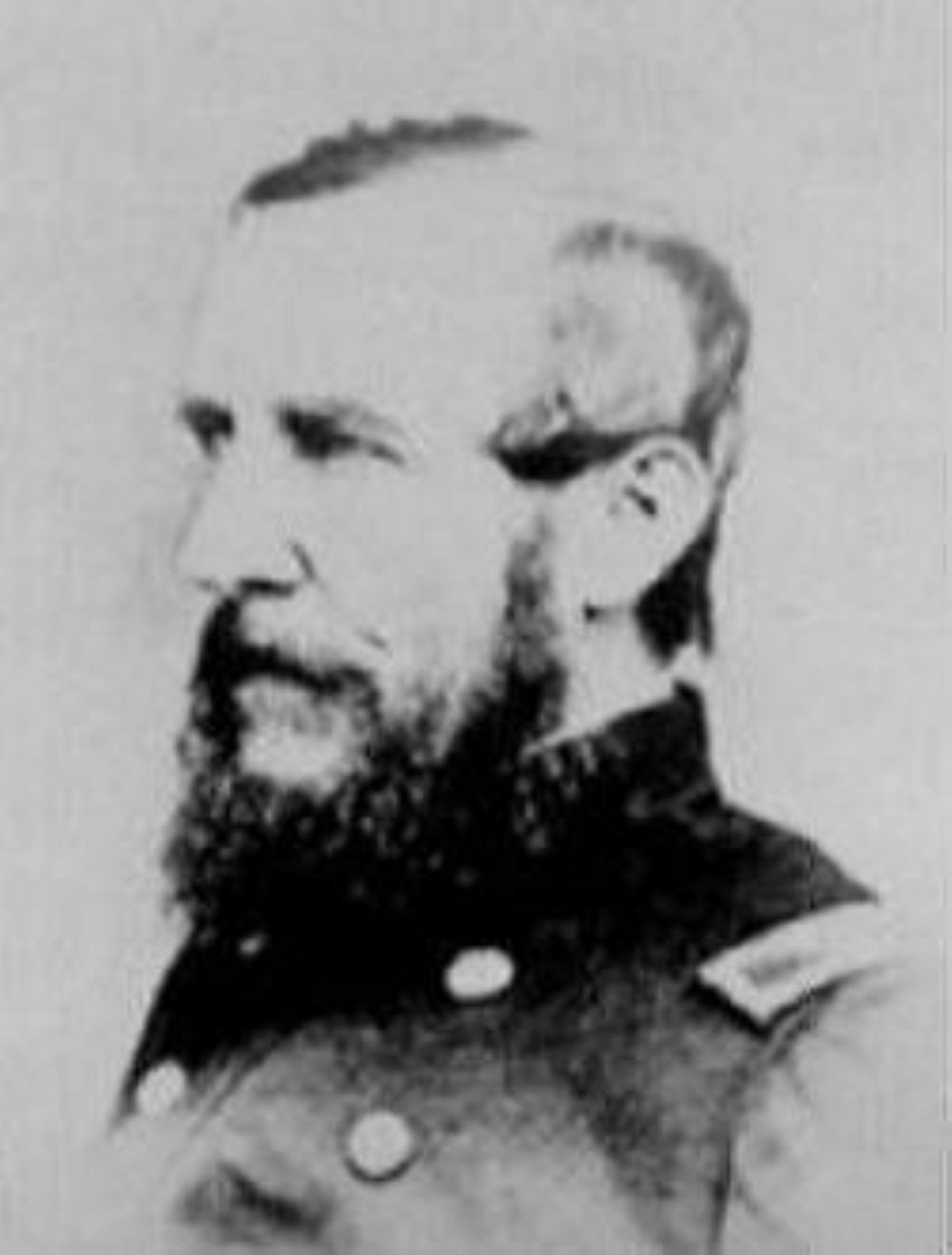
Construction on the Pungoteague Creek Light was overseen by Major Hartman Bache of the U.S. Army Corps of Topographical Engineers, a military unit that existed from 1838 to 1863 to design and build federal civil works such as lighthouses and canals. Bache, who is shown in the accompanying photo, was a great-grandson of Founding Father and renowned polymath Benjamin Franklin. Bache’s wide range of projects prior to the construction of the Pungoteague Creek Light included helping to design and build the Brandywine Shoal Light.
Work on the Pungoteague Creek Light was completed a little over six months after construction on it had begun. This lighthouse first went into service on November 1 of that year. In his subsequent account of this project, Bache provided an in-depth description of what was involved in making the Pungoteague Creek Light a full-fledged reality.
Bache wrote, “The structure now completed consists of seven hollow iron piles with conical bases, disposed at the angles and centre, sunk ten feet [three meters] eight inches [20.3 centimeters] into the bottom and rising ten feet [three meters] above the water, which is 7½ feet [2.3 meters] deep at low tide, being connected by spider-web braces, and also cross-braces between each two consecutive periphery piles, and between each periphery pile and its centre-pile.”
Bache provided a similarly detailed account of the lighthouse’s living quarters. “The dwelling, thirty feet [9.1 meters] in diameter, is conveniently divided into a sitting room, sleeping-room, store-room and kitchen,” he stated. “Two sash-doors and four windows open on to the gallery, to which there is a convenient ascent from the water by an iron ratline ladder.” In addition, Bache mentioned the installation of a lightning rod at the Pungoteague Creek Light; that type of rod had been popularized by his great-grandfather about a century earlier.
John Winder, a local resident, was appointed head keeper at the Pungoteague Creek Light. Ultimately, both his tour of duty in this role – along with the lighthouse itself – would be short-lived. On February 2, 1856, a large mass of floating ice overturned the Pungoteague Creek Light and caused the structure to be swept away into the water. Newspaper accounts reported that there were three men at the lighthouse on that Saturday night. (Winder was most certainly one of them.) All of the men, faring a lot better than the now-destroyed lighthouse, managed to safely make their way to the mainland.
Since this incident occurred only 459 days after the Pungoteague Creek Light had first gone into service, this structure holds the unenviable record for the shortest documented existence of any lighthouse in the Chesapeake Bay region and perhaps even the entire United States. The dire fate of the Pungoteague Creek Light led to increased efforts to more fully bolster screw-pile lighthouses with riprap (human-placed rocks or other solid material used to protect shoreline structures against natural hazards).
A second version of the Pungoteague Creek Light was never built, and a privately maintained beacon was instead installed at the site in 1856. The beacon remained in operation until 1908, when the federal government erected an automated flashing light atop a concrete-fille caisson there. This navigational aid was eventually placed out of service.
Nearly a century after the Pungoteague Creek Light found itself at the losing end of a run-in with an ice floe, a February 1954 edition of the Eastern Shore News (based in Accomack County) reported that at least a portion of this lighthouse survived after all. This newspaper stated that Winder “salvaged much of the material and used it in the construction of a building in Pungoteague which at different times served as a tavern, a store, a lodge hall and a post office, and now owned and a part used as a filling station by the Texaco Company.”
Photo Credit: Public Domain
For more information on the Pungoteague Creek Light, please check out https://archives.uslhs.org/places/pungoteague-creek and https://en.wikipedia.org/wiki/Pungoteague_Creek_Light
Additional information on Hartman Bache is available at https://en.wikipedia.org/wiki/Hartman_Bache

 Transportation History
Leave a comment