More than a year after the start of the American Revolutionary War, the Declaration of the Independence – officially called The unanimous Declaration of the thirteen united States of America – was adopted by the Second Continental Congress at Pennsylvania State House (later renamed Independence Hall) in Philadelphia on July 4, 1776.
On that same day, a Philadelphia printer named John Dunlap (1746-1812) was commissioned by the congress to produce copies of the Declaration of Independence for distribution in all 13 of the newly established states. Dunlap worked throughout the night to print numerous poster-sized copies of that founding document of the United States. These copies have become known as the Dunlap Broadsides.
The large-scale effort to transport the Dunlap Broadsides throughout the states was launched on July 5 and 6. This effort involved John Hancock (1737-1793), president of the Second Continental Congress, dispatching messengers who would depart from Philadelphia on their horses to deliver the copies to points far and wide. Charles Thomson (1729-1824), secretary of the congress, assisted Hancock in this history-making sendoff of horseback riders.
These riders subsequently galloped along established postal routes to reach their assigned destinations. The designated recipients of those copies of the Declaration of Independence included the primary legislative bodies in each state; committees of safety (grassroots panels authorized by the Continental Congress to govern communities and organize militias); and military commanders in the Continental Army.
The task of transmitting the Dunlap Broadsides as quickly as possible was a lot easier said than done at this juncture of the 18th century. This is because many of the roads – especially those outside major cities in the 13 states – were undeniably rough and often rutted. A stagecoach carrying mail from Philadelphia, for example, could take anywhere from half to most of a month to reach Boston.
The messengers dispatched by Hancock and Thomson nonetheless did their best to expeditiously navigate those roads to distribute the copies of the Declaration of Independence. At least one of the riders made it to New York City by July 9. General George Washington (1732-1799), commander-in-chief of the Continental Army, was encamped there with his troops and preparing for a possible British attack.
The copy that Washington received on July 9 was accompanied by a note from Hancock asking that he “have it proclaimed at the Head of the Army in the way, you shall think most proper.” Washington readily complied, having the document read to troops and area residents gathered at six o’clock that evening at the Commons (site of present-day City Hall Park) in Manhattan. Washington later asserted to Hancock that “that the measure seemed to have their hearty assent.”
Copies of the Dunlap Broadsides were delivered to Hancock’s home state of Massachusetts a few days later and arrived in Boston on July 15. The following day, the Salem-based American Gazette became the first newspaper in the Bay State to publish the Declaration of Independence. Other newspapers in Massachusetts soon followed suit.
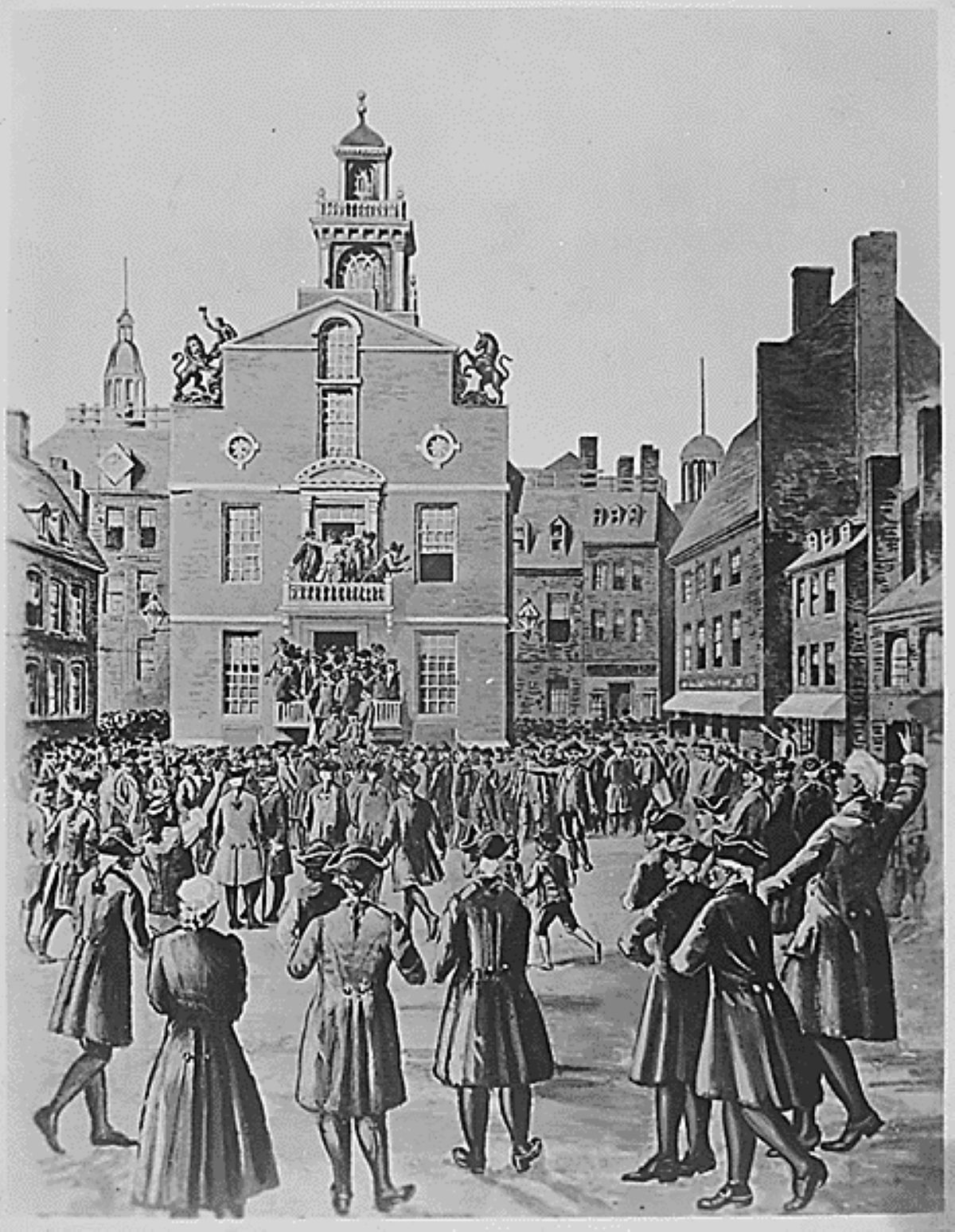
The first public reading of the Declaration of Independence in Boston took place at one o’clock on the afternoon of July 18. The document was read from the balcony of the state house. (This building continued to serve as the seat of state government until 1798; now known as the Old State House, it is an official site along Boston’s Freedom Trail and a National Historic Landmark.) The accompanying image of this public reading was created sometime around 1930 for the George Washington Bicentennial Commission.
Those attending this event at the state house included Abigail Adams (1744-1818), whose husband John Adams (1735-1826) was not only a delegate representing Massachusetts in the Continental Congress but also a pivotal figure in the drafting of the Declaration of Independence. Abigail Adams traveled to Boston from their family farm in the town (now city) Braintree to witness the reading of the document that her husband had helped create.
Since John Adams was still in Philadelphia at the time, she wrote to him about that public reading and the attendant festivities. The future first lady recounted the following in this letter: “three cheers…bells rang, the privateers fired, the forts and batteries, the cannon were discharged, the platoons followed, and every face appeared joyful . . .Thus ends royall Authority in this State.”
In the meantime, quite a few of Hancock’s horseback riders continued delivering the copies of the Declaration of Independence nationwide. Copies of the document were finally distributed in Charleston, South Carolina, early the following month. At least one messenger made it at long last to Georgia, the southernmost of the 13 states and the one furthest away from Philadelphia, by August 10 – well over five weeks after what is essentially America’s birth certificate had been adopted.
Image Credit: Public Domain
For more information on the role of the horseback riders who delivered copies of the newly adopted Declaration of Independence, please check out https://www.masshist.org/object-of-the-month/objects/the-reading-of-the-declaration-of-independence-in-boston-18-july-1776-2008-07-01 and https://historicipswich.net/2025/06/14/ipswich-declaration-of-independence/


Leave a comment